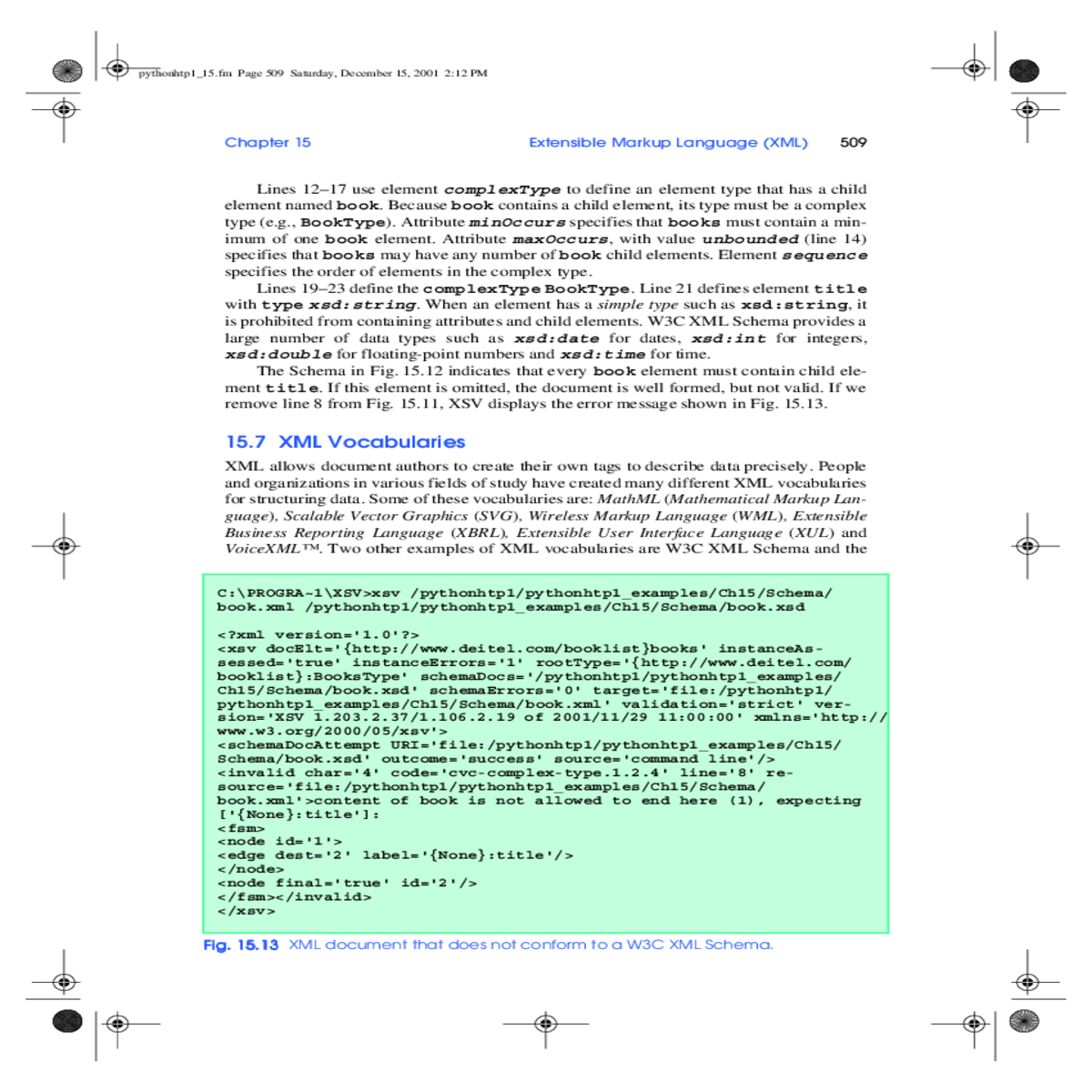
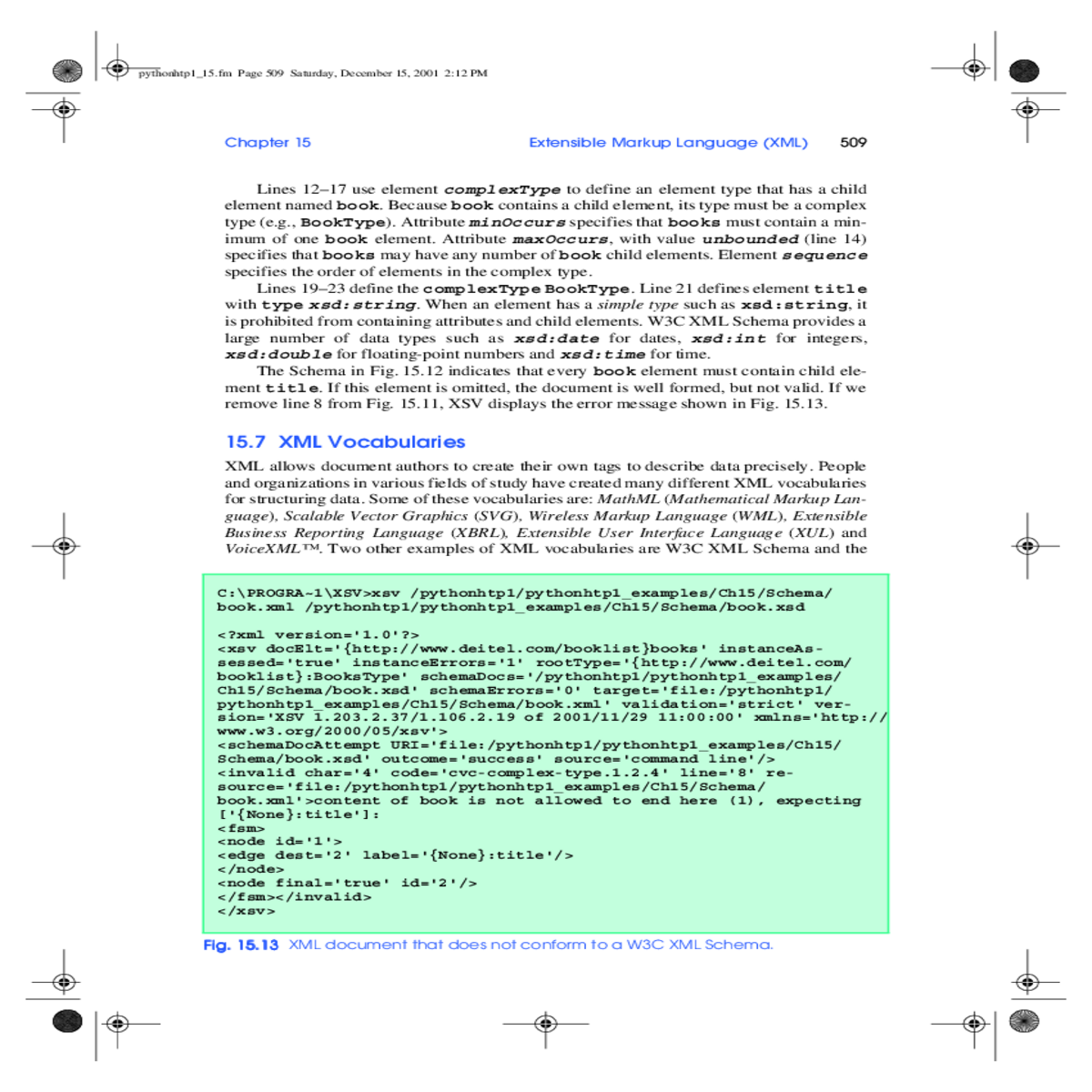
Xsv displays the error message shown fig

|
 |
|||
|---|---|---|---|---|
| Chapter 15 | Extensible Markup Language (XML) |
The Schema in Fig. 15.12 indicates that every book element must contain child ele-ment title. If this element is omitted, the document is well formed, but not valid. If we remove line 8 from Fig. 15.11, XSV displays the error message shown in Fig. 15.13.
15.7 XML Vocabularies
| XML allows document authors to create their own tags to describe data precisely. People | ||
|---|---|---|
| and organizations in various fields of study have created many different XML vocabularies | ||
| for structuring data. Some of these vocabularies are: MathML (Mathematical Markup Lan- | ||
| guage), Scalable Vector Graphics (SVG), Wireless Markup Language (WML), Extensible | ||
| Business Reporting Language (XBRL), Extensible User Interface Language (XUL) and | ||
| VoiceXML™. Two other examples of XML vocabularies are W3C XML Schema and the | ||
|
||

 |
||||
|---|---|---|---|---|
| 510 |
|
Chapter 15 | ||
Extensible Stylesheet Language (XSL), which is introduced in Section 15.8. The following subsections describe MathML, Chemical Markup Language (CML) and other XML vocab-ularies.
MathML markup describes mathematical expressions for display. Figure 15.14 uses MathML to mark up a simple expression. [Note: In this section, we provide sample outputs that illustrate how a MathML-enabled application might render the markup.]
| 1 2 3 4 5 6 7 8 9 10 11 12 13 14 15 16 17 18 19 20 21 22 23 24 25 26 27 28 |
|||
|---|---|---|---|
| Fig. 15.14 Expression marked up with MathML. (Part 1 of 2.) | |||
 |
 |
||