Working together aboriginal and torres strait islander mental health
An Aboriginal Australian cross-cultural practice framework
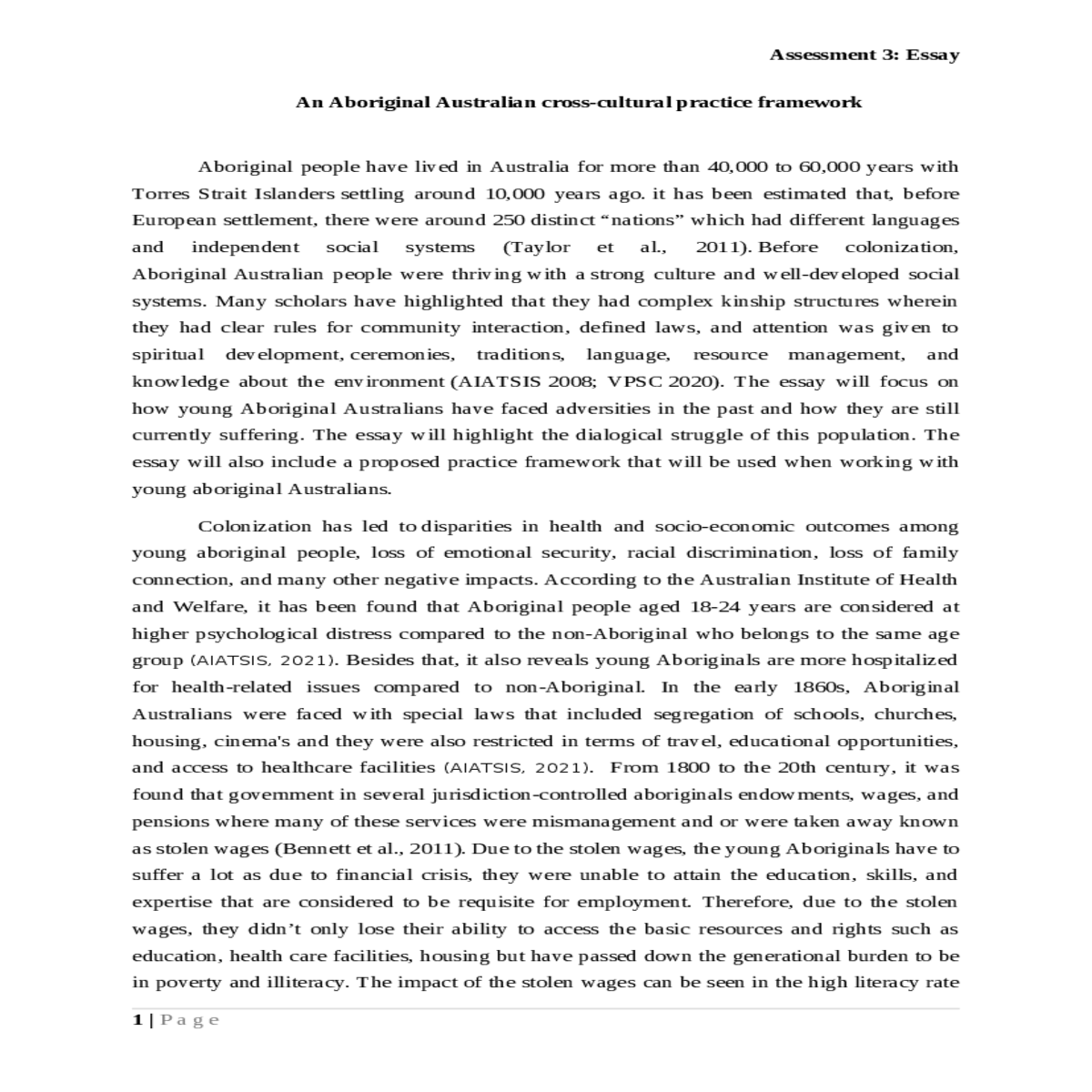
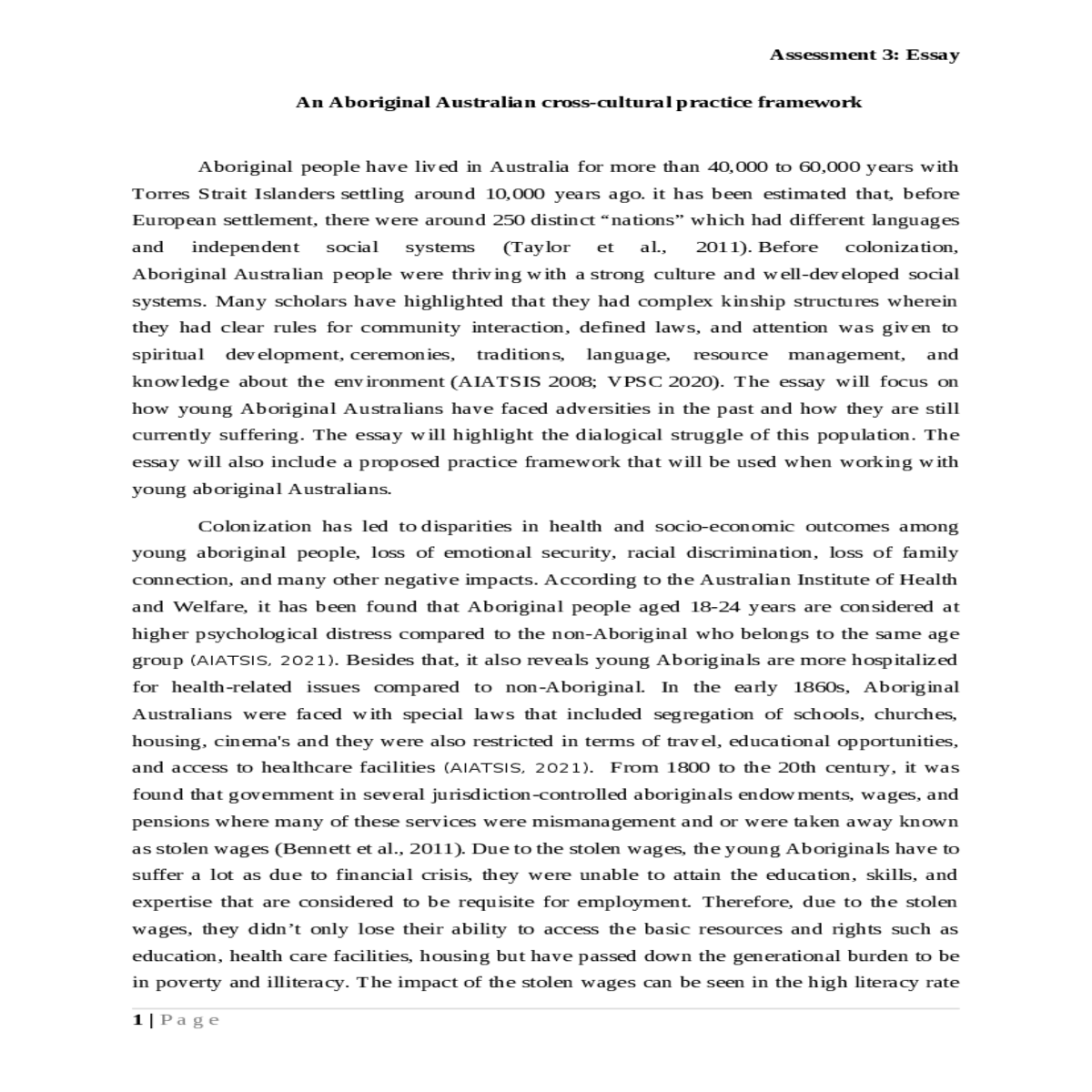
Aboriginal people have lived in Australia for more than 40,000 to 60,000 years with Torres Strait Islanders settling around 10,000 years ago. it has been estimated that, before European settlement, there were around 250 distinct “nations” which had different languages and independent social systems (Taylor et al., 2011). Before colonization, Aboriginal Australian people were thriving with a strong culture and well-developed social systems. Many scholars have highlighted that they had complex kinship structures wherein they had clear rules for community interaction, defined laws, and attention was given to spiritual development, ceremonies, traditions, language, resource management, and knowledge about the environment (AIATSIS 2008; VPSC 2020). The essay will focus on how young Aboriginal Australians have faced adversities in the past and how they are still currently suffering. The essay will highlight the dialogical struggle of this population. The essay will also include a proposed practice framework that will be used when working with young aboriginal Australians.
I believe that the positionality of an individual tends to play a crucial role in shaping the perspectives about the world. I believe that the individual experience of power, marginalization, sexual orientation, gender, class, and race is influenced by the social location of the individual. Considering I belong to the Indian community where we worship the land and natural resource. Therefore, it is quite easy for me to resonate with the Aboriginals who were isolated from their land. Besides, that belonging from the country (India) where we were under colonization also helps me in understanding the aftermath of the colonization and its impact on Aboriginal communities. I am born in a middle-class family where there were no racial conflicts (Kondrat, 2011). I was born and bought up in an environment where there we respect everyone and give importance to the environment, culture, tradition, and language. I believe that every person has dignity and worth. I believe with the intersectional lens it will be easier to address the injustice, especially when understanding how injustice towards one group can impact the different group. Therefore, I believe that personal values, background, and perspectives will help in providing better advocacy to the client (Kondrat, 2011). I believe that my own positionality will help me in strengthening the model, as I have faced a similar situation (colonization) and understand the importance of environment, culture, and traditions.
The person-in-environment framework is one of the most important frameworks which can be used by social workers to understand every individual has his or her mutual influential relationship with their social and physical environment and therefore, cannot be understood apart from that context (Weiss-Gal, 2008). This theory of ecological perspective depicts the oppression and injustice which is responsible for many challenges faced by the clients. The method, ‘person-interaction-environment', is the method to utilize a simple and comprehensive practice system for client analysis and assessment. Such methods are enforced by the whole system concept (Weiss-Gal, 2008). A holistic perspective of social work suggests that social workers should be broad in their theoretical frameworks and ways of assessment. Moreover, the understanding of practices of profession varies depending upon many factors like culture, time, information available, personal background, experience, and their interactions. Such factors often create difficulties in interactions among the workers in the profession and diversify the profession within itself. In practical implication, a systemic person-in-environment assessment of clients ‘biopsychosocialspititual’ state (Weiss-Gal, 2008). The presence of ‘interaction’, or ‘in’ component along with person-environment describes the concept of ‘relationship’ in the social work profession. The concept ‘person in the environment as a practical orienting perspective for social work activities. This method is based on the theory that every individual’s or her behavior cannot be understood accurately without considering all the various factors of that individual’s background including social, temporal, political, familial, economic, spiritual, and physical. Considering a person-in-environment is said to imply a better and more adequate framework for assessing the client considering these mentioned factors including personal and environmental, as compared to the methods that use the only environment as the basis of the assessment. The system is also perceived to influence the range of interventions available to the practitioner with the option to intervene directly with the client with various aspects of both physical and environmental (Wilson et al., 2020). The system person-in-environment perspective has been accepted by the various profession as adequate differentiating and defining social work from related disciplines such as sociology and psychology. Considering the epistemological status, the method “person in environment” is said to describe as a framework or perspective to help the practitioner organize assessment, analysis, planning, and intervention strategy. In this comprehensive understanding, person-in-environment is not a theory that can be preserved as a statement that can be verified with data but is a practical framework that is required to assess the clients in social work more accurately (Wilson et al., 2020).
References
AIATSIS. (2021). Australian Aboriginal: Past issues. Aiatsis.gov.au. Retrieved 14 November 2021, from https://aiatsis.gov.au/.
Parsons, R., Hernandez, S., & Jorgensen, J. (1988). Integrated Practice: A framework for problem solving. Social Work, 33(5), 417-421. https://doi.org/10.1093/sw/33.5.417
Purdie, N, Dudgeon, P., & Walker, R. (2010). Working together: Aboriginal and Torres Strait Islander mental health. https://research.acer.edu.au/indigenous_education/24/.