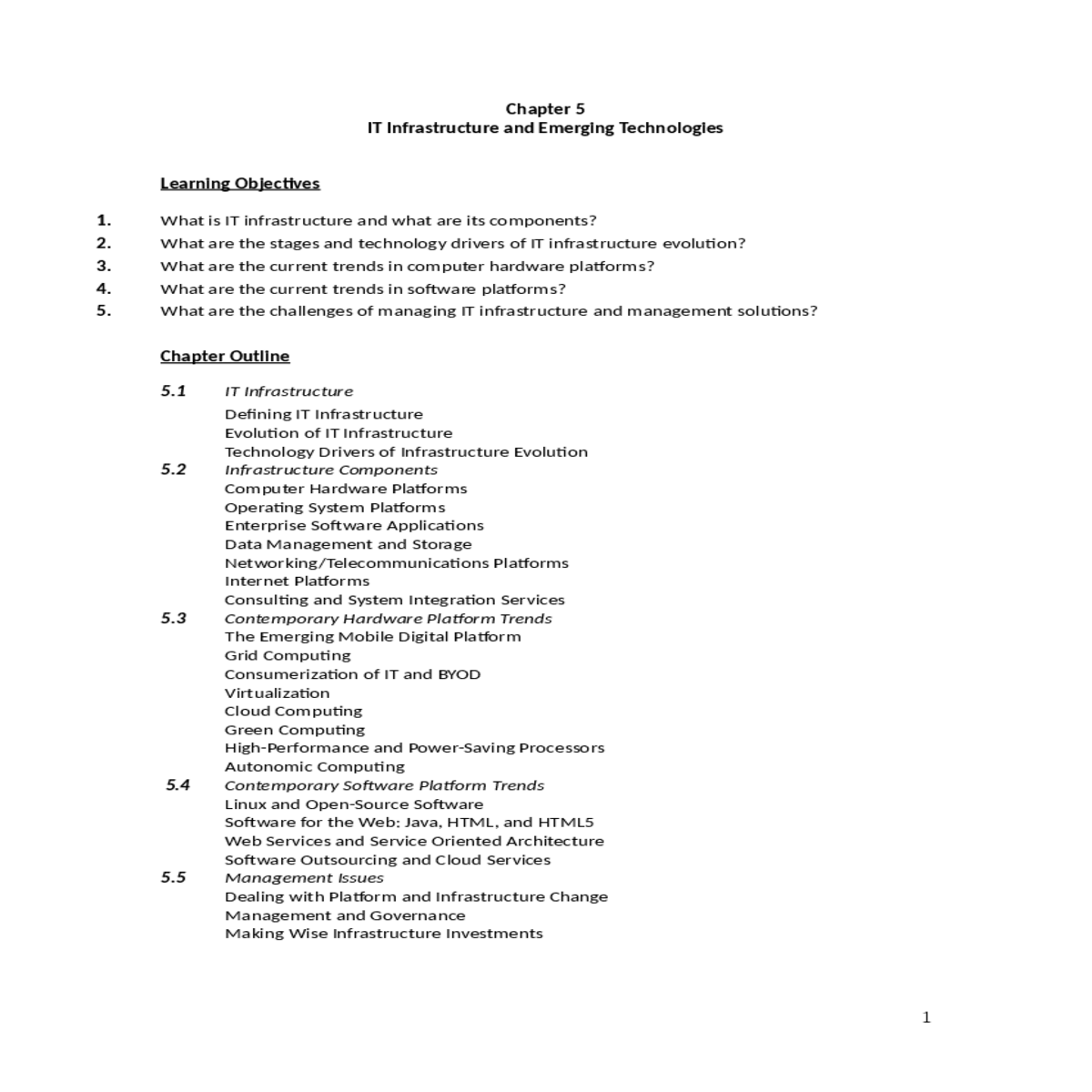
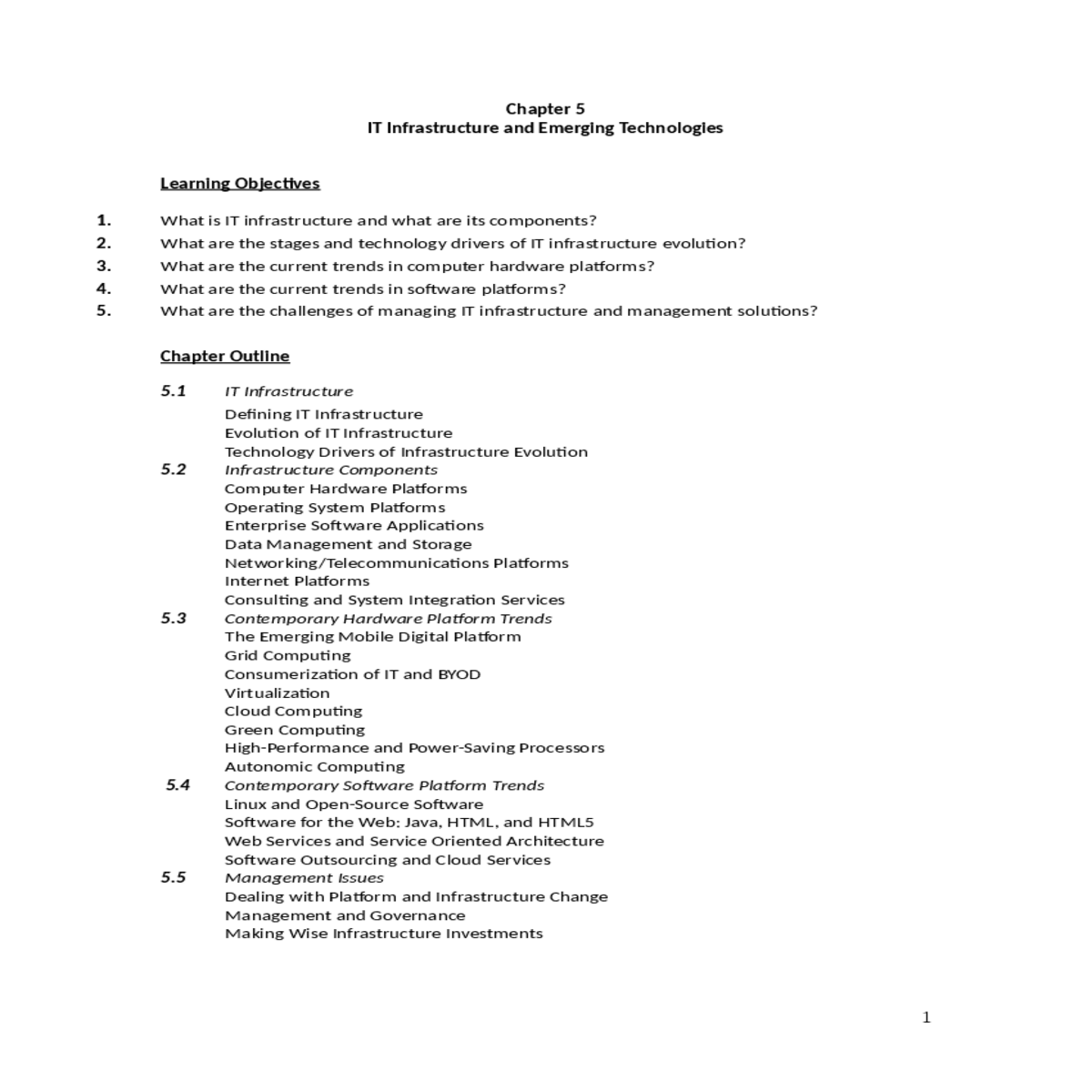
What are the current trends computer hardware platforms
Chapter 5
IT Infrastructure and Emerging TechnologiesLearning Objectives
5. What are the challenges of managing IT infrastructure and management solutions?
Chapter Outline
Case Study Questions
1. What are the advantages and disadvantages of allowing employees to use their personal smartphones for work?
Organization: A significant portion of corporate IT resources is dedicated to managing and maintaining a large number of devices within an organization. In the past, companies tried to limit business smartphone use to a single platform, making it easier to keep track of each mobile device and to roll out software upgrades or fixes. Firms need an efficient inventory management system that keeps track of which devices employees are using, where the device is located, whether it is being used, and what software it is equipped with. For unprepared companies, keeping track of who gets access to what data could be a nightmare.
Technology: The most popular employer-issued smartphone was Research in Motion’s BlackBerry, which is considered the most secure mobile platform available. The mobile digital landscape is now much more complicated, with a variety of devices and operating systems on the market that do not have well-developed tools for administration and security. To access company information, the company’s networks must be configured to receive connections from a device. Virtualization helps companies manage mobile devices easier.
By using virtualization, employees can access their entire desktop on their smartphones and mobile handhelds and thus are able to use the same programs on the road that they use in the office. Placing virtualization software on employees’
personal tablets is less expensive than outfitting them with company-purchased laptops.One of the biggest worries that managers have about mobility is the difficulty of measuring their return on investment.
Businesses must pay to power their servers and then pay again to keep them cool and operational. Cooling a server requires roughly the same number of kilowatts of energy as running one.
2. What solutions are available for these problems? Are they management, organizational, or technology solutions? Explain your answer.
3
3. What are the business benefits and costs of these solutions?
Most students use the Web and Internet daily so have them explore how new software technologies are making their experiences richer and more efficient. Have them research mashups and apps on the Web sites they use the most. If any students use MySpace, Facebook, or other social networking sites, ask them to demonstrate how they use these new technologies.
Perhaps the most important point of this section is to show how these technologies are designed to make computing more seamless between applications and between computing hardware platforms. Increasingly, software is taking on three major characteristics: it’s available over the Internet; components are interchangeable; and applications freely integrate with other applications. These characteristics are critical towards making computing easier, faster, and cheaper.
grounded in the realities of running a business. Table 5-3 will help students understand all the hidden costs of technology ownership.
Review Questions
| |
|
|---|
working with vendors, and managing internal firm business processes. In this sense, IT infrastructure focuses on the services provided by all the hardware and software. IT infrastructure is a set of firm-wide services budgeted by management and comprising both human and technical capabilities.
|
|
|---|
2. What are the stages and technology drivers of IT infrastructure evolution?
List each of the eras in IT infrastructure evolution and describe its distinguishing characteristics.
| |
|
|---|
together into local area networks and the growing use of standards and software to link
rather than purchasing their own hardware and software.
Define and describe the following: Web server, application server, multitiered client/server architecture.
Describe Moore’s Law and the Law of Mass Digital Storage
Moore’s Law: The number of components on a chip with the smallest manufacturing
percent a year.
Both of these concepts explain developments that have taken place in computer
Network economics: Metcalfe’s Law helps explain the mushrooming use of computers by
showing that a network’s value to participants grows exponentially as the network takes on
3. What are the current trends in computer hardware platforms?
Describe the evolving mobile platform, grid computing, and cloud computing.
Autonomic computing
Benefits of autonomic computing include systems that automatically do the following:
Configure themselves
Optimize and tune themselves
7
Green computing
Businesses can minimize their impact on the environment by adopting better practices and technologies for designing, manufacturing, using, and disposing of computers, servers, and other computing devices. Reducing power consumption in data server centers is the leading practice in the green computing movement.
4. What are the current trends in software platforms?
Define and describe open source software and Linux and explain their business benefits.
Thousands of open-source programs are available from hundreds of Web sites. Businesses can choose from a range of open-source software including operating systems, office suites, Web browsers, and games. Open-source software allows businesses to reduce the total cost of ownership. It provides more robust software that’s often more secure than proprietary software.
Define Java and HTML5 and explain why they are important.
Web services offer a standardized alternative for dealing with integration across various computer platforms. Web services are loosely coupled software components based on XML and open Web standards that are not product specific and can work with any application software and operating system. They can be used as components of Web-based applications linking the systems of two different organizations or to link disparate systems of a single company. Web services are not tied to a particular operating system or programming language. Different applications can use them to communicate with each other in a standard way without time-consuming custom coding.
Businesses use Web services to tie their Web sites with external Web sites creating an apparently seamless experience for users. The benefit derives from not having to re-create applications for each business partner or specific functions within a single company.
Software packages and enterprise software: Prewritten commercially available set of software programs that eliminates the need for a firm to write its own software program for certain functions like payroll processing or order handling. Large-scale enterprise software systems provide a single, integrated, worldwide software system for firms at a cost much less than they would pay if they developed it themselves.
Cloud-based software services and tools: A business that delivers and manages applications and computer services from remote computer centers to multiple users using the Internet or a private network. Instead of buying and installing software programs, subscribing
companies can rent the same functions from these services. Users pay for the use of this software either on a subscription or a per-transaction basis. The business must carefully assess the costs and benefits of the service, weighing all people, organizational, and technology issues. It must ensure it can integrate the software with its existing systems and deliver a level of service and performance that is acceptable for the business.Businesses benefit most from these new tools and trends by not having to re-invent the wheel. Apps have already been developed by someone else and a business can use them for
10
Dealing with platform and infrastructure change: As firms grow, they can quickly outgrow their infrastructure. As firms shrink, they can get stuck with excessive infrastructure purchased in better times. Scalability refers to the ability of a computer, product, or system to expand to serve a larger number of users without breaking down. Businesses that bring mobile computing and cloud computing platforms into the mix need new policies and procedures for managing them.
Management and governance: Involves who will control and manage the firm’s IT infrastructure. Will the IT infrastructure be centrally controlled and managed or divided among departments and divisions? How will infrastructure costs be allocated among business units?
The total cost of owning technology resources includes not only the original cost of acquiring and installing hardware and software, but it also includes the ongoing administration costs for hardware and upgrades, maintenance, technical support, training, and even utility and real estate costs for running and housing the technology. The TCO model can be used to
11
2. Should organizations use software service providers for all their software needs? Why or why not? What management, organization, and technology factors should be considered when making this decision?
The answer to the first question is very dependent upon the organization and its processing, storage, and business needs. When evaluating software service providers, the organization should examine such factors as availability and reliability, technology, fees and how the fees are assessed, and available applications. Managers should compare the costs and
capabilities of using software service providers to the organization’s costs and capabilities of operating and owning its own hardware and software assets. The organization should examine how using the service will impact organizational culture and how using an outside vendor addresses organizational and business needs. The technology factors include examining how well usage of the service fits with the firms IT infrastructure, as well as examining the appropriateness of using a software service provider to address the current problem.
|
|
|---|
|
|---|
Management Decision Problems
1. University of Pittsburgh Medical Center: Demand for additional servers and storage technology was growing by 20 percent each year. UPMC was setting up a separate server for every application; servers and other computers were running different operating systems; it was using technologies from many different vendors.
services provided, criteria for performance measurement, support options, provisions for security and disaster recovery, hardware and software ownership and upgrades, customer support, billing, and conditions for terminating the agreement.
Improving Decision Making: Using a Spreadsheet to Evaluate Hardware and Software Options
Software skills: Internet-based software
Business skills: Researching transportation and lodging costsThe students will likely find hotels that interest them personally. The template that has been provided has a checklist for all of the hotel requirements to help keep them on track. You can show this in class or distribute it for your students to use. They should also write a brief report detailing why they chose the hotel they did and price should not be the only issue. Several airlines’ Web sites are available now and the students will choose various ones based on their knowledge of airlines. Some will go directly to the airline site and others will go to discounters. Ask them to rate the use of the Web site in their report as well.
Form a group with three or four of your classmates. Choose server or mobile operating systems to evaluate. You might research and compare the capabilities and costs of Linux versus the most recent version of the Windows operating system or UNIX. Alternatively, you could compare the capabilities of the Android mobile operating system with the most recent version
14
|
|---|
hardware and software.
2. What are the disadvantages of cloud computing?
|
|---|
Businesses should assess the costs and benefits of the service, weighing all people, organization, and technology issues. Does the software-as-a-service applications integrate well with the existing systems? Does it deliver a level of service and performance that’s acceptable for the business? Does the SaaS fit with the business’s overall competitive strategy and allow the company to focus on core business issues instead of technology challenges?
Capacity planning predicts when a computer hardware system becomes saturated and how that affects performance measures such as minimum response time for processing business transactions. Business managers need to determine acceptable levels of computer response time and availability for the firm’s mission-critical systems to maintain the level of business performance they expect.
As the case study points out, companies like Zynga are good candidates for cloud computing. The company needs to scale up when it releases a new game but it can't determine exactly how much capacity it needs to make available. Rather than purchase hardware that it may not need, or not purchase enough, it relies on cloud providers to give it just the right amount of capacity.
16