Various standards including australian standards and published posters
ENCOR 4010 | Methodology | Sustainable Technologies for Building
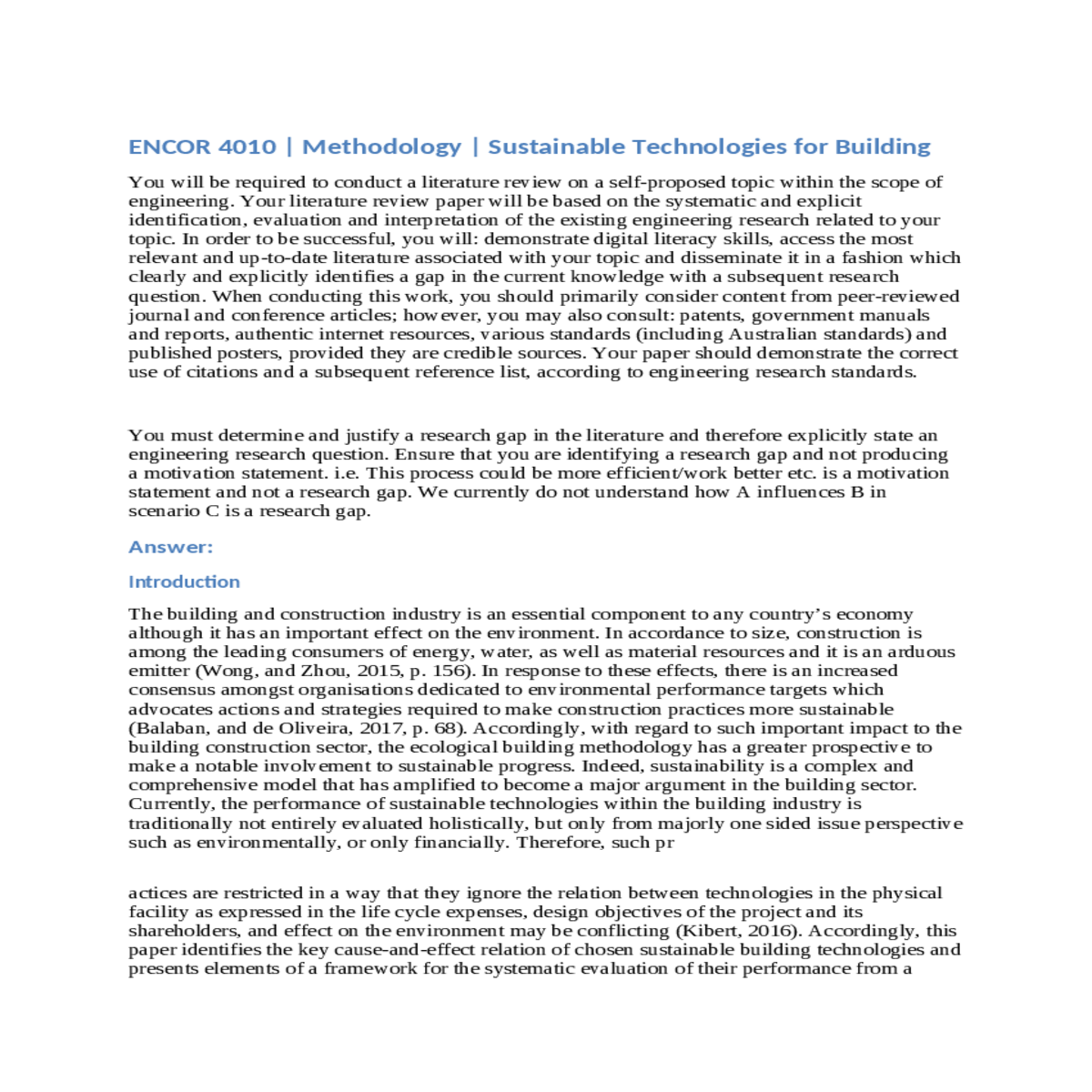
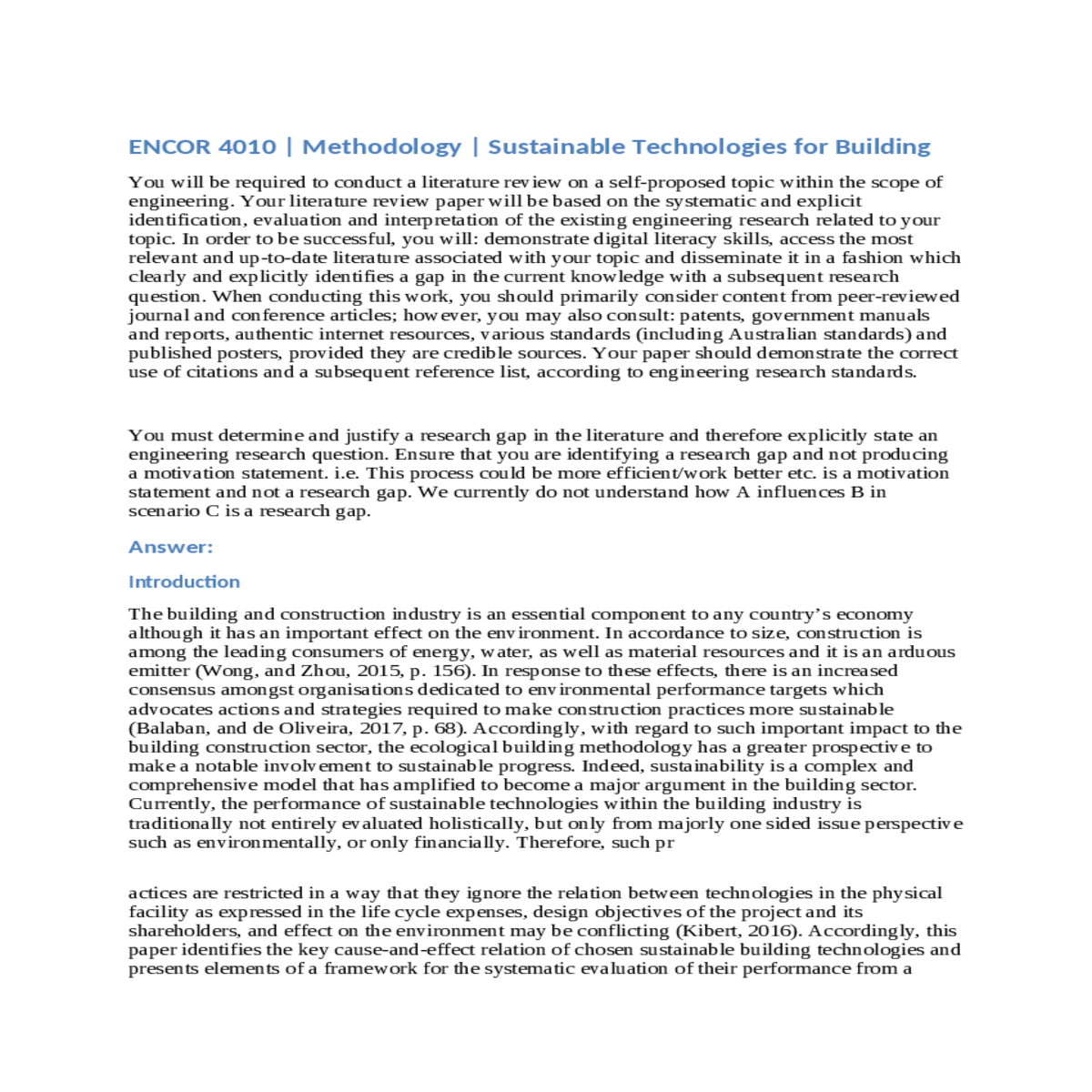
You will be required to conduct a literature review on a self-proposed topic within the scope of engineering. Your literature review paper will be based on the systematic and explicit identification, evaluation and interpretation of the existing engineering research related to your topic. In order to be successful, you will: demonstrate digital literacy skills, access the most relevant and up-to-date literature associated with your topic and disseminate it in a fashion which clearly and explicitly identifies a gap in the current knowledge with a subsequent research question. When conducting this work, you should primarily consider content from peer-reviewed journal and conference articles; however, you may also consult: patents, government manuals and reports, authentic internet resources, various standards (including Australian standards) and published posters, provided they are credible sources. Your paper should demonstrate the correct use of citations and a subsequent reference list, according to engineering research standards.
Answer:
Introduction
Harris, Shealy, and Klotz, (2016) Claim that so as to realise a sustainable future in the building sector, there is need to adopt multi-disciplinary approach including a range of aspects like advanced use of materials, energy saving, control of emissions and pollutants, and minimising waste materials. There are several approach through which the present nature of building practice can be improved and regulated to make it less destructive to the surrounding. Thus, to advance a competitive advantage by using eco-friendly building performance, the entire lifecycle of the building should be under the context that these practices are undertaken (Pearce, and Ahn, 2017). Research has highlighted a number of objectives which are supposed to shape the structure for instigating ecological building design and building while considering the ethics of sustainable concerns such as ecological, technological, social and economic aspects. As such objectives include cost efficiency, resource maintenance and design for humanoid adaptation.
Resource conservation is the practice of realising more with less which involves managing of the usage of resources by humans to give the maximum outcome to the present generation and at the same time maintaining the aptitude to attain the requirements of the upcoming generations Von (Geibler et al, 2017, p. 133). This matter has become a fierce discussion regarding sustainable development. Guo, Tian, Chertow, and Chen, (2016) asserts that some means are becoming exceptionally intermittent thus the use of the outstanding stock should be carefully handled. The building sector is the leading user of natural resources thus there is need to pursue initiatives to construct environment sustaining buildings to focus on the rising the efficiency of resource consumption (Grubler et al., 2018, p. 515). Accordingly, approaches which decline wastage of material during the process of construction and give prospects for reusing as well as reuse of construction materials contribute to enhancing efficient resource consumption. Certainly, calls for becoming resource effective has been spearheaded by the rising concern by the exhaustion of non-renewable resources. Renewable materials play a vital part in the building industry such as water, energy, material and land. The preservation of non-renewable means play a great role towards a sustainable future.
Bibliography
Chen, R.H., Lin, Y. and Tseng, M.L., 2015. Multicriteria analysis of sustainable development indicators in the construction minerals industry in China. Resources Policy, 46, pp.123-133.
Dincer, I. and Acar, C., 2015. A review on clean energy solutions for better sustainability. International Journal of Energy Research, 39(5), pp.585-606.
Harris, N., Shealy, T. and Klotz, L., 2016. Choice architecture as a way to encourage a whole systems design perspective for more sustainable infrastructure. Sustainability, 9(1), p.54.
Kibert, C.J., 2016. Sustainable construction: green building design and delivery. John Wiley & Sons.
Weaver, P., Jansen, L., Van Grootveld, G., Van Spiegel, E. and Vergragt, P., 2017. Sustainable technology development. Routledge.
Wong, J.K.W. and Zhou, J., 2015. Enhancing environmental sustainability over building life cycles through green BIM: A review. Automation in Construction, 57, pp.156-165.