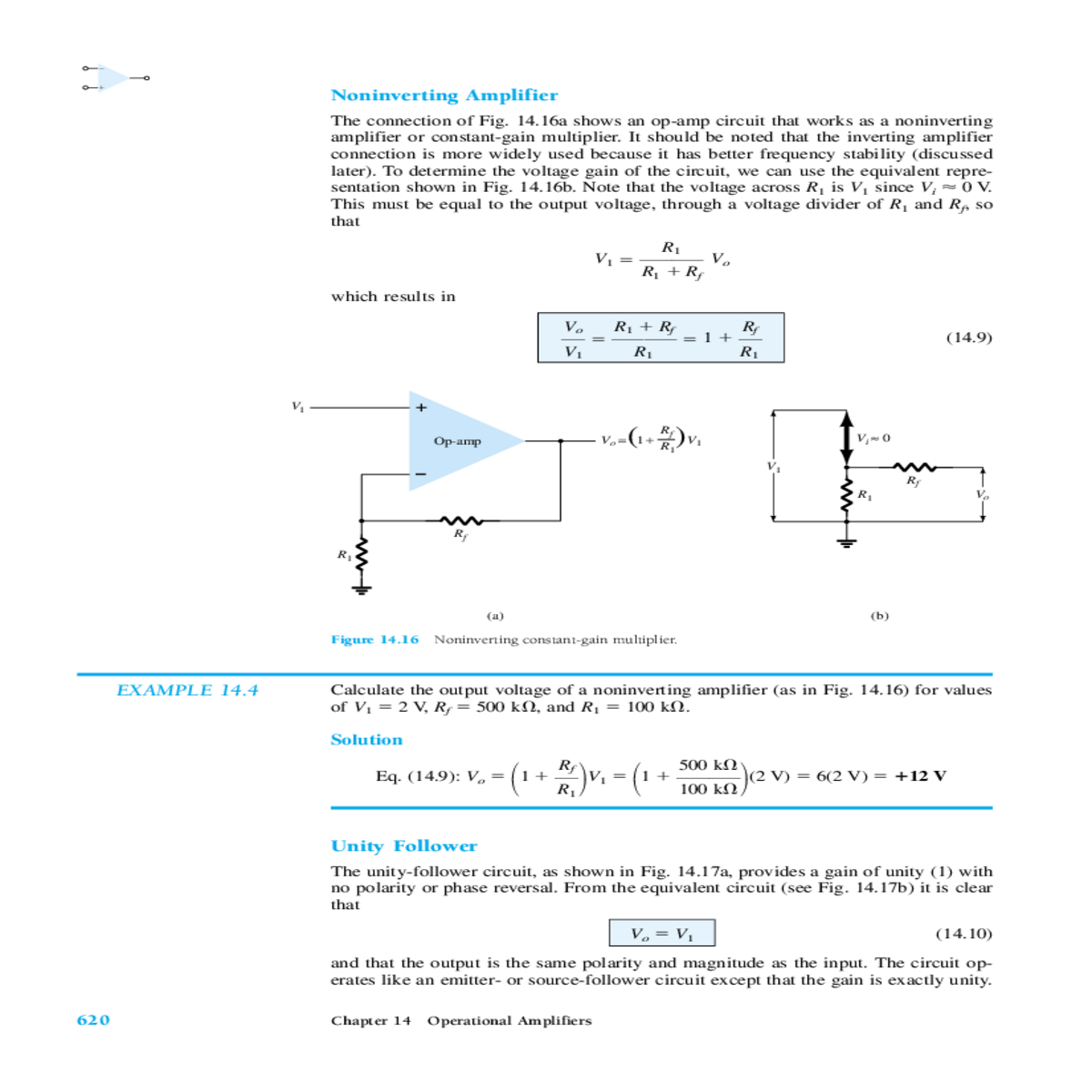
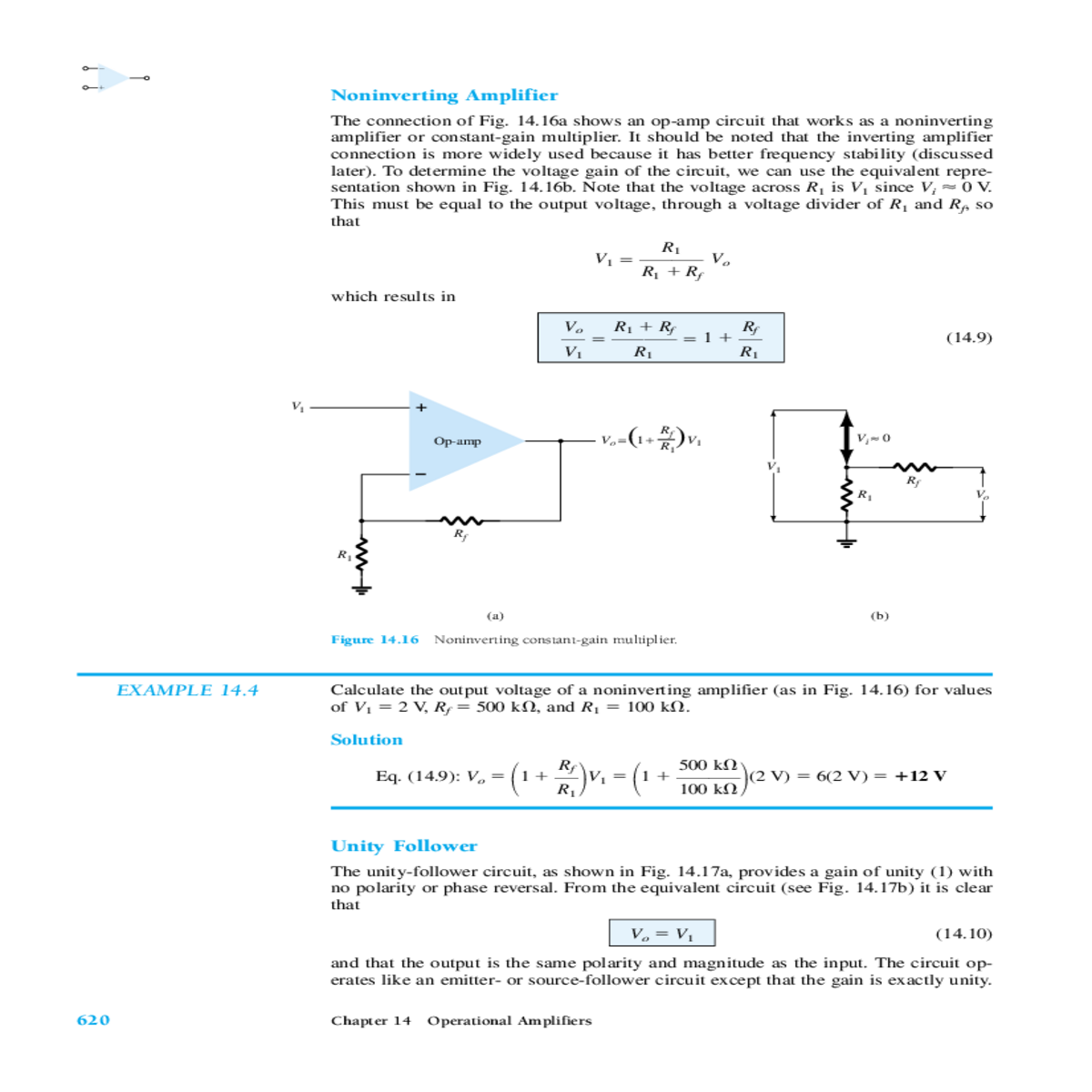
Using the equivalent representation shown fig


| V1 | + |
|
|
Vi ≈ 0 | Rf |
|
|||
|---|---|---|---|---|---|---|---|---|---|
| Vo | = |
|
|||||||
| – | V1 | R1 | Vo | ||||||
| (a) | (b) | ||
|---|---|---|---|
| Figure 14.16 | |||
| EXAMPLE 14.4 | |||
Solution
|
|---|
|
(14.10) |
|---|
|
Chapter 14 |
|
|---|
| Figure 14.17 | ||
|---|---|---|
Probably the most used of the op-amp circuits is the summing amplifier circuit shown in Fig. 14.18a. The circuit shows a three-input summing amplifier circuit, which pro-vides a means of algebraically summing (adding) three voltages, each multiplied by a constant-gain factor. Using the equivalent representation shown in Fig. 14.18b, the output voltage can be expressed in terms of the inputs as
|
|---|
| Figure 14.18 |
|---|
|
|
621 | |
|---|---|---|---|
| 14.4 | |||