Useful life and residual value of asset
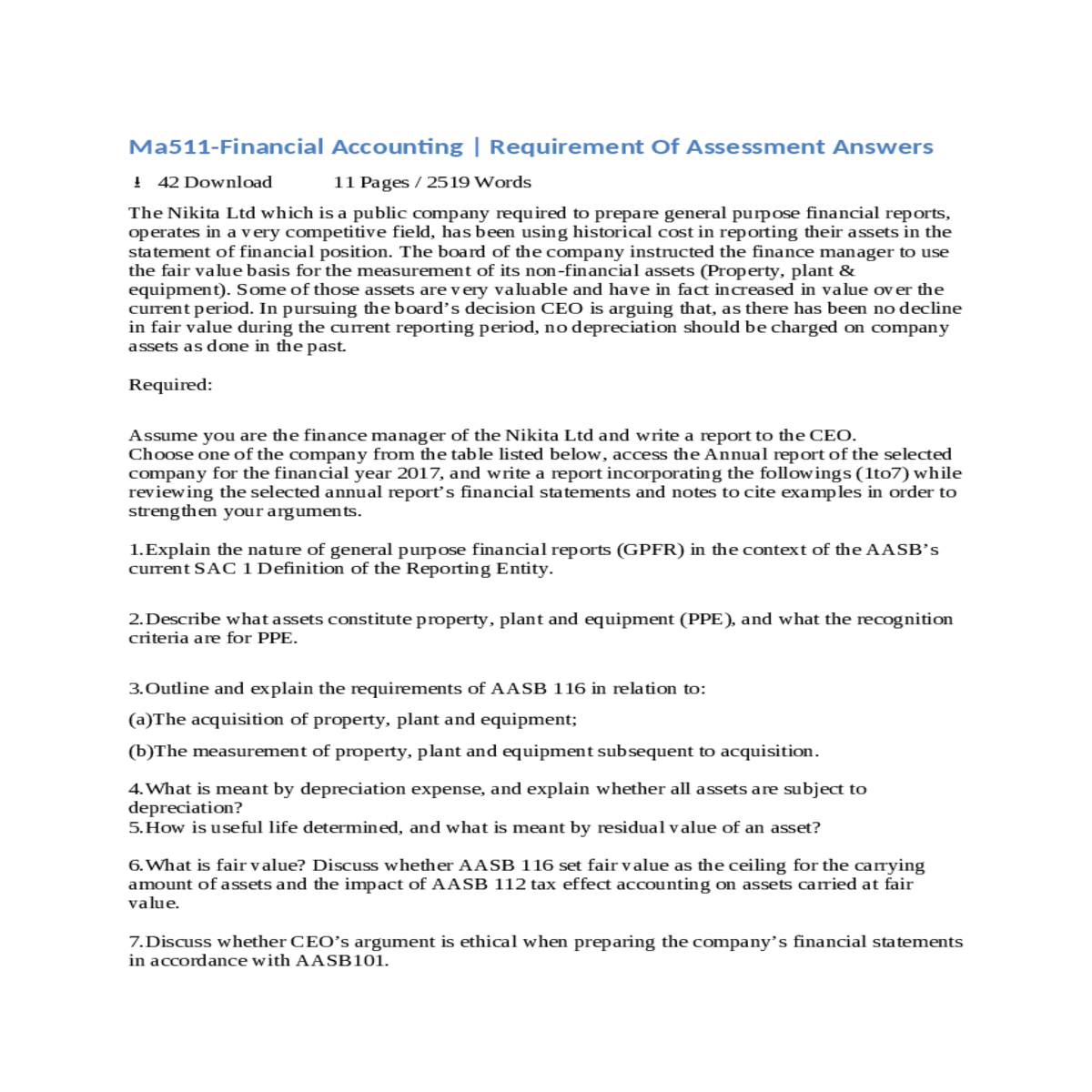
Ma511-Financial Accounting | Requirement Of Assessment Answers
⭳ 42 Download 📄 11 Pages / 2519 Words
The Nikita Ltd which is a public company required to prepare general
purpose financial reports, operates in a very competitive field, has
been using historical cost in reporting their assets in the statement of
financial position. The board of the company instructed the finance
manager to use the fair value basis for the measurement of its
non-financial assets (Property, plant & equipment). Some of those
assets are very valuable and have in fact increased in value over the
current period. In pursuing the board’s decision CEO is arguing that, as
there has been no decline in fair value during the current reporting
period, no depreciation should be charged on company assets as done in
the past.
Required:
(b)The measurement of property, plant and equipment subsequent to
acquisition.
4.What is meant by depreciation expense, and explain whether all assets
are subject to depreciation?
5.How is useful life determined, and what is meant by residual value of
an asset?
6.What is fair value? Discuss whether AASB 116 set fair value as the
ceiling for the carrying amount of assets and the impact of AASB 112 tax
effect accounting on assets carried at fair value.
7.Discuss whether CEO’s argument is ethical when preparing the company’s
financial statements in accordance with AASB101.
8.Recommendations and Conclusion
Answer:
Introduction
The board of Nikita Company, a public limited company with ASX listing, engaged in a competitive type of business, decided to introduce General Purpose Financial Reports. The company was practicing historical cost method to ensure valuation of their assets in financial reports. Now the company wants to introduce fair value basis to measure its non-financial assets in the form of Property, Plant and Equipment. The company also wants to test the implication of different AASB standards in different fields of application for financial reporting related to derivation of fair value of assets falling under the segment of PPE with their identification, subsequent acquisition and measurement, definition of depreciation expense with its applicability to all assets, determination of useful life of any asset and its residual value. The CEO of Nikita Company has argued that there is no need to depreciate value of assets for current period. This issue is to be justified with respective AASB standard. Recommendation is to be made to suggest the board about the above issues. This report will be based on with the example of an ASX listed company named Woolworth. The annual financial report of that company will be consulted for this purpose to justify future steps of Nikita Company related to different financial issues to be streamlined as per AASB standards to comply with basic guidelines as endorsed by Australian Corporation Act, 2001.
AASB-SAC 1- General Purpose Financial Report- Nature
Assets Constitute Property, Plant and Equipment (PPE) and their recognition
Constituent
- Property, plant and equipment as segmented to be held for sale as per AASB 5 –Non- current assets with the nature of held for sale and discontinued service;
- Assets fall under the segment of biological assets related to activities of agriculture as per AASB 141- Agriculture;
- The recognition followed by measurement of exploration and evaluation assets as per AASB 6- Exploration for and Evaluation of Mineral Resources;
- Rights of mineral business with mineral reserves like fossil fuel, natural gas and similar products of non-recycled in nature.
However AASB 116 is applicable to property and plant and equipment, which are used to develop or maintain the assets as specified above in the classification mentioned in 2 to 4 above.
Recognition
As per AASB 116, the recognition criteria of PPE are specified as below:
- In case of possibility of future financial benefit associated with those items flow to the business entity;
- The scope of measurement of the cost of the items to be ensured with reliability. (aasb, 2014)
Requirement of AASB 116- Acquisition and Measurement of PPE
Acquisition
Measurement
Measurement after recognition is followed by cost or revaluation model. Cost model depicts that post- recognition of PPE assets shall be carried at its cost less any type of devaluation in the form of depreciation or impairment losses. Revaluation model endorses the concept of measurement of PPE item, when the fair value derivation is reliably done and accepted. In that case, the revalued amount of the item can be considered as the fair value at the date of revaluation less any sort of devaluation through the impact of depreciation or impairment losses. Revaluation process is to be carried with enough regularity to assure the uniformity of carrying amount in material basis. This value can be determined by the using of fair value at the close of any reporting period. (AASB, 2015)
Depreciation
Definition
Depreciation is an expense, non-cash in nature and used to diminish value of fixed assets over a period of time to make it nil or negligible. The system of depreciation allocation is to allow certain part of fixed asset value on yearly basis and record in the income statement to reduce profit or loss. As per AASB 116, each part of an item under property, plant and equipment is depreciated separately by allocating the justified cost in relation to the total cost of that asset. Three basic criteria are considered while calculating depreciation of any asset: useful life of the asset, salvage value of the asset and the cost of the asset. (profitbooks, 2017)
Assets – to be depreciated and not depreciated
- Buildings
- Machinery
- Vehicles
- Furniture and fixtures
- Computers
- Equipments including office equipments
- Patents
- Copyrights
- Computer software- company owned
Basic concept of depreciated assets is with features like its ownership to the entity, role of the asset in income generating process or productive activities, and possessing of determinable useful life and with useful life of more than one year.
The assets which cannot be depreciated are:
- Land- due to its nature of not worn out or used up after certain fixed period;
- Current assets including cash. (Jean, 2017)
Useful life and residual value of asset
Useful life of asset
- Anticipated usage of the asset;
- Anticipated physical wear and tear depending upon operational factors like number of shifts with the normal course of repair and maintenance and the same while the asset is kept idle;
- Technical or commercial process for the asset to prove it obsolete due to changed situation;
- Legal or such limits on the use of that asset like expiry dates or referred leases.
Residual value of asset
Fair value
Definition
Role of AASB 116 to set fair value as ceiling amount for carrying amount of asset
Role of AASB 112 for tax impact of fair value asset carrying amount
AASB 112 endorses the concept of carrying amount of assets in fair value. In some context, revaluation process due to fair value, which may affect taxable profit for that period. In other context, the reverse happens with no impact on taxable profit. But the occurrence of future recovery of current amount will lead to taxable flow of financial benefit to the entity with subsequent deduction of the amount for tax purposes.
AASB 101- booking of depreciation
As per the CEO of Nikita Company, depreciation booking in financial account is not required. This is not ethical as per AASB 101; as specific directive is mandated for booking of depreciation and amortization in the financial statement of profit or loss and other comprehensive income statement of any public limited company.
Recommendation
Conclusion
References:
AASB. (2018). Definition of the Reproting Entity- SAC 1. (A. S. Public Sector Accounting Standards Board of the Australian Accounting Research Foundation, Producer) Retrieved May 23, 2018, from AASB.GOV.au: https://www.aasb.gov.au/admin/file/content102/c3/SAC1_8-90_2001V.pdf
aasb. (2014, August 12). PPE- AASB 116. Complied AASB Standrad .