Use the inverse laplace transform directly using laplace transform table
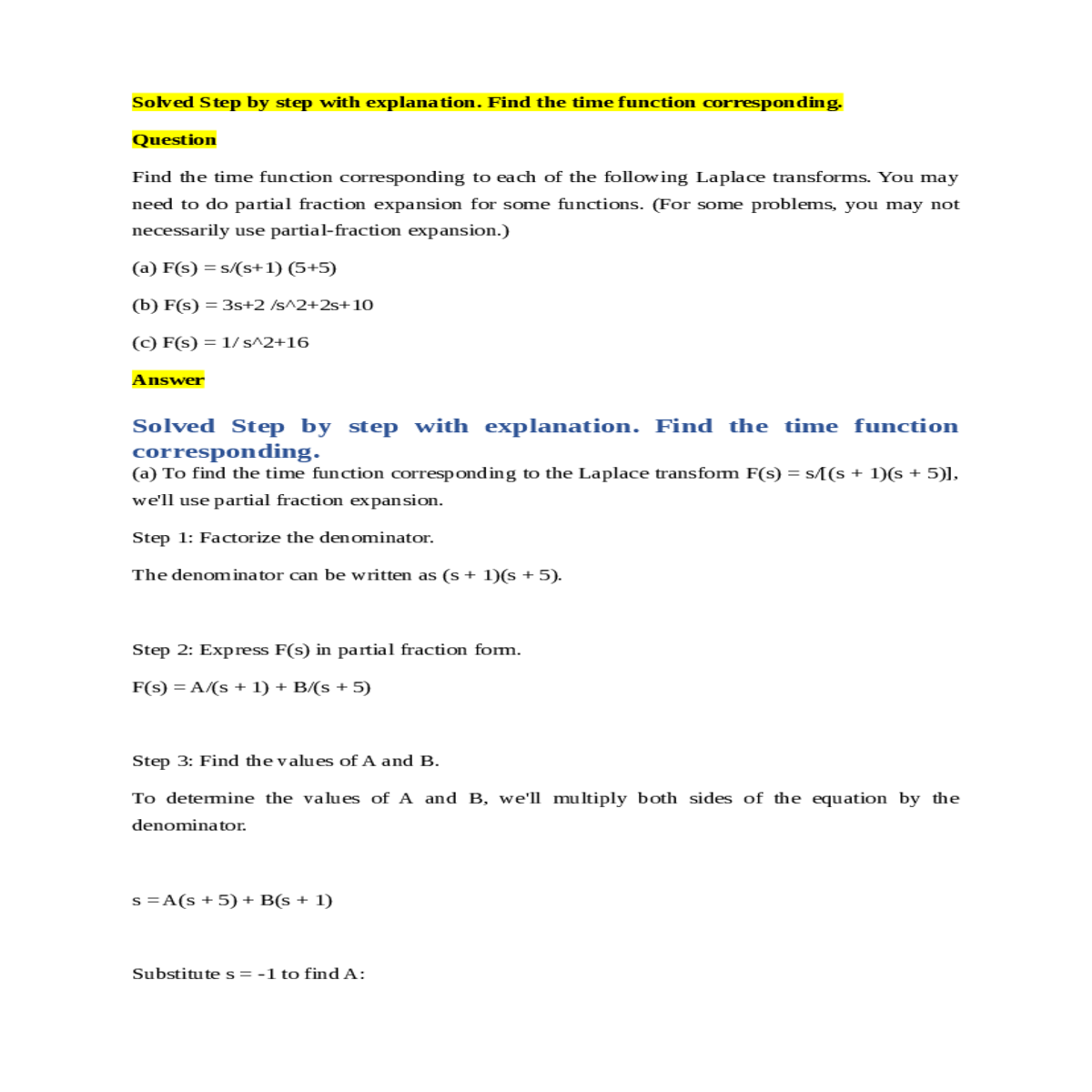
(b) F(s) = 3s+2 /s^2+2s+10
(c) F(s) = 1/ s^2+16
Solved Step by step with explanation. Find the time function corresponding.
Step 2: Express F(s) in partial fraction form.
F(s) = A/(s + 1) + B/(s + 5)
-1 = A (-1 + 5) + B(-1 + 1)
-1 = 4A
B = 5/4
So, F(s) can be written as:
We can now consult a Laplace transform table to find the inverse Laplace transform of each term.
L^-1 {(-1/4)/ (s + 1)} = -1/4 * e^(-t)
L^-1 {F(s)} = L^-1 {(3s + 2)/(s^2 + 2s + 10)}
Again, we'll consult a Laplace transform table to find the inverse Laplace transform.
(c) To find the time function corresponding to the Laplace transform F(s) = 1/(s^2 + 16), we'll use the inverse Laplace transform directly.
L^-1 {F(s)} = L^-1 {1/ (s^2 + 16)}
f(t) = sin(4t)/4