Use the bending stress formula ixwhere the bending stress
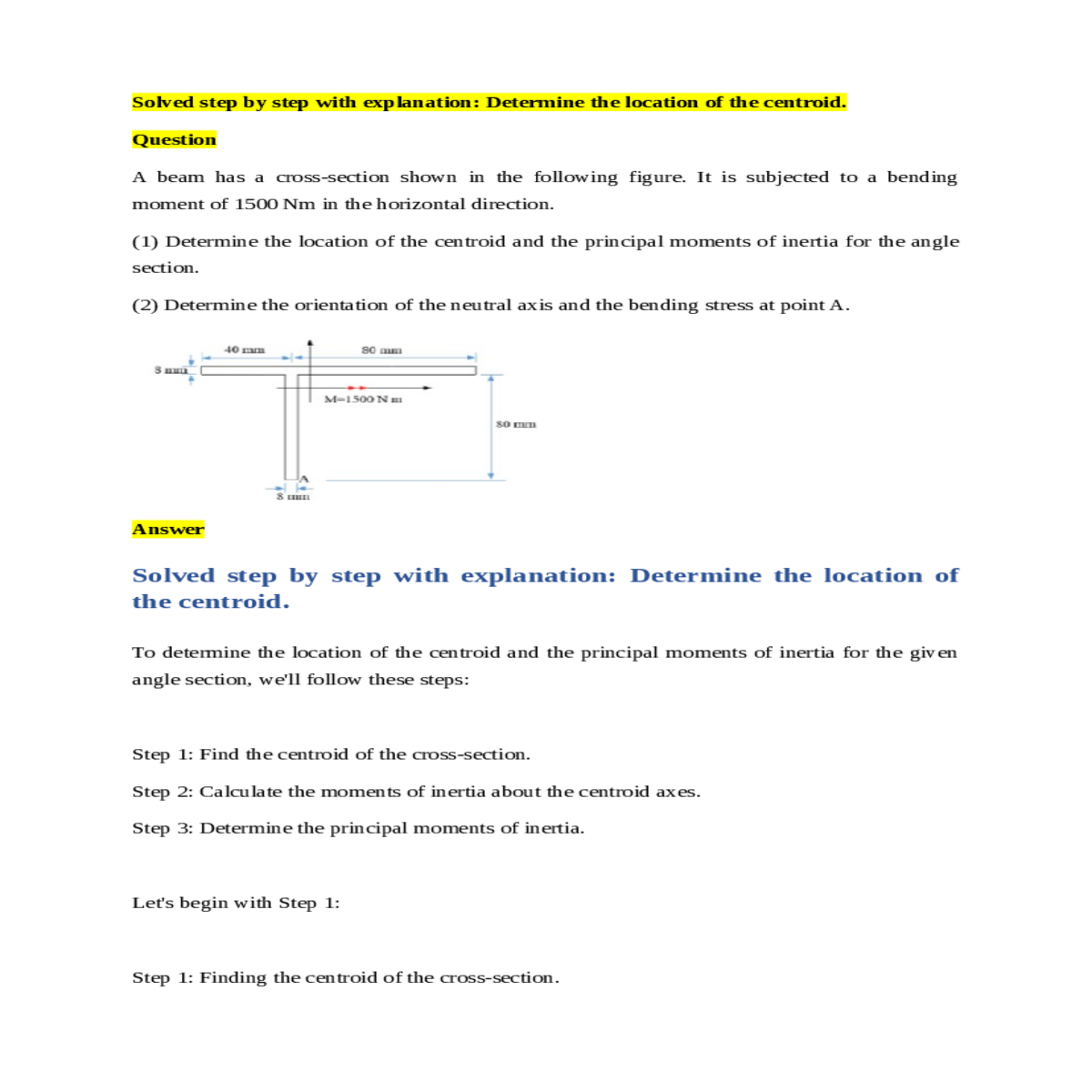
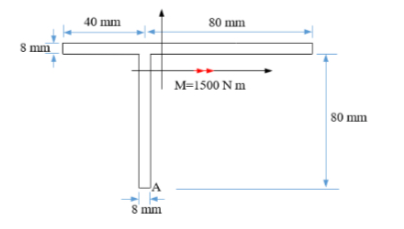
(2) Determine the orientation of the neutral axis and the bending stress at point A.
Answer
Solved step by step with explanation: Determine the location of the centroid.
Let's begin with Step 1:
Step 1: Finding the centroid of the cross-section.
Height (H1) = 80 mm
Rectangle 2 (smaller rectangle):
Height (H3) = 8 mm
Let (x, y) represent the coordinates of the centroid. The y-axis is taken along the vertical direction, and the x-axis is taken along the horizontal direction.
Now, let's calculate the centroid coordinates:
Rectangle 1 centroid coordinates:
(x3, y3) = (B/3, H1 + H2 + H3/3) = (40/3, (80 + 80 + 8)/3) = (40/3, 168/3) = (40/3, 56)
Now, calculate the areas of the regions:
Area of Triangle:
A3 = (1/2) * B * H3 = (1/2) * 40 * 8 = 160 mm^2
= (3200 * 20 + 640 * 4 + 160 * (40/3)) / 4000
= (64000 + 2560 + 2133.33) / 4000
= (128000 + 25600 + 8960) / 4000
= 161560 / 4000
The formula for the moment of inertia of a region about a centroid axis is:
I = ∑(A * d^2)
= (40 * 80^3) / 12
= 2,133,333.33 mm^4
Ix2 = (W2 * H2^3) / 12
= (8 * 80^3) / 12
Triangle moment of inertia about the centroid axis (Ix3 and Iy3):
Ix3 = (B * H3^3) / 36
= 7111.11 mm^4
Now, sum up the individual moments of inertia to get the total moments of inertia:
= 2,133,333.33 + 6826.67 + 7111.11
≈ 2,148,271.11 mm^4
inertia (Ix in this case). Therefore, the neutral axis will be horizontal.
To calculate the bending stress at point A, we'll use the bending stress formula:
y = 40.39 mm (distance from the neutral axis to point A)
Ix = 2,151,111.11 mm^4 (principal moment of inertia about the x-axis)
Therefore, the bending stress at point A is approximately 0.0282 N/mm^2.