Unit lqueuing theory definitions queue waiting line
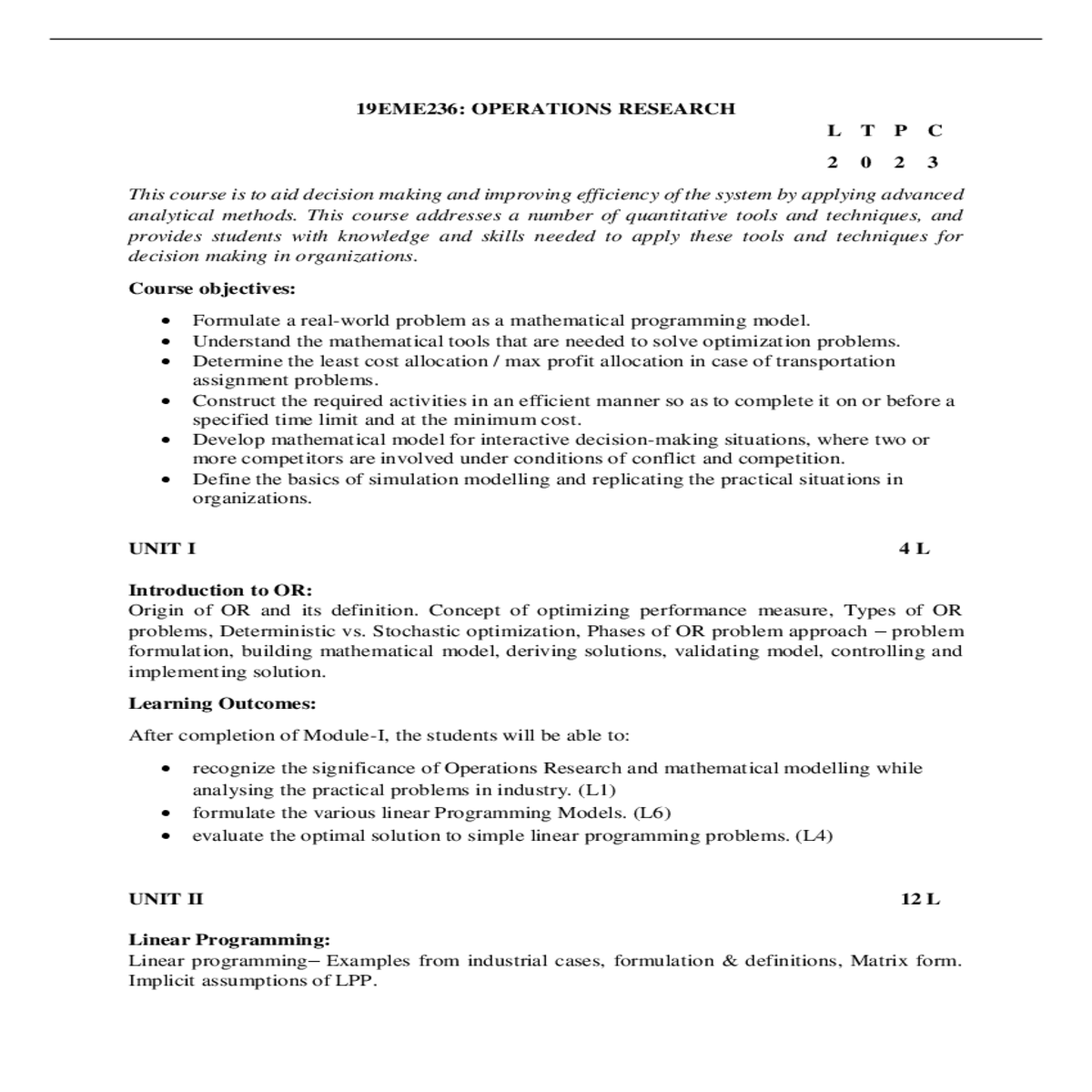
19EME236: OPERATIONS RESEARCH
| L | T | P | C |
|---|---|---|---|
| 2 | 0 | 2 |
|
Course objectives:
• Formulate a real-world problem as a mathematical programming model.
specified time limit and at the minimum cost.
• Develop mathematical model for interactive decision-making situations, where two or
Introduction to OR:
Origin of OR and its definition. Concept of optimizing performance measure, Types of OR
After completion of Module-I, the students will be able to:
• recognize the significance of Operations Research and mathematical modelling while
Linear Programming:
Linear programming– Examples from industrial cases, formulation & definitions, Matrix form.
Duality – formulation, results, fundamental theorem of duality, dual-simplex and primal-dual algorithms.
Learning Outcomes:
UNIT III 10 L
Transportation and Assignment problems:
TP - Examples, Definitions – decision variables, supply & demand
constraints, formulation, Balanced & unbalanced situations, Solution
methods – NWCR, minimum cost and VAM, test for optimality (MODI method),
degeneracy and its resolution.
• formulate the linear programming problem as an Assignment model. (L6)
• evaluate the optimal solution to Transportation Problems. (L4)
Learning Outcomes:
After completion of Module-V, the students will be able to:
• evaluate the optimal order/batch quantity for minimum inventory cost. (L4)
UNIT V 10 L
After completion of Module-III, the students will be able to:
• define the various queuing models. (L1)
1. H.A. Taha, Operations Research: An Introduction,10/e, Pearson,2017.
Reference Books:
5. Thomas L. Saaty, Elements of Queuing Theory, New Ed edition, Dover Pubns, October 1, 1983.
6. A. Ravi Ravindran, Operations Research and Management Science, Hand Book, 1/e, CRC Press, 2008.
Course Objectives:
|
|---|
List of Experiments
Introduction to Operations Research Packages - using Solver/Excel and TORA/Statistical
• Waiting Lines.
2. Production management:
including
|
|---|
Course Objectives:
• The course aims at imparting basic principles of thought process, reasoning and inferencing. Sustainability is at the core of Indian Traditional Knowledge Systems connecting society and nature.
Modern Science and Indian Knowledge System
Yoga and Holistic Health care
3. Fritzof Capra, Tao of Physics, 3/e, 2007.
4. Fritzof Capra, The wave of Life.