The triple constraint the project management triangle scope
MS Project 1
(20 marks - 20%)
1 Or other suitable PM software – up to you!
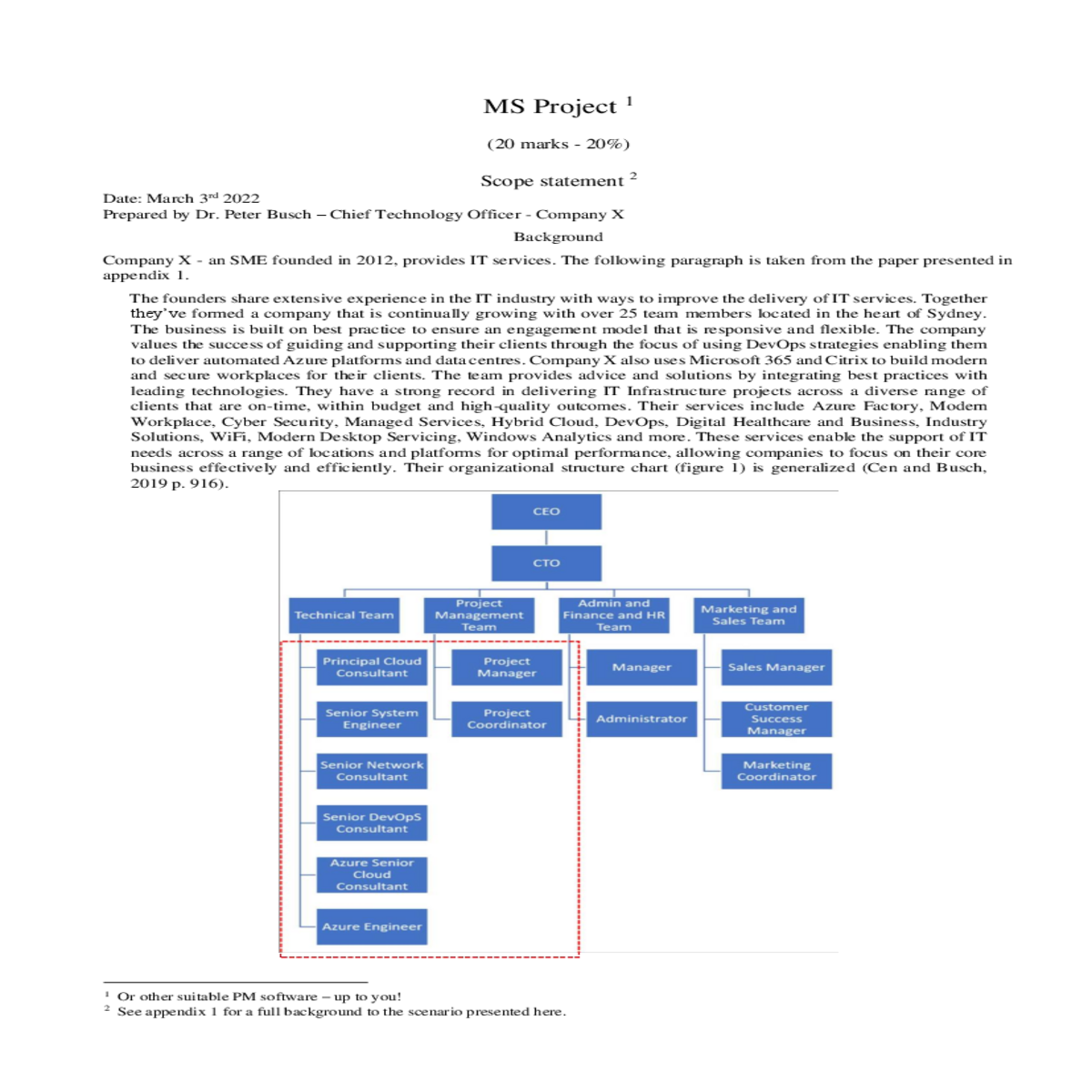
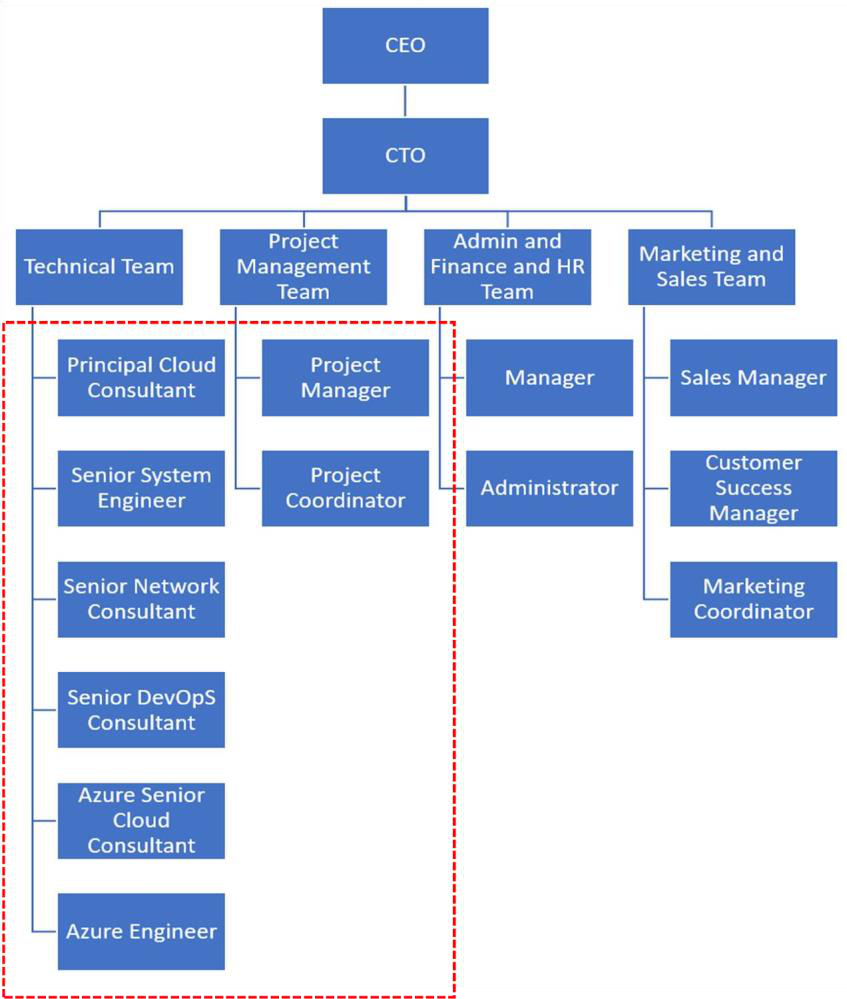
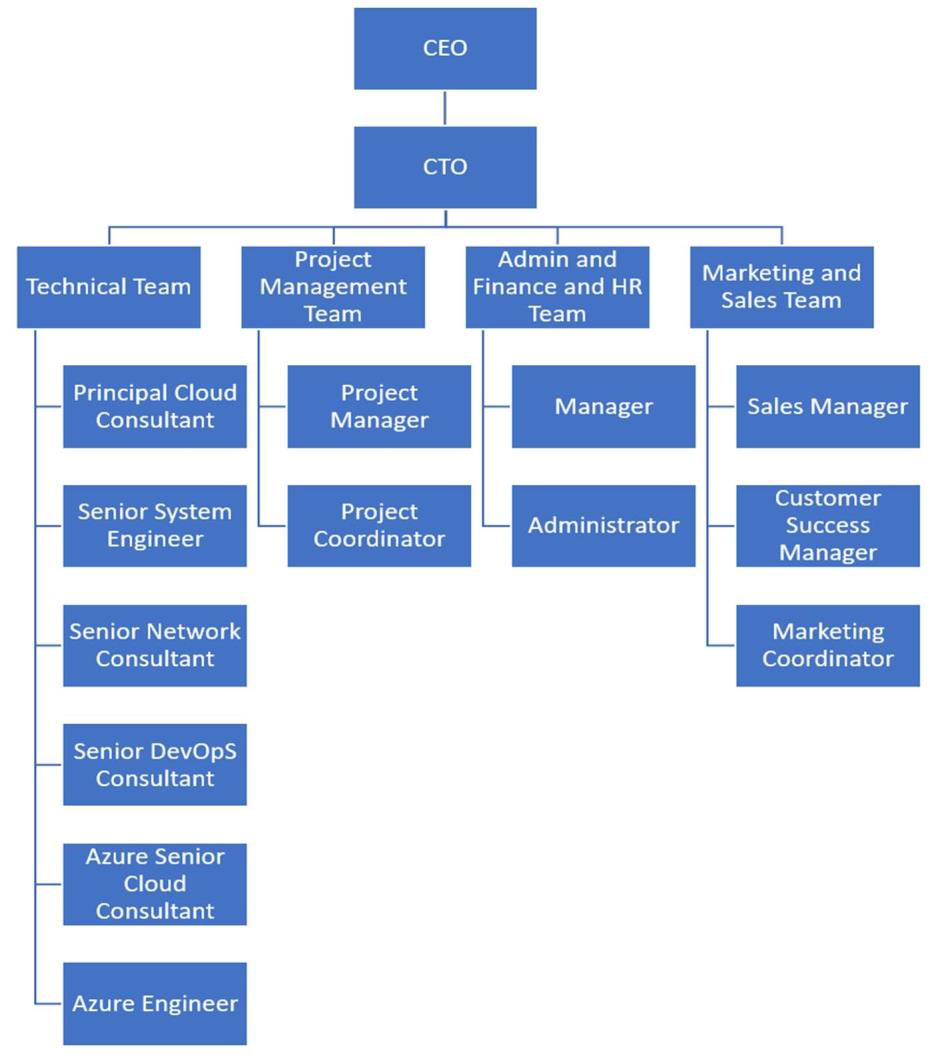
Q1. Assume YOU are the project manager (PM) in company X (a real IT company) illustrated above. Fifteen (15) staff are illustrated in figure 1, of which we could consider the 8 profiled in the red rectangle to comprise the actual IT staff.
The CTO (i.e., me - with the CEO’s blessing) has instructed you (PM) to prepare a project plan for a knowledge system garnering expertise in the firm, regarding the sorts of technologies listed in the background above. To remain competitive company X needs to draw better upon their internal knowledge. The system requirements at a high level are as follows:
|
|---|
Our goal is to complete this project within 4 months for no more than $? 4 The main goal is increase access to expertise by providing a system that can be used by all 25 staff in the company ideally, even though the 8 staff listed above, comprise the core of staff with most of the IT knowledge (15 marks).
Q2. Comment on the importance of the Triple Constraint with reference to both the concepts provided in Cen and Busch (2019 – see Appendix 1) and relating such concepts to the scenario you have worked on in question 1. What do you think are the most important constraints in the assignment scenario here – Scope, Time, or Cost? Why? (5 marks).
a. You are the PM as illustrated in figure 1. Consider your salary cost too.
b.Company X wants a knowledge system which can store expertise on the platforms, software and cloud knowledge of 8 staff in particular, mentioned in the scope above.
• One way to work the payments out might be to work out an hourly rate of pay and multiple by the number of days per week and weeks per month your staff might be allocated to the lab.
| i. |
|
|---|
5 You are the PM - so you work out the costings of these staff. ‘Google’ what the salaries might be.
to modify the WBSs as you see appropriate (15 marks).
Please answer the following: -
point, rather than redrawing from scratch.
• Provide a discussion of your approach – how did you arrive at your costings, timeframes, how staff were
COMP3770/6770
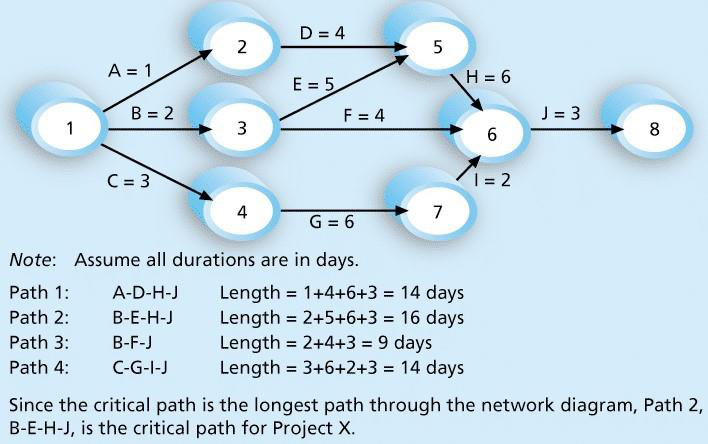
WBS charts, including
i. Gantt chart
Place your soft copy (1 file) in the appropriate folder on iLearn (Turnitin submission).
Marking Rubric
COMP3770/6770
| Developing (Borderline Pass-Fail) |
|
|||
|---|---|---|---|---|
| Comprehending the underlying scenario |
|
|
||
|
||||
|
Late submissions
Late submissions will be accepted but will incur a penalty unless there is an approved Special Consideration request. A 12hour grace period will be given after which the following deductions will be applied to the awarded assessment mark: 12 to 24 hours late = 10% deduction; for each day thereafter, an additional 10% per day or part thereof will be applied until five days beyond the due date. After this time, a mark of zero (0) will be given. For example, an assessment worth 20% is due 5 pm on 1 January. Student A submits the assessment at 1 pm, 3 January. The assessment received a mark of 15/20. A 20% deduction is then applied to the mark of 15, resulting in the loss of three (3) marks. Student A is then awarded a final mark of 12/20. If you require an extension, please do so via ask.mq.
competitive advantage. The research uses qualitative measures to establish the influence of project management while identifying project success factors between the project team and client when delivering IT services. The study revealed that management areas with greatest impact on project success were time, cost, and quality. Keywords: Project Management, Survey, Triple Constraint, Australian SME
Introduction
Organisational background
Small and medium sized enterprises (SMEs) play a significant role in providing competitive advantage and increasing efficiency, which can lead to eventual success in the digital economy (Fakieh, Blount & Busch, 2014; 2016). Oritogun, Busch and Picoto (2018) note SMEs comprise a significant percentage of all businesses in Australia. In Australia, 3.8% of all organisations are medium-sized businesses employing 50-199 employees, while 96% are small businesses employing fewer than 50 staff (Anon, 2018; Connolly, Norman, and West, 2012). Other characteristics of SMEs include having a flat organizational structure, the division of activities is unclear, the span of activities narrow, they tend to have a fast response to environmental changes, they possess a high incidence of innovativeness often involving information evaluation, control, and reporting procedures, have flexible organization flows and top management level is highly visible (Ghobadian and Gallear, 1996). Interestingly, Angela Mentis, CEO of National Australia Bank (NAB 2018), mentions SMEs created 7 million jobs contributing 57% of Australia’s Gross Domestic Product (GDP), making SMEs the backbone of the Australian economy (NAB, 2018), driving growth and employment - particularly in developing economies (Radas and Božić, 2009).
IT Infrastructure projects across a diverse range of clients that are on-time, within budget and high-quality outcomes. Their services include Azure Factory, Modern Workplace, Cyber Security, Managed Services, Hybrid Cloud, DevOps, Digital Healthcare and Business, Industry Solutions, WiFi, Modern Desktop Servicing, Windows Analytics and more. These services enable the support of IT needs across a range of locations and platforms for optimal performance, allowing companies to focus on their core business effectively and efficiently. Their organizational structure chart (figure 1) is generalized.
|
|---|
In the project management team, we have the:
| - |
|---|
- - |
|---|
Our study adopted questionnaires but in the form of written interviews carried out face to face through phone calls and internal mail. Questionnaires are cheap, quick, and efficient to obtain a lot of information from many people (McLeod, 2018). The advantages of questionnaires are that they are cost efficient, practical to gather data and results are quick and easy to collect while being scalable (Debois, 2016). On the other hand, some questions may be difficult to analyze, may lack personalization or have differences in understanding and interpretation (Debois, 2016). For a good questionnaire, it is important to lead respondents to answer questions appropriately to capture the needed data (SmartSurvey Blog, 2018). The questionnaires were put into place through interviews, focusing questions on the ten bodies of knowledge (appendices 1 and 2), but particularly the triple constraint. The questionnaire was developed through altering pre-existing questions from academic sources (Serrador and Turner, 2015; Silvius, et al., 2017). Some changes were made to questions, so they better suited our research and profile of company X. The questions mainly focused on project management, including the triple constraint of time, quality, and scope. Respondents provided a response on a scale of 1-10 (1 being the least important, 10 being the most important). Respondents were asked to rank the level of importance between time, quality and scope and project success perceived by the sponsor, client and project team and the performance of project efficiency in time, cost, and scope. The project was nationwide, taking place within Australia.
Results
Page 9
|
|
|
||||
Cost is the most important factor to take into account. |
|
|
|
|||
|
|
The results given for time (figure 2) in terms of whether time is the most important factor, whether being on schedule is a must and whether checking the schedule is a priority - all have vastly different ratings due to differences in opinions between technical and business employees. Moreover person 4 and person 6 worked as project managers and understood dependencies between different projects. In particular, person 6 assessed a project which was funded by another company for the client, hence the drastic difference in rating.
Page 11
COMP3770/6770
As the interviews were not role specific, we interviewed not only managerial but also technical employees - hence the interview questions included the option of being ‘unsure’. Generally, we can see at least 50% of projects were under-budget (figure 6), for accurate contingency plans were in fact put into place. For projects over-budget, this was mainly due to time
delays as the internal team provided further help where the client should’ve requested a project change request (PCR). Moreover, it was understood that consistent and accurate communication with the project manager was felt to be important by the interviewees.
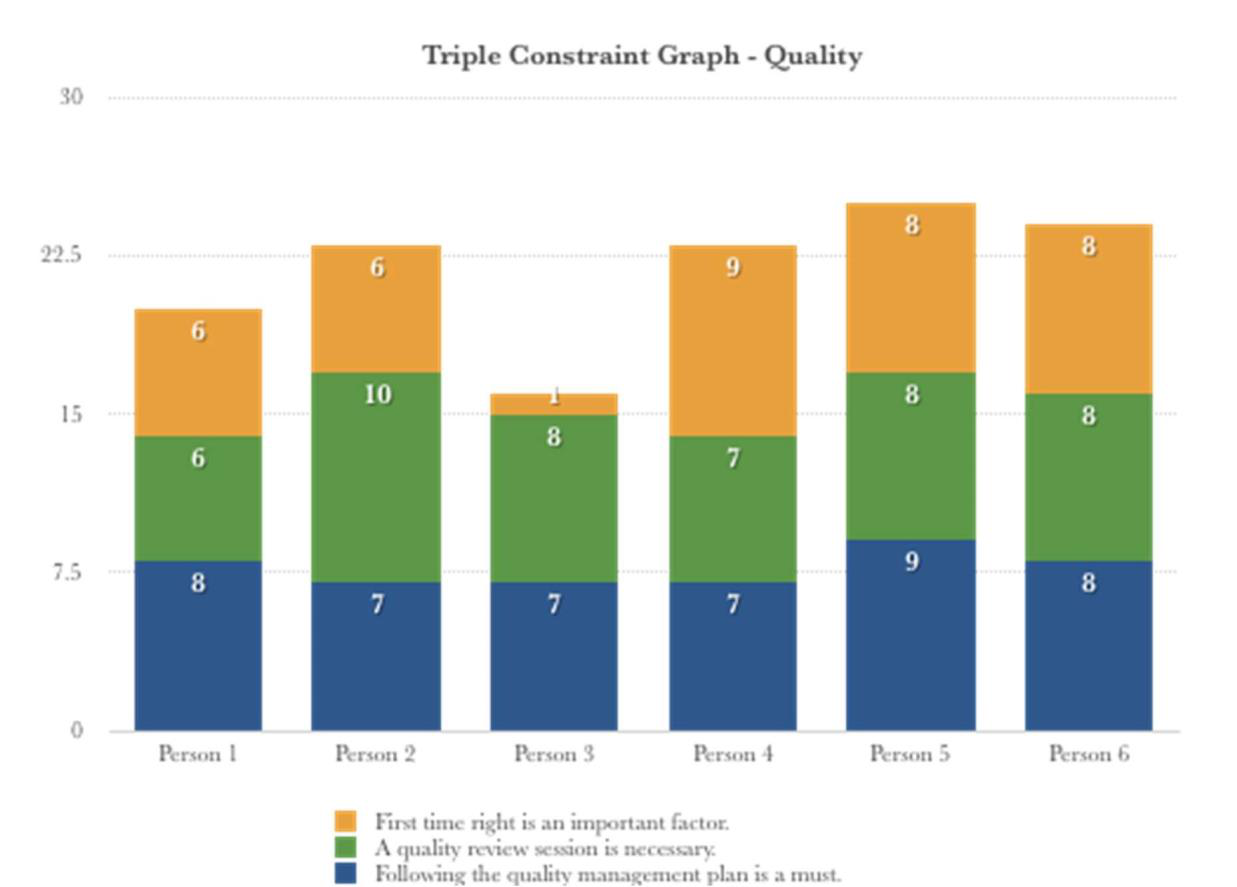
Figure 3: Illustrating results of quality (from appendix 1).
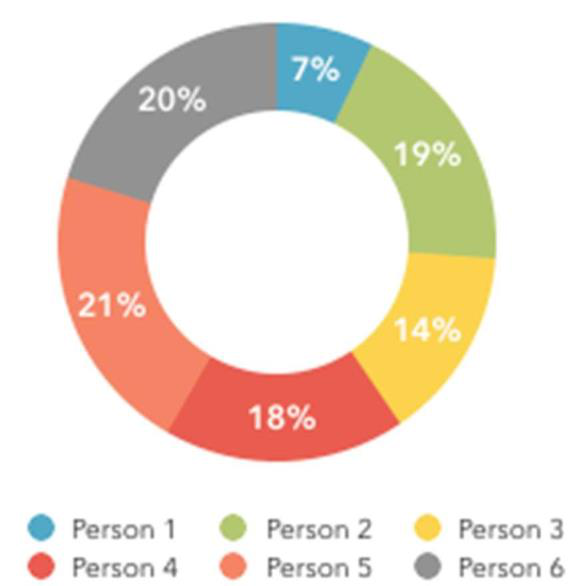
Figure 5: Meeting Timeline Goals. Meeting Scope/Requirement Goals
Project Team Assessment
Figure 8 present findings of whether different projects were unsuccessful, successful, very successful or mixed. However, all employees interviewed had relatively positive outcomes. Persons 1 and 4 had mixed responses, as problems such as delays were influenced by clients, as well as changes made in requirements. On the contrary for projects that were very successful, employees recognised this was achieved through good scope, set expectations, and flagged areas of concern.
Page 14
COMP3770/6770
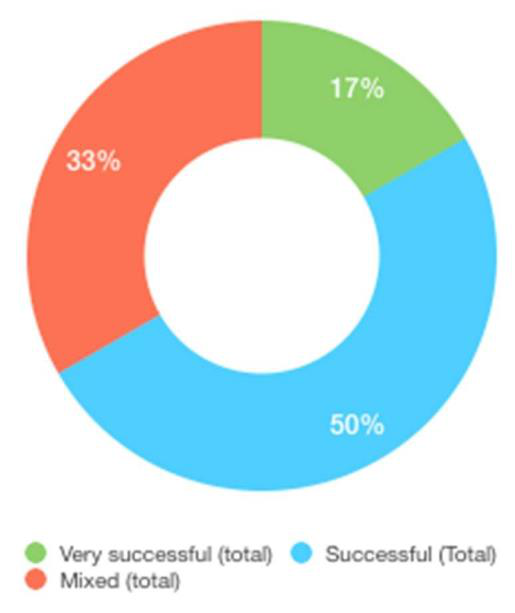
Figure 10: Overall Project Success
Page 15
COMP3770/6770
Anon, (2018). Financial services and Small and Medium-Sized
Enterprises (SMEs). [online] Available at:
https://financialservices.royalcommission.gov.au/publications/Documents/financial-services-and-small-andmedium-sized-enterprises-paper-12.pdf
[Accessed 10 Sep. 2018].
Baratta, A. (2006). The triple constraint: a triple illusion. Paper presented at PMI® Global Congress 2006—North America, Seattle, WA. Newtown Square, PA: Project Management Institute.
Debois, S. (2016). Advantages and Disadvantages of Questionnaires - Survey Anyplace. [online] Survey Anyplace. Available at: https://surveyanyplace.com/questionnaire-pros-and-cons/ [Accessed 13 Sep. 2018].
Dvir, D., Raz T. and Shenhar, A. (2003). An empirical analysis of the relationship between project planning and project success. International Journal of Project Management, 21(2), pp: 89-95.
McLeod, S. (2018). Questionnaire | Simply Psychology. [online] Simplypsychology.org. Available at: https://www.simplypsychology.org/questionnaires.html [Accessed 13 Sep. 2018].
Müller, R. and Turner, J R. (2007). Matching the project manager's leadership style to project type. International Journal of Project Management, 25(1), pp: 21-32.
Oritogun, K., Busch, P., Picoto, W., (2018) "Effectiveness of Social Media for KM Tools in SMEs" International Business Information Management Conference (32nd IBIMA) 15-16th November Seville, Spain pp: 1-12.
Pant, I. & Baroudi, B., 2008. Project management education: The human skills imperative. International Journal of Project Management, 26(2), pp: 124–128.
Rosenau, M.D. and Githens, G.D., (2011). Successful project management: a step-by-step approach with practical examples. John Wiley & Sons.
Schwalbe, K., (2015). Information technology project management. Cambridge MA: Cengage Learning US. 8th Edition
SmartSurvey Blog., (2018). What Makes a Good Online Questionnaire - SmartSurvey Blog. [online] Available at: https://blog.smartsurvey.co.uk/what-makes-a-good-online-questionnaire/ [Accessed 13 Sep. 2018].
Westland, J., (2018). The Triple Constraint in Project Management: Time, Scope & Cost. [online] ProjectManager.
In your opinion, is time, quality or cost the most important in a project?
|
||
|---|---|---|
Page 17
COMP3770/6770
|
|---|
Page 19