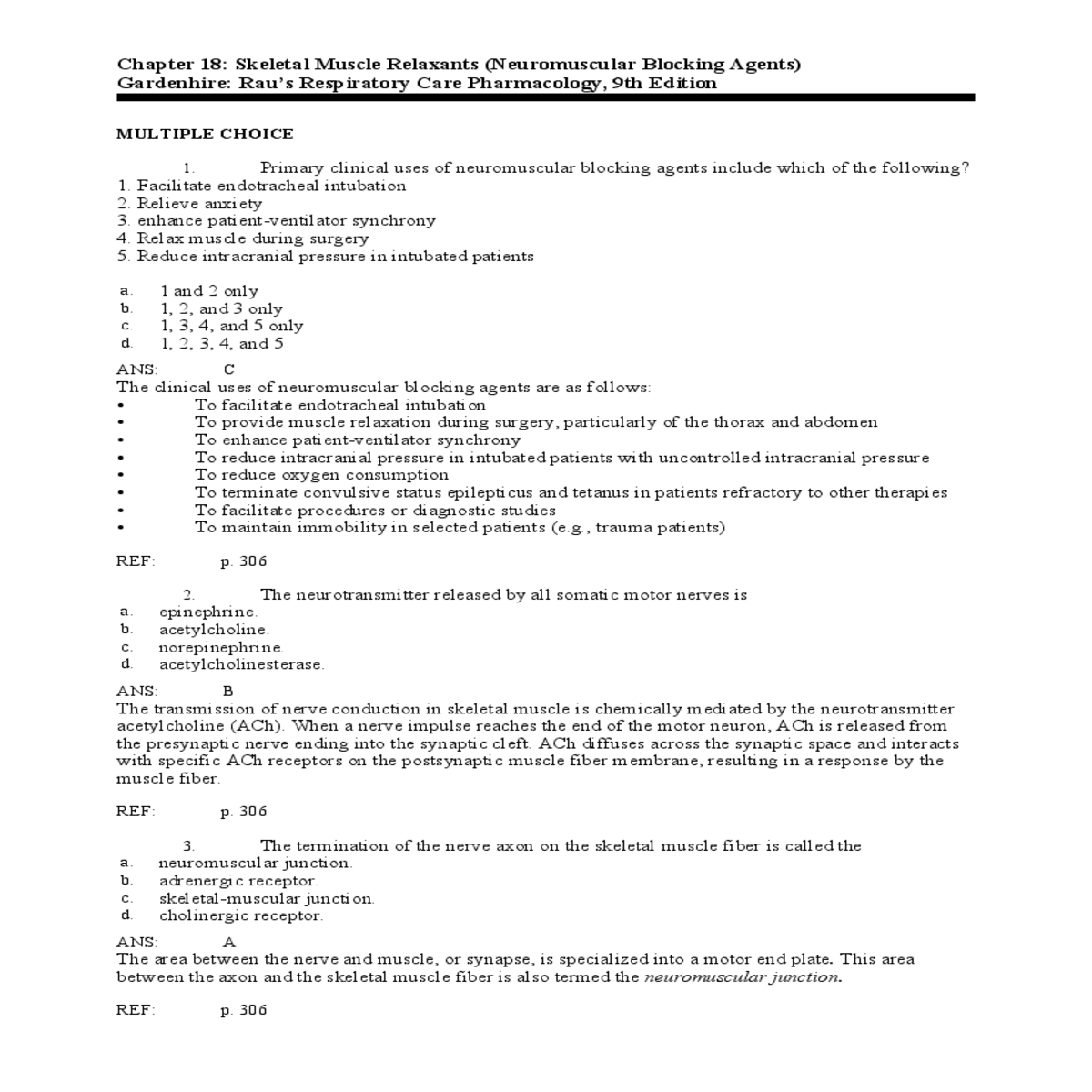
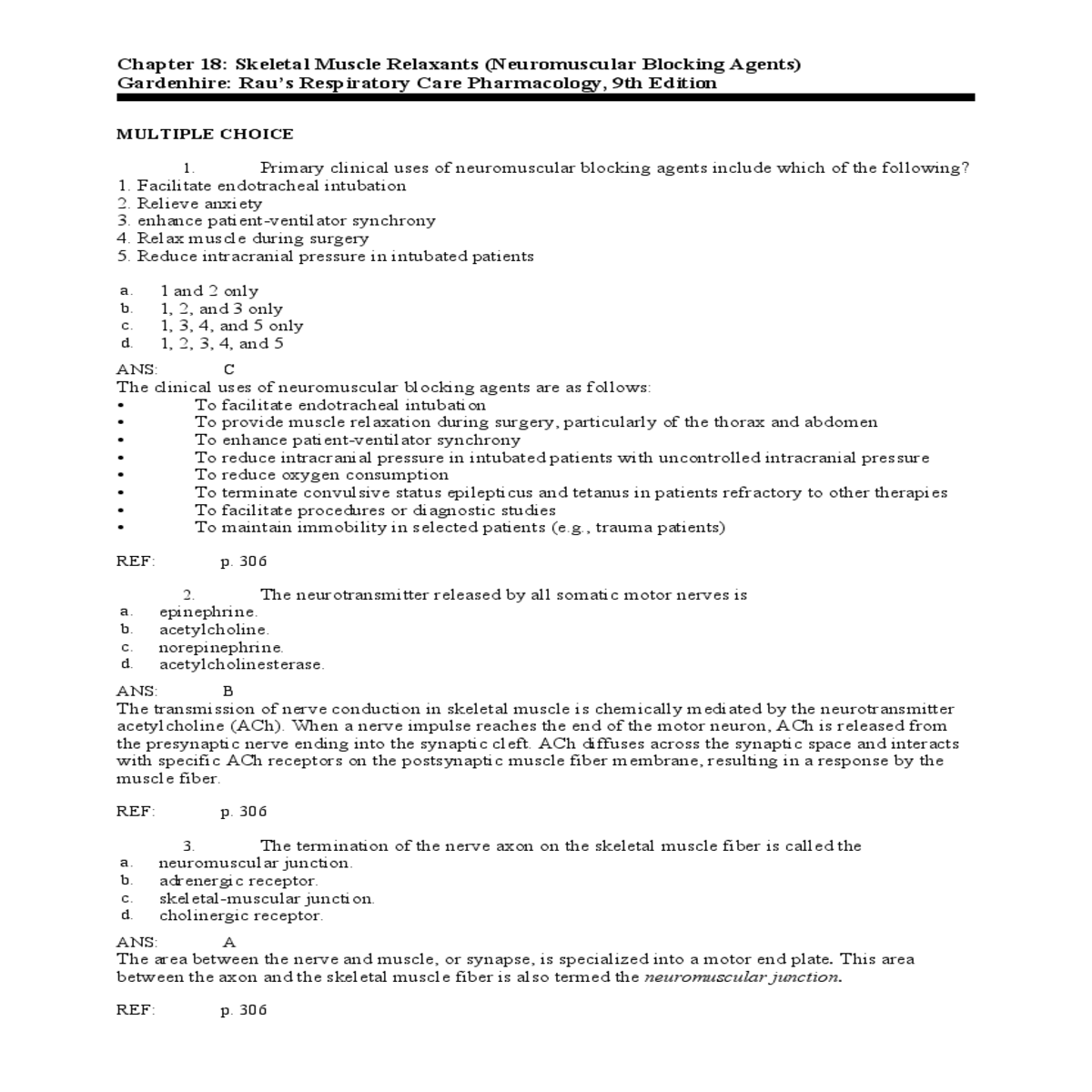
The termination the nerve axon the skeletal muscle fiber called the
Chapter 18: Skeletal Muscle Relaxants (Neuromuscular Blocking Agents) Gardenhire: Rau’s Respiratory Care Pharmacology, 9th Edition
MULTIPLE CHOICE
ANS: C
The clinical uses of neuromuscular blocking agents are as follows:
• To facilitate endotracheal intubation
• To provide muscle relaxation during surgery, particularly of the thorax and abdomen• To enhance patient-ventilator synchrony
• To reduce intracranial pressure in intubated patients with uncontrolled intracranial pressure• To reduce oxygen consumption
• To terminate convulsive status epilepticus and tetanus in patients refractory to other therapies• To facilitate procedures or diagnostic studies
• To maintain immobility in selected patients (e.g., trauma patients)REF: p. 306
3. The termination of the nerve axon on the skeletal muscle fiber is called the a. neuromuscular junction.
b. adrenergic receptor.c. skeletal-muscular junction.
cholinergic receptor. d.d. acetylcholinesterase.
ANS: D
During the short period that acetylcholine (ACh) is in contact with the muscle fiber membrane, a nerve action potential, or nerve impulse, is initiated in the postsynaptic cell. ACh is broken down and inactivated by the enzyme acetylcholinesterase (AChE)allowing the muscle fiber to repolarize.ANS: C
Succinylcholine is the only available depolarizing skeletal muscle relaxant. The other choices listed are nondepolarizing agents.REF: p. 310
1. Quadriceps
2. Bronchial wall
3. Biceps
4. Diaphragm
5. Cardiac fibers
motor functions such as movement, lifting, and breathing. The autonomic nervous system includes
peripheral nerves that control “involuntary” movement. These nerves stimulate visceral organs such as the
a. nondepolarizing.
b. depolarizing.
depolarization. By preventing repolarization of the nerve ending, the postsynaptic ending becomes
refractory and unexcitable, resulting in flaccid muscles. At the present time, succinylcholine is the only
a. by inhalation.
b. orally.
muscles. Inhalation would result in deposition mostly in the lung, and oral administration would delay the
onset of action.
b. They quickly diffuse across the blood–brain barrier
c. They reach peak effect slowly when given intravenously
receptor. Nondepolarizing agents are poorly lipophilic and do not penetrate well into fat tissue or across
the blood–brain barrier. Also, these agents are poorly absorbed from the gastrointestinal tract and must be
b. 2 to 5 minutes.
c. 5 to 10 minutes.
1. Bronchospasm
2. Tachycardia
3. Apnea
4. Increased airway resistance
5. Increased blood pressure
|
|---|
c. reduce blood pressure.
reduce intracranial pressure. d.
|
|
|---|
1. Succinylcholine (Anectine)
2. Pancuronium (Pavulon)
3. Rocuronium (Zemuron)
4. Vecuronium (Norcuron)
|
|---|
c. sympathomimetics.
acetylcholine inhibitors. d.
administer a cholinesterase inhibitor other than neostigmine. c.
d. immediately place the patient on continuous positive airway pressure (CPAP).
ANS: D
Atracurium and cisatracurium differ from other neuromuscular blocking agents regarding route of elimination. These agents are partly inactivated by a spontaneous degradation mechanism that is dependent on the pH of blood and temperature of the body. This nonenzymatic breakdown is termed Hofmann degradation. In addition to Hofmann degradation, these agents are rapidly converted to less active metabolites by circulating plasma esterases that cause hydrolysis of the compounds. Because of the lack of liver and kidney elimination, atracurium and cisatracurium provide optimal choices for patients with hepatic or renal failure.REF: p. 309
REF: p. 314
22. Your patient has been given neostigmine for reversal of the nondepolarizing blockade agent he received during surgery. On examination, you observe severe bradycardia and increased salivation. What is a possible explanation?
23. Succinylcholine is metabolized to
a. cholinesterase inhibitors.
b. succinylmonocholine.c. laudanosine.
24. Succinylcholine is metabolized by
a. cholinesterase inhibitors.
b. succinylmonocholine.c. laudanosine.
2. hyponatremia.
3. hypocalcemia.
4. hypokalemia.
5. hypothermia.
| Potentiating Factors | ||
|---|---|---|
| Potent anesthetic vapors |
|
|
| Antibiotics |
|
|
| • Aminoglycosides | ||
| • Clindamycin | ||
| • Vancomycin | ||
| • Tetracycline | ||
| Local anesthetics |
|
Antiarrhythmics
• Procainamide
• Quinidine
Calcium channel blockers
b-adrenergic blockers
Cyclosporine
Dantrolene
Cyclophosphamide
Lithium
Mineralocorticoids
Echothiophate
Tacrine
Metoclopramide
| Organophosphate poisoning |
|
|
|---|---|---|
| Myasthenia gravis |
Muscular dystrophy
Amyotrophic lateral sclerosis
Poliomyelitis
Multiple sclerosis
Eaton-Lambert syndrome
negative inspiratory force. c.
d. hand-grip strength.
3. hypercalcemia.
4. thrombocytopenia.
5. hypothermia.
| Acidosis | Alkalosis | |
|---|---|---|
| Hyponatremia | Hypercalcemia | |
| Hypocalcemia | Demyelinating injuries | |
| Hypokalemia | Peripheral neuropathy |
Muscular dystrophy
Amyotrophic lateral sclerosis
Poliomyelitis
Multiple sclerosis
Eaton-Lambert syndromeREF: p. 313
ANS: C
Neuromuscular blocking agents (NMBAs) are divided into two types: depolarizing and nondepolarizing.
ANS: A
Nondepolarizing agents have a longer duration of action than the depolarizing agent succinylcholine.REF: p. 308