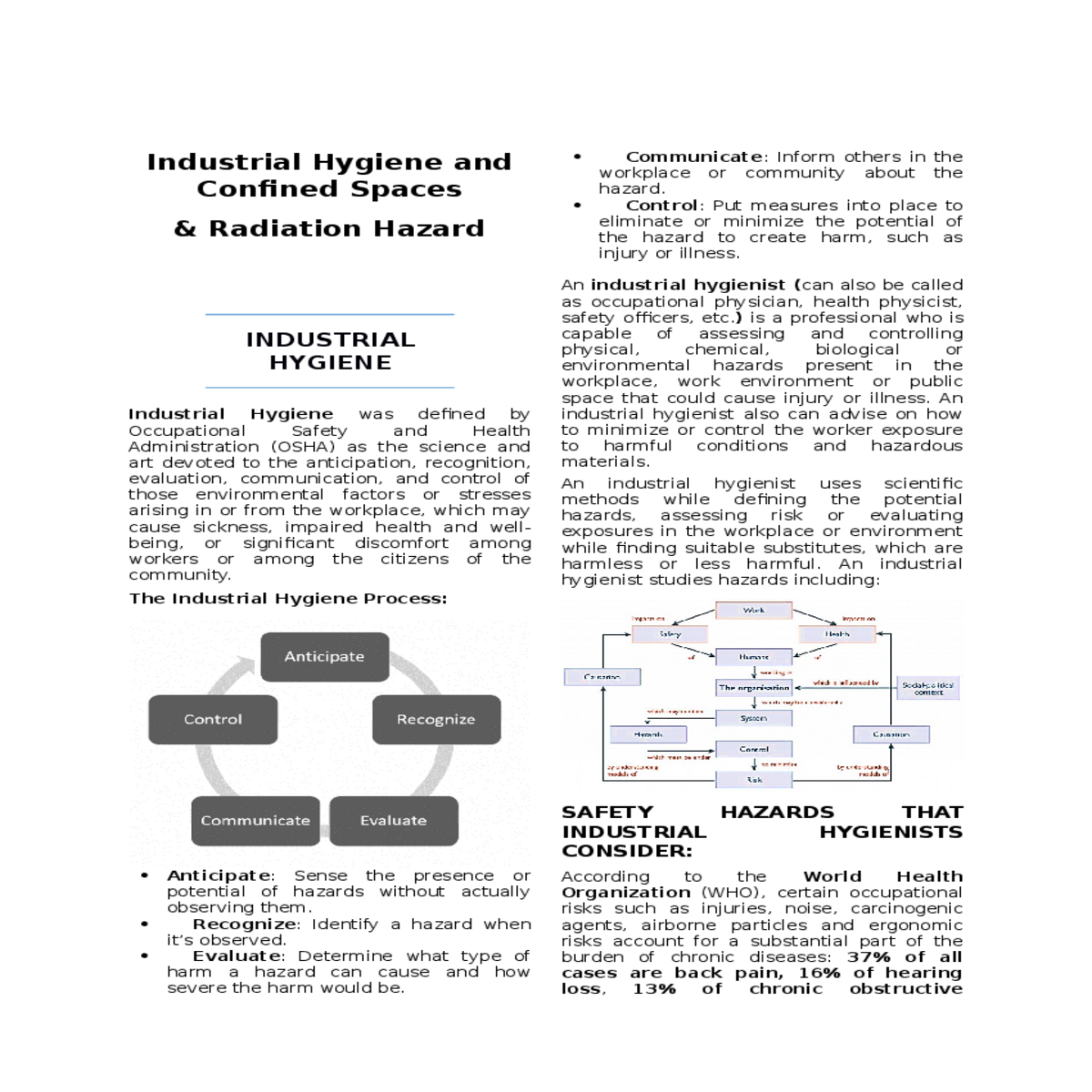
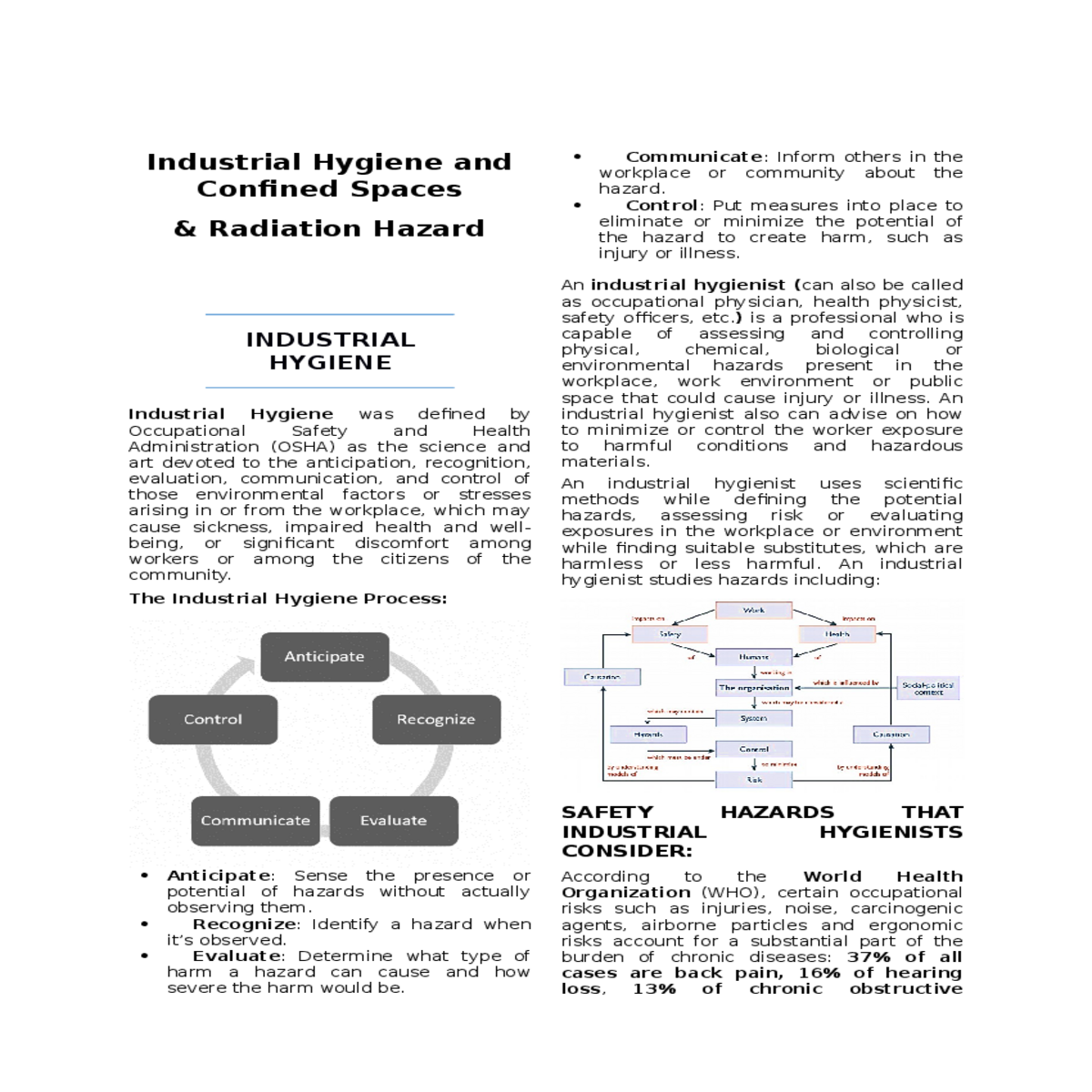
The sun and cosmic microwave background cmb radiation
Industrial Hygiene and
Confined Spaces
| was defined by | |||
|---|---|---|---|
| Safety | and | Health | |
|
|||
The Industrial Hygiene Process:
| | ||||
|---|---|---|---|---|
| | ||||
|
||||
| chemical, | biological | or | ||
pulmonary disease, 11% of asthma, 8% of injuries, 9% of lung cancer, 2% of leukaemia and 8% of depression. These environmental stressors on which industrial hygiene focuses can be divided into the following broad categories: chemical, physical, biological, and ergonomic hazards.
1. Aerosols
Aerosol is a suspension of fine solid particles or liquid droplets in a gas. An aerosol includes both the particles and the suspending gas, which is usually air.
|
||
|---|---|---|
| their | origin, | physical |
Work processes likely to
generate dust include the
|
|---|
| Prolonged | exposure | to | |
| c. Smoke |
|
||
|
|||
| combustion | occurs | new | |
| spraying | |||
|
|||
| that | are | generated | by |
|
|||
b. Vapors are produced when a substance becomes gaseous at a temperature that is lower than its critical point. The compounds found in vapor are the same as the compounds found in the substance that was vaporized
| including | fire | ||
|---|---|---|---|
| resistance, |
|
||
|
|||
| | | Asbestos-related | non- | |
|---|---|---|---|---|
|
||||
|
and | |||
| | ||||
| mesothelioma), | intestine | |||
|
||||
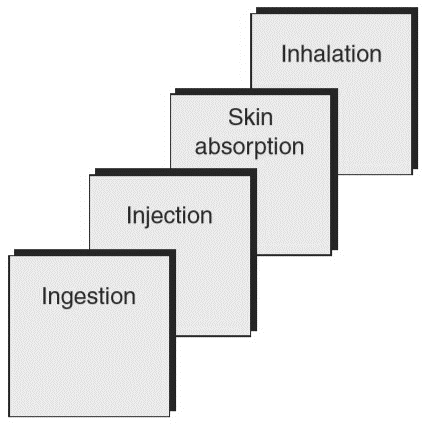
1. Entry points for Toxic Substances
c. Inhalation
e. Ingestion
| f. | |||
|---|---|---|---|
| involves | the | ||
2. Effects of Toxic Substances
The effects of toxic substances vary widely, as do the substances themselves. However, all the various effects and exposure times can be categorized as being either acute or chronic.
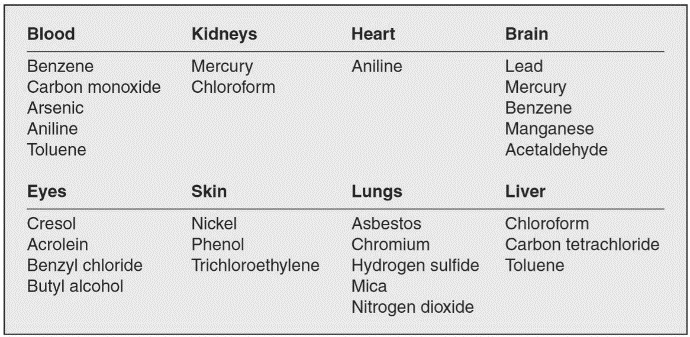
Consequently, the associated health problems develop slowly.
The characteristics of chronic effects and exposures are (1) continual exposure over time, (2) limited concentrations of toxic substances, (3) progressive accumulation of toxic substances in the body and progressive worsening of associated health problems, and (4) little or no awareness of exposures on the part of affected workers.
Section II - Hazardous ingredients: Contains the common name, chemical name, and Chemical Abstracts Service (CAS) number for the substance. The CAS number is the unique number for a given chemical that is assigned by the Chemical Abstracts Service.
Section III - Physical and chemical characteristics: Data relating to the vaporization characteristics of the substance are contained in this section.
Section VII -Safe handling and use: This section explains special handling, storage, spill, and disposal methods and precautions relating to the
substance. Section VIII -Control measures: The types of ventilation, personal protective equipment, and special hygienic practices recommended for the substance are explained in this section.3
|
|---|
hazards. Laboratory and medical personnel also can be exposed to biological hazards. Any occupations that result in contact with bodily fluids pose a risk to workers from biological hazards.
A. Legionnaire’s Disease
Airborne - coughs or sneezes release airborne pathogens, which are then inhaled by others.
Contaminated objects or food —the pathogens in a person's faeces may be spread to food or other objects, if their hands are dirty.
| — | ||
|
||
abrasions, or through the mucus membranes of the mouth and eyes.
Phys
C. Vibration hazards
Another physical hazard that can harm workers on the job is exposure to vibrations. An obvious example of this is the vibration that a jackhammer operator is e.D. Temperature hazards
Temperature–both high and low–is yet another type of physical hazard. Workers can be exposed to hazards from naturally occurring, climatic hea sample below.
|
controls: | Use |
|---|---|---|
|
||
| partial | of | the | |
|
|||
| Respirators/ | Air-supplying | ||
|
|||
| Place | |||
| employees | and |
|
|
|
|||
CONFINED SPACES
|
|
|---|---|
| 1. | |
| 2. | |
|
|
| 3. |
|
| 1. | |
| 2. | “Contains a material that has the | 5. |
|
||||
|---|---|---|---|---|---|---|---|
|
|||||||
| 3. | “Has an internal configuration such | ||||||
| 6. | |||||||
| 4. | “Contains any other recognized | ||||||
serious safety or health hazard”.
|
|||||||
| 7. | no spraying or painting using volatile | ||||||
|
|||||||
| 8. | any manhole, tank opening, or other | ||||||
| 1. | 9. | ||||||
|
|||||||
| Tunneling | operation | or | an | ||||
| 2. | underground mine (stopes, |  |
|||||
| a. |
|
||||||
|
|||||||
| b. | |||||||
| c. | |||||||
|
|||||||
| 3. | |||||||
| 4. | |||||||
and they are not primarily designed for people to occupy them. They may have structures such as ladders or platforms where workers can perform work within the space on occasion. However, these spaces were not designed for continuous human occupancy.
A chamber or vault may have cooling
ventilation for equipment purposes and have a temporary access
storage tanks, tank cars, process vessels, boilers, pressure vessels, vats, bins, silos, bag-houses and other tank like compartments usually having only a manhole for entry
open topped spaces such as pump wells, augured caissons, pits or degreasers
of fire or explosion in the confined space.
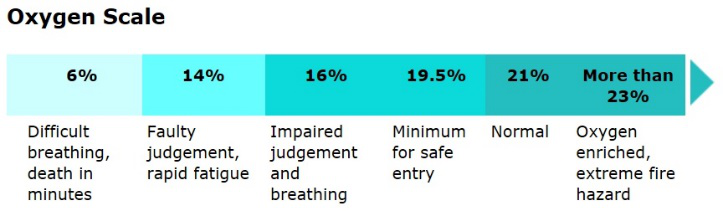
Oxygen deficiency may occur from biological or chemical reactions such as rusting, or by displacement of oxygen by other gases.
may produce Liquids
hazardous atmospheres if they evaporate — for example, liquid fuel in a tank producing vapours. Dangerous conditions
can develop when pockets of gas in waste materials are disturbed during cleaning. For example, an organic material such as manure sludge can release the toxic gas hydrogen sulfide when manure pits are cleaned out. Rotting pulp in tanks also creates hydrogen sulfide. If grains in silos ferment, they use up oxygen and produce deadly gases.ii. As a result of work done inside the confined space..
A confined space may be located next to a source of a hazardous contaminant. The contaminant could enter the confined space through porous walls, such as those that may be found in sewers or trenches, or through difficult-to-seal openings such as conduits. Normally, mechanical ventilation is set up to bring outside air into the confined space. If the intake hose is located beside a running vehicle or equipment with an internal combustion engine, the intake hose brings in exhaust fumes.
c. Explosive Atmosphere
Three elements are necessary for a fire or explosion to occur: oxygen, flammable material (fuel), and an ignition source.
NOTE: Two or more chemicals may react with each other and become explosive.
Containers of fuels such as gasoline and propane should not be taken into a confined space as fuel can easily burn or explode. Here are some other common substances that can cause explosions or fires in confined spaces:
• Acetylene gas from leaking welding equipment;
• Methane gas and hydrogen sulfide gas produced by rotting organic wastes in sewers or tanks; • Hydrogen gas produced by contact between aluminum or galvanized metals and corrosive liquids;
• Grain dusts, coal dust; and • Solvents such as acetone, ethanol, toluene, turpentine, and xylene, which may have been introduced into the space through spills or by improper use or disposal
|
|---|
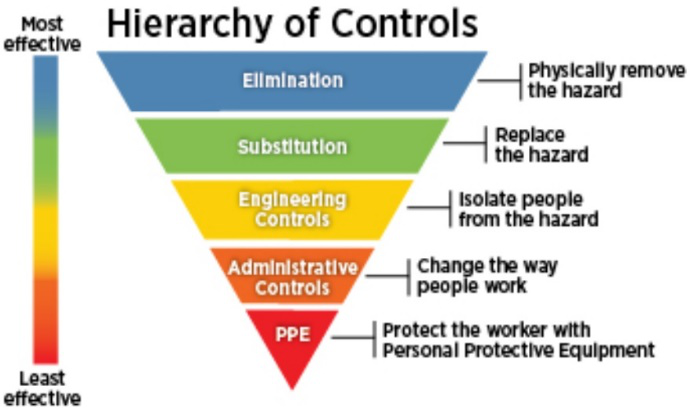
If the hazard cannot be eliminated and there is a danger of falling from a height, a fall protection system (such as guardrails or a harness and lifeline) may be needed.
Falling Objects c.
e. Electrical shock
Electrical shock can result from defective extension cords, welding cables, or other electrical equipment. Work done in metal enclosures or in wet conditions can be particularly dangerous. Install ground fault circuit interrupters (GFCIs) or use assured grounding where there may be a danger ofelectrical shock. All electrical sources that pose a hazard to workers inside the space must be locked out following the written lockout procedure for the particular confined space.
fallen face-down into a small pool of water have drowned.
|
CONFINED | SPACE |
|---|
type, classification, and level. Figures 20–22, 20–23, 20–24, 20–25, 20–26, and 20–27 are examples of devices used for checking the atmosphere.
3. Ventilate the space
Spaces containing airborne contaminants should be purged to remove them. Such areas should also be ventilated to keep contaminants from building up again while an employee is working in the space.
inside. Communication can be visual,
verbal, or electronic (radio, telephone)
| 6. | ||||
|---|---|---|---|---|
|
lose | consciousness. |
|
|
permit confined spaces annually. According
to the National Institute for
Administration reported that when
multiple deaths occur during a rescue, the
85% of the time a SUPERVISOR was
present.
15% had Confined Space TRAINING.
0% had a RESCUE PLAN.
Out of 670 confined space deaths, the most common types of hazards were atmospheric hazards and loose materials.
And out of 217 confined space deaths that were investigated, the two most common types of gases in confined spaces, hydrogen sulfide and carbon monoxide, were the causes found.
or a combination of these effects. In the human body, these effects may lead to changes in the structure or behavior of cells.
Non-ionizing Radiation
When not used properly, lasers burn and cause severe damage to tissues, especially in the eye. The narrow beam of light concentrates the effects on the retina, causing blind spots.
b. Extremely Low Frequencies
c. Radio Frequencies
AM and FM radio broadcasts, Wi-Fi signals, cell phones, amateur radio,
|
 |
|
|---|---|---|
| absorbed | ||
Microwave radiation (MW) comes from microwave ovens, radar, transmission towers, satellite transmissions, the sun and Cosmic Microwave Background (CMB) radiation. CMB is radiation left over from the Big Bang when the universe began.
There are three subcategories of MW radiation. Extremely high frequency (EHF) waves are used in remote sensors and radio astronomy. Super high frequency (SHF) waves are commonly used in mwave ovens, radar transmitters, phones and satellite communications. Finally, the ultra-high frequency (UHF) is used in television broadcasts, walkie-talkies and cordless phones. Microwaves are sometimes grouped with radio waves because these two types of non-ionizing radiation have some overlap on the electromagnetic spectrum.
The visible light portion of the electromagnetic spectrum can be seen by humans, animals and other organisms. This type of light consists of seven colors: red, orange, yellow, green, blue, indigo and violet. When all the colors are present at one time, the light is white. Rainbows are created when visible light passes through raindrops. The raindrops act like a prism and break the light down into its individual colors. Overexposure tsible light can damage both the and skin.
g. Ultraviolet