

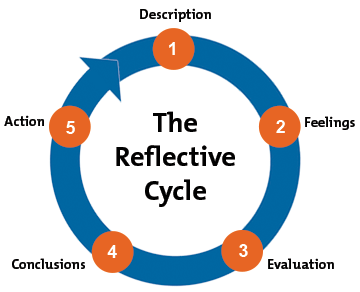
The six stages involved the gibbs reflective cycle are description
Running head: GIBB’S REFLECTIVE CYCLE
GIBB’S REFLECTIVE CYCLE
Cope, J., & Watts, G. (2010). Learning by doing-an exploration of experience, critical incidents and reflection in entrepreneural learning. International Journal of Entrepreneural Behavior and Research, 6(3), 104-124.
Step three: Evaluation
One positive thing that have remained to me on my mind since that time even before the scenario was that I was not only helping the old lady to shower but I was also playing a critical part in making her comfortable and feel like she was at her home. I had a thinking that the lady at her older age deserved to remain to be happy and thus her being mistreated would make her develop a bad attitude towards health services. All the pessimism I had originated from my registered nurse as she questioned me with an assumption that I had abandoned the ward duties for my unprofessional objectives. In this situation therefore, the social bondage was therefore acquired successfully and I had a belief that in future, the Greece lady would always prefer me to attend to her in case she would want to be cleaned. I also came to realize that my only problem was the timing as it went way longer that I should have done. The patient being unable to speak a common dialect as mine was not her problem and thus she was not to be blame [CITATION Qui10 \l 2057 ].Step Four: Analysis
In this situation, there are several factors that were involved. The first factor is patient nurse relationship which in this case emerges too be the best factor for ensuring that patients are satisfied with the services offered at the facility. Another factor in this case is time, as it comes out in this scenario, it is evident that time is important as far as patient services are concerned.GIBB’S REFLECTIVE CYCLE
6
therefore, every nursing facilities should not just always concentrate on offering services but also should consider creating social connections with their patients, as this possibly makes the patients comfortable with their services. And also, these facilities should always identify emerging issues from their patients and teach their nurses appropriately on how to handle the issues. Hence there should be successive clinical teaching programs to inform the workers of any emerging issues.Gaberson, K., & Oermann, M. (2010). Clinical teaching strategies in nursing. Springer publishing company.
Huseb, S. E., Dieckmann, P., Rystedt, H., Soreide, E., & Friberg, F. (2013). The relationship between facilitators' questions and the level of reflection in postsimulation debriefing. Simulation in Healthcare, 8(3), 135-142.