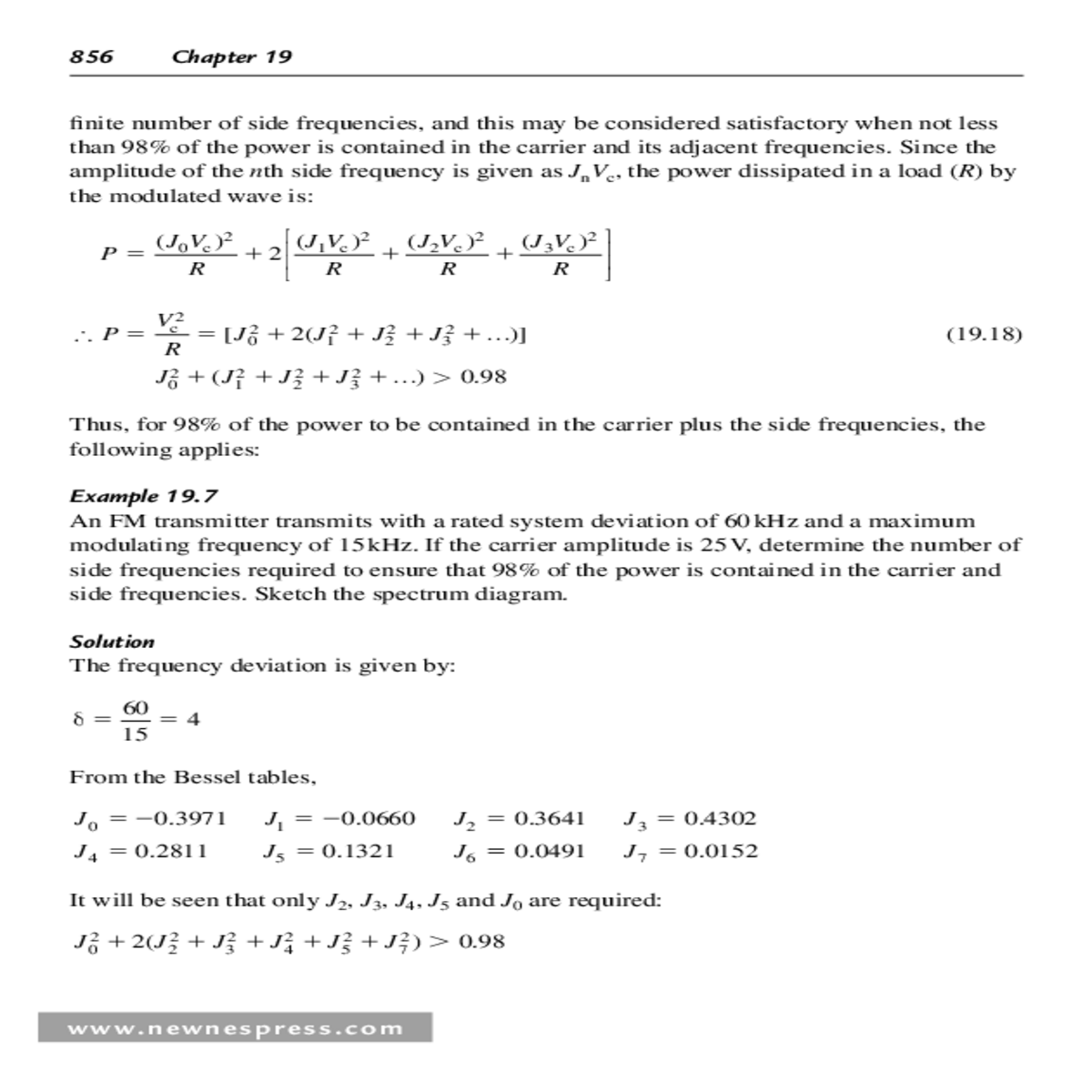
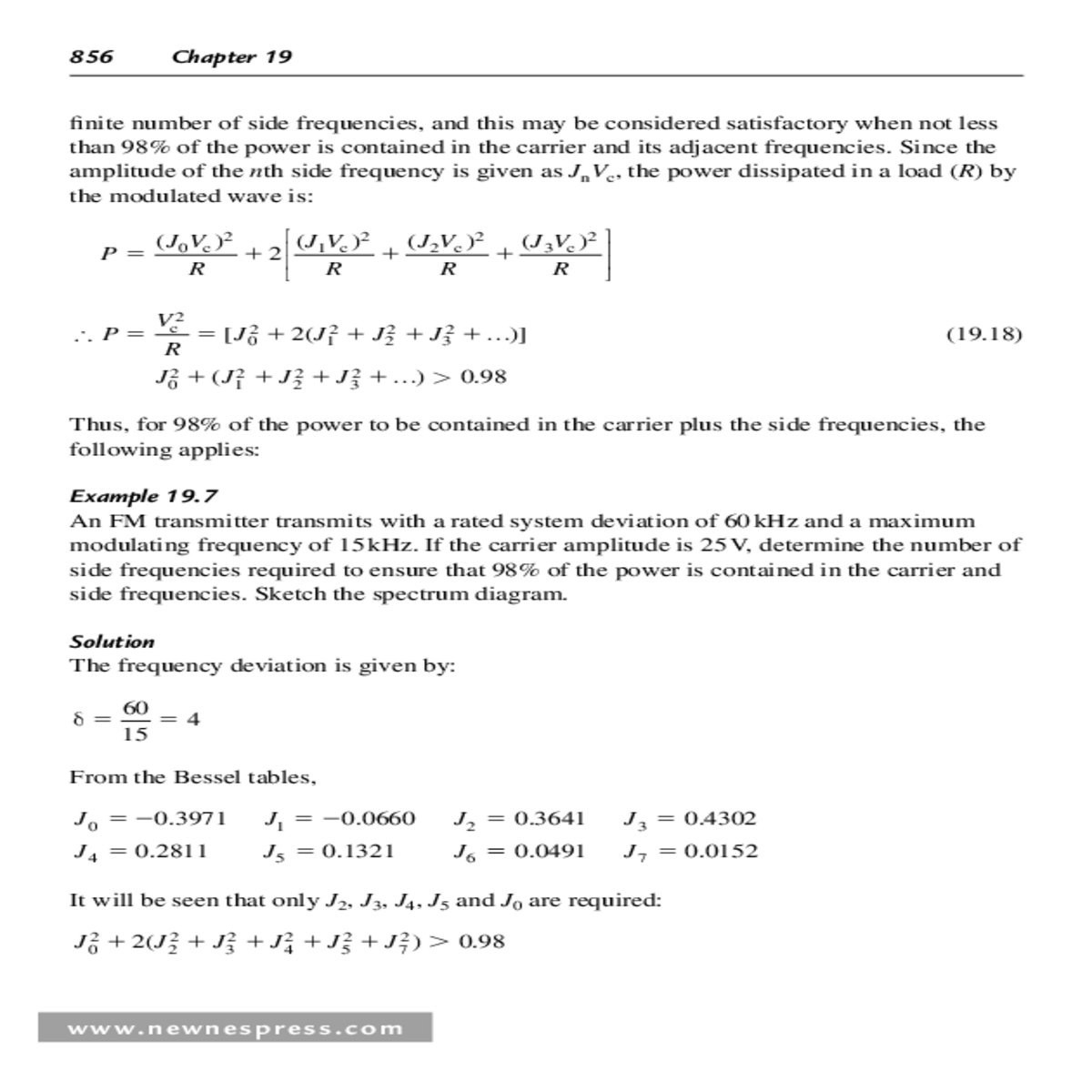
The power dissipated load the modulated wave thus
|
|
|---|
| P | � | ( | ) | � | 2 | ⎡ ⎢⎢⎣ |
( | ) 2 | � | ( |
|
) | 2 | � | ( |
|
) 2 | |||||||||||||||||
|---|---|---|---|---|---|---|---|---|---|---|---|---|---|---|---|---|---|---|---|---|---|---|---|---|---|---|---|---|---|---|---|---|---|---|
| ∴ | R | R | R | R | (19.18) | |||||||||||||||||||||||||||||
| P | � | V c 2 | � | [ | J | 2 0 | � | 2 ( | J 1 2 | � | J | 2 2 | � | J | 2 3 | � | …)] | |||||||||||||||||
| R | ||||||||||||||||||||||||||||||||||
| J | 2 0 | � | ( | J 1 2 | � | J | 2 2 | � | J | 2 3 | � | … > | ||||||||||||||||||||||
Example 19.7
An FM transmitter transmits with a rated system deviation of 60 kHz and a maximum modulating frequency of 15 kHz. If the carrier amplitude is 25 V, determine the number of side frequencies required to ensure that 98% of the power is contained in the carrier and side frequencies. Sketch the spectrum diagram.Solution
The frequency deviation is given by:
| δ � |
|---|
| J | 0 | J 1 |
|
J | 2 | � |
|
J | 3 | � | |||||
|---|---|---|---|---|---|---|---|---|---|---|---|---|---|---|---|
| J | 4 | � | J | 5 | � | J | 6 | � | J | 7 | � |
|
|||
It will be seen that only J2 , J3 , J4 , J5 and J0 are required:
| J | 2 0 | � | 2 ( | J | 2 2 | � | J | 2 3 | � | J | 2 4 | � | J | 2 5 | � | J | 2 7 | ) | � |
|---|
| www.newnespress.com |
|---|
| Communications Systems |
|---|
| J1 | 0.3641 |
|
|
|---|---|---|---|
|
|||
| J5 | |||
–0.0660
J0
–0.3971
| BW � | ( 6 | � | 15 2 | � |
|
|---|
This is a considerable saving in bandwidth and hence a reduction in noise in the modulator circuits.
| www.newnespress.com |
|---|