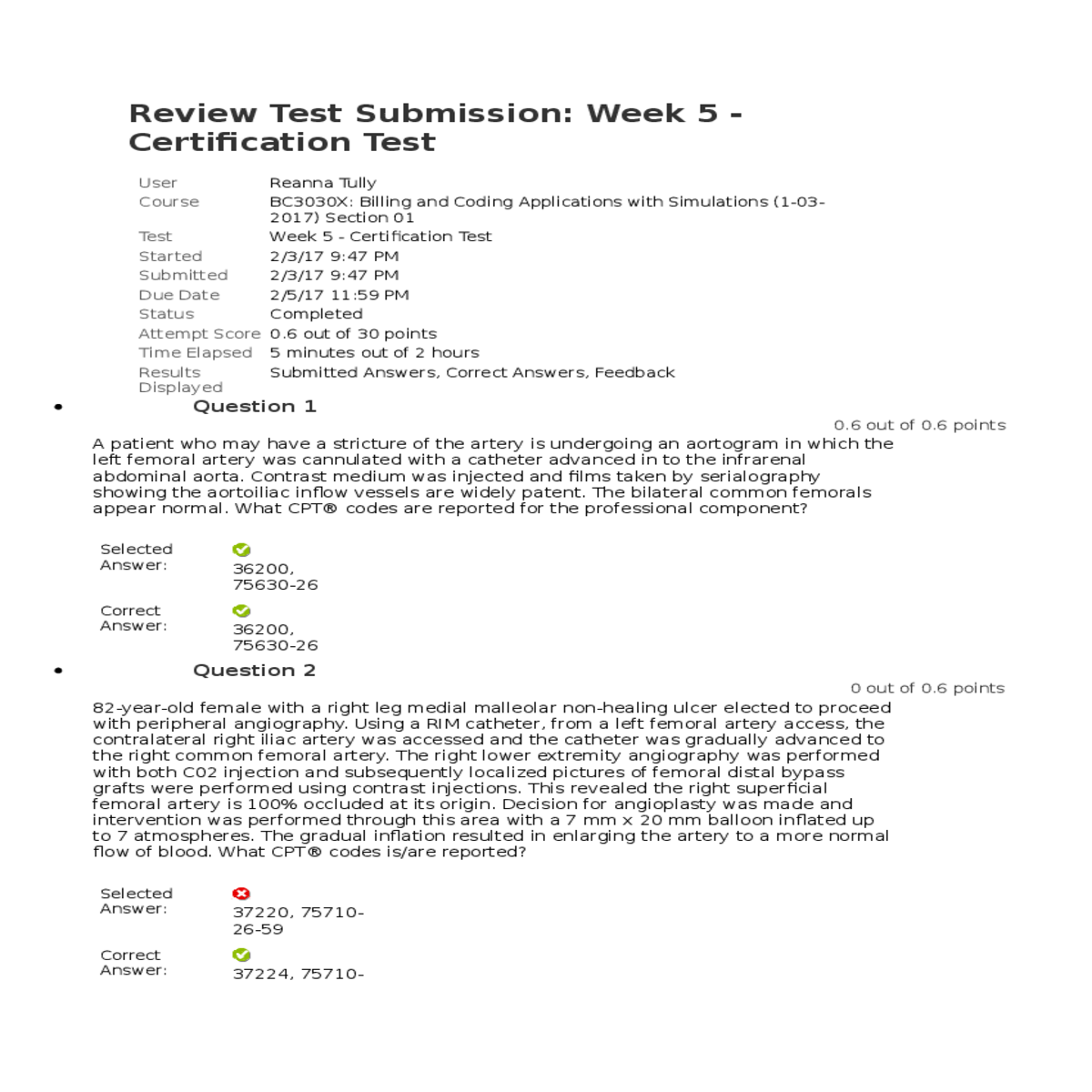
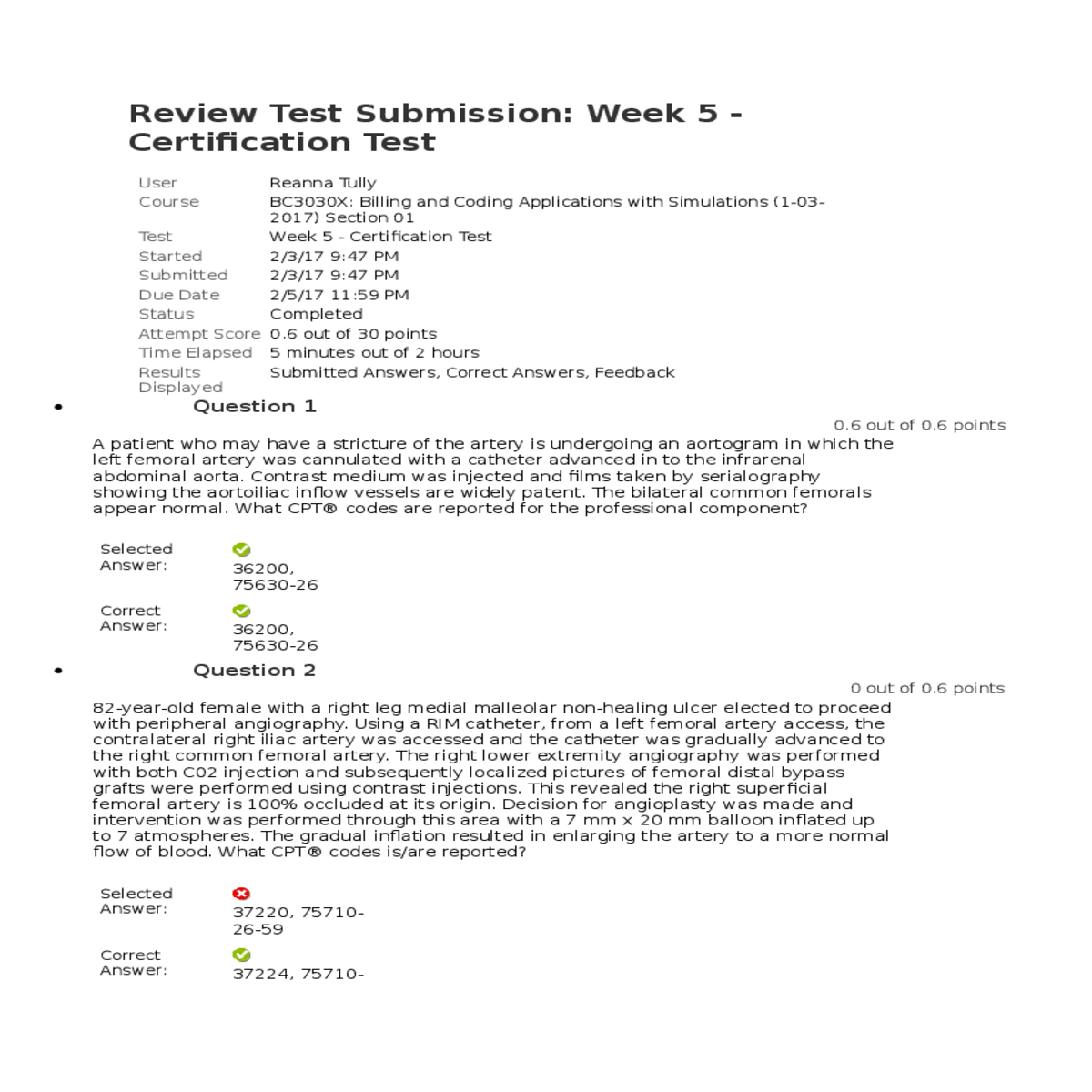
Review Test Submission: Week 5 - Certification
Test
Submitted 2/3/17 9:47 PM
Due Date 2/5/17 11:59 PM
|
|
interventional angioplasty, code 37224. The diagnostic angiography
is
|
|
|
Artery/Intraoperative direction you to 37224. Look for
Angiography/Leg Artery
|
|
| Answer: |
Given]
|
| Answer: |
|
Feedback:
|
body is found. In the CPT® Index, look for X-ray/Nose to
Rectum/Foreign
|
|
| Answer: |
Given]
|
| Answer: |
|
Feedback
|
Points are given (0, 1 or 2) in five areas (fetal movement, tone,
heart rate,
|
|
code 59025 Fetal non-stress test, should not be reported separately.
This is
|
|
| 0 out of 0.6 points |
| Answer: |
| Correct |
|
|
|
Feedback
|
|
|
appended to indicate the professional service.
|
| 0 out of 0.6 points |
?
REVIEW OF SYSTEMS: Positive for orthopnea and one
episode of PND. Negative for flank pain, obstructive symptoms or
documented exposure to nephrotoxins.
LABS: BUN 56, creatinine 2.1, K 5.2, HGB 12.
?
IMPRESSION:
Severe exacerbation of CHF
Poorly controlled HTN
Worsening ARF due to cardio-renal syndrome
?
What CPT? code should be reported?
| Answer: |
|
| Answer: |
99233
|
|
|
|
|
complications). According to the documentation guidelines for E/M
services,
|
|
|
| 0 out of 0.6 points |
75-year-old established patient sees his regular primary care
provider for a physical screening prior to joining a group home. He has
no new complaints. The patient has an established diagnosis of Cerebral
Palsy and Type II Diabetes and is currently on his meds.
A comprehensive history and examination is performed. The provider
counsels the patient on the importance of taking his medication and
gives him a prescription for refills. Blood work was ordered. PPD was
done and flu vaccine given. Patient already had had a vision exam. No
abnormal historical facts or finding are noted. What CPT® code is
reported?
|
not have any complaints and the doctor did not identify any new
problems. In
|
|
|
Mr. Trumph loses his yacht in a poker game and experiences a sudden
onset of chest pain which radiates down his left arm. The paramedics are
called to the casino he owns in Atlantic City to stabilize him and
transport him to the hospital. Dr. H. Art is in the ER to direct the
activities of the paramedics. He spends 30 minutes in two-way
communication directing the care of Mr. Trumph. When EMS reached the
hospital Emergency
Department, Mr. Trumph is in full arrest with torsades de pointes
(ventricular
tachycardia). Dr. H. Art spends another hour stabilizing the patient and
performing CPR. The time the provider spent on CPR was 15 minutes. What
are the appropriate procedure codes for this encounter?
60-year-old woman is seeking help to quit smoking. She makes an
appointment to see Dr.
Lung for an initial visit. The patient has a constant cough due to
smoking and some shortness of breath. No night sweats, weight loss,
night fever, CP, headache, or dizziness. She has tried patches and
nicotine gum, which has not helped. Patient has been smoking for 40
years and smokes 2 packs per day. She has a family history of emphysema.
A limited three system exam was performed. Dr Lung discussed in detail
the pros and cons of medications used to quit smoking. Counseling and
education was done for 20 minutes of the 30 minute visit. Prescriptions
for Chantrix and Tetracylcine were given. The patient to follow up in 1
month. A chest X-ray and cardiac work up was ordered. Select the
appropriate CPT code(s) for this visit.
| Answer: |
|
| Answer: |
99203
|
|
|
|
|
Question 16
|
32 year old patient sees Dr. Smith for a consult at the request of
his PCP, Dr. Long, for an ongoing problem with allergies. The patient
has failed Claritin and Alavert and feels his symptoms continue to
worsen. Dr. Smith performs an expanded problem focused history and exam
and discusses options with the patient on allergy management. The MDM is
straightforward. The patient agrees he would like to be tested to
possibly gain better control of his allergies. Dr. Smith sends a report
to Dr. Long thanking him for the referral and includes the date the
patient is scheduled for allergy testing. Dr. Smith also includes his
findings from the encounter. What E/M code is reported?
28-year-old female patient is returning to her physician’s office
with complaints of RLQ pain and heartburn with a temperature of 100.2.
The physician performs a detailed history, detailed exam and determines
the patient has mild appendicitis. The physician prescribes antibiotics
to treat the appendicitis in hopes of avoiding an appendectomy. What are
the correct CPT® and ICD-10-CM codes for this encounter?
The PCP transferred the patient to the cardiologist to manage/treat
the congestive heart failure. The cardiologist accepted the transfer of
care of the patient and sent a letter to the PCP with findings of the
first visit and stress test. This would be coded as a new patient since
the cardiologist accepted the patient and is taking over the care of a
specific problem.
|
| Answer: |
Given]
|
| Answer: |
|
Feedback:
|
(pectoris) (syndrome) (vasomotor)/with/documented spasm I20.1.
|
|
| 0 out of 0.6 points |
70-year-old patient with chronic obstructive asthma is brought to the
urgent care center with increased wheezing and coughing. The physician
initiated an Albuterol inhalation treatment, one dose, delivered by
nebulizer. After treatment, the patient’s exacerbation was somewhat
improved but the physician determined a second treatment was necessary.
What codes are reported?
2, J44.1
| Answer: |
| Correct |
|
|
Feedback
|
Biofeedback training is not reported since it was not performed; it
is
|
|
for Incontinence/feces directing you to R15.9. Verification in the
Tabular List
|
|
Feedback
|
|
|
CM Index to Diseases and Injuries, look for Fitting (and
adjustment)
|
|
|
| 0 out of 0.6 points |
55-year-old male has had several episodes of tightness in the chest.
His physician ordered a PTCA (percutaneous transluminal coronary
angioplasty) of the left anterior descending coronary artery. The
procedure revealed atherosclerosis in the native vessel.
64-year-old patient came to the emergency department complaining of
chest pressure. The physician evaluated the patient and ordered a 12
lead EKG. Findings included signs of acute cardiac damage. Appropriate
initial management was continued by the ED physician who contacted the
cardiologist on call in the hospital. Admission to the cardiac unit was
ordered. No beds were available in the cardiac unit and the patient was
held in the ED. The cardiologist left the ED after completing the
evaluation of the patient. Several hours passed and the patient was
still in the ED. During an 80-minute period, the patient experienced
acute breathing difficulty, increased chest pain, arrhythmias, and
cardiac arrest. The patient was managed by the ED physician during this
80-minute period. Included in the physician management were a new 12
lead EKG, endotracheal intubation and efforts to restore the patient’s
breathing and circulation for 20 minutes. CPR was unsuccessful, the
patient was pronounced dead after a total of 44 minutes critical care
time, exclusive of other separately billable services. What CPT® codes
are reported by the physician?
| Answer: |
|
| Answer: |
|
Response
|
|
|
critical care, although the second part did meet critical care. In
the CPT®
|
|
|
Question 26
|
49 year old patient had several episodes of esophageal reflux and
underwent a gastroesophageal reflux test to measure the pH balance (a
measure of the degree of acidity or alkalinity). The test was performed
with a mucosal attached capsule. The physician provided an
interpretation and report. The physician stated the diagnosis as
gastroesophageal reflux. What CPT® and ICD-10-CM codes are reported?
| Answer: |
|
| Answer: |
|
| Respons |
In the CPT® Index, look for Electromyography/Needle/Extremities and
you are
|
|
|
is also known as Lou Gehrig’s disease. In the ICD-10-CM Index to
Diseases
|
|
| 0 out of 0.6 points |
A teenager has been chronically depressed since the separation of her
parents 1 year ago and included moving to a new city. Her school grades
continued to slip and she has not made new friends. She has frequent
crying episodes and is no longer interested in
| Answer: |
Given]
|
| Answer: |
|
|
|
|
|
Question 31
|
| Answer: |
|
| Answer: |
|
Feedback:
|
|
|
| Answer: |
|
| Answer: |
|
|
|
therefore, the appropriate modifier to report is AD for the
anesthesiologist.
|
|
Feedback
|
|
|
in the base value assigned. Anesthesia time ends when the
anesthesiologist
|
|
|
circumstances units (Base 3 + QC 2 = 5 units). Five (5) time units,
in fifteen
|
|
|
| 0 out of 0.6 points |
Using your CPT® Index, look up anesthesia for an appendectomy. What
CPT® code is reported for the anesthesia?
0 out of 0.6 points
| Answer: |
| Correct |
|
|
|
inappropriate with a urine test. In the CPT® Index, see Pregnancy
|
|
What CPT® and ICD-10-CM codes are reported?
| Answer: |
| Correct |
Response
|
N60.32
|
|
|
Laboratory/Surgical Pathology/Gross and Micro Exam/Level IV; also
look for
|
|
|
shows that a fifth character is needed to indicate laterality, report
2 for the
|
|