Language:EN
Pages: 20
Rating : ⭐⭐⭐⭐⭐
Price: $10.99
Page 1 Preview
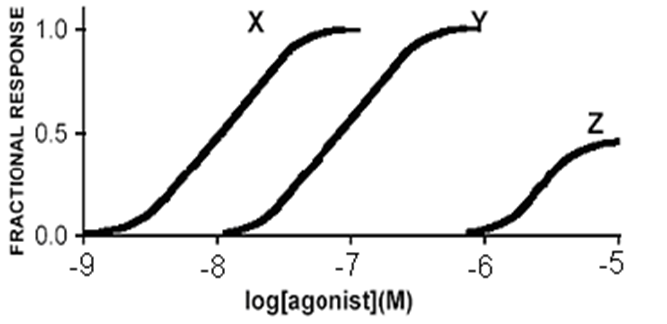
the occupancy theory receptor theory drug action

The occupancy theory receptor theory drug action

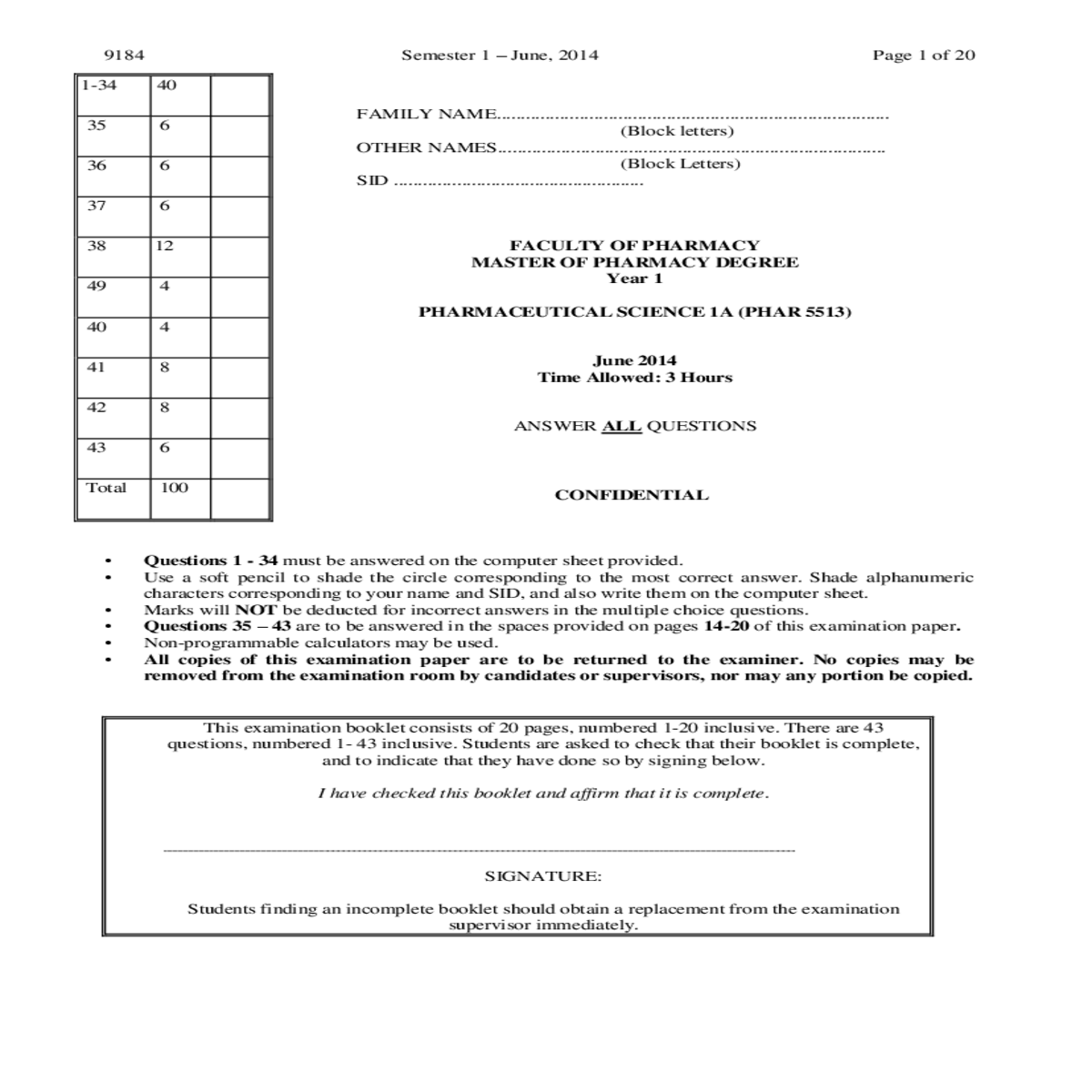
This examination booklet consists of 20 pages, numbered 1-20 inclusive. There are 43 questions, numbered 1- 43 inclusive. Students are asked to check that their booklet is complete, and to indicate that they have done so by signing below.

Q6.

Semester 1 – June, 2014 Page 3 of 20

Which of the following criteria is the most important to be met for a drug to be considered a lead compound:

E.

understanding of the biochemistry of the disease state
optimising the pharmacokinetic and pharmacodynamic properties of drug candidates evaluation of the screened compounds.

the maximum strength of the effect of the drug .

the amount of drug required for a specific effect to occur.

A.
B.
C.

D.
E.

answers B and C are correct.

Q11. The occupancy theory of receptor theory of drug action:

the maximum amount of binding.

the measurement of free and bound ligand concentrations. the equilibrium dissociation constant.

Q13. The characteristics of a standard combinatorial chemistry library are

A.
B.
C.
D.
E.

Labile under most reaction conditions.

Reacts slowly with starting material.

Q16. The following is an important resin used in combinatorial chemistry.

O NH2

Purifying a lead compound.

Optimising a lead compound.

*** ROUGH WORK SPACE ***

9184

Semester 1 – June, 2014 Page 8 of 20
Semester 1 – June, 2014 Page 9 of 20

Q23. Which of the following statements are CORRECT?

Q24. Gs

Semester 1 – June, 2014 Page 10 of 20

Q26. LogP:

is equal to the log of the octanol-water partition coefficient of a pure compound is equal to the log of the sum of the π values.

Q27. Comparative Molecular Field Analysis (CoMFA) and Comparative Molecular Similarity Indices (CoMSIA):

Q29. Which one of the following Michaelis-Menten plots represents active site noncompetitive

reversible enzyme inhibition?

D. Plot 4

E. None of the above

Q31. Enzymes catalyse reactions by:

A.
B.
C.
D.
E.

A.
B.
C.
D.
E.

inhibitory ligand gated ion channels
exitatory ligand gated ion channels
G-protein coupled receptors that mediate their effect through Gi/o
G-protein coupled receptors that signal through Gq/11
linked to different G-proteins depending on which cell they are located in

9184 Semester 1 – June, 2014 Page 13 of 20

(6 marks)

A. What are these specific stages?

9184 Semester 1 – June, 2014 Page 15 of 20
9184 Semester 1 – June, 2014 Page 16 of 20

9184 Semester 1 – June, 2014 Page 18 of 20

Q40. Outline a common procedure for assessment of the predictive power of a QSAR model. (4 marks)

Q41. The kinetics of the enzyme E as a function of substrate concentration is presented using

A. Find Vmax (apparent) of inhibitor A. (2 marks)

Semester 1 – June, 2014 Page 20 of 20

X-Ray
Crystallography

Homology Modeling

***** THIS IS THE END OF THE QUESTIONS *****

You are viewing 1/3rd of the document.Purchase the document to get full access instantly

Immediately available after payment
Both online and downloadable
No strings attached
How It Works
Login account
Login Your Account
Place in cart
Add to Cart
send in the money
Make payment
Document download
Download File
img

Uploaded by : Peter Cox

PageId: DOC583E46E