Language:EN
Pages: 9
Rating : ⭐⭐⭐⭐⭐
Price: $10.99
Page 1 Preview
the cyclic nucleotides camp and cgmp

The cyclic nucleotides camp and cgmp

34

CHAPTER 34 Drugs Used in Disorders of Coagulation 609
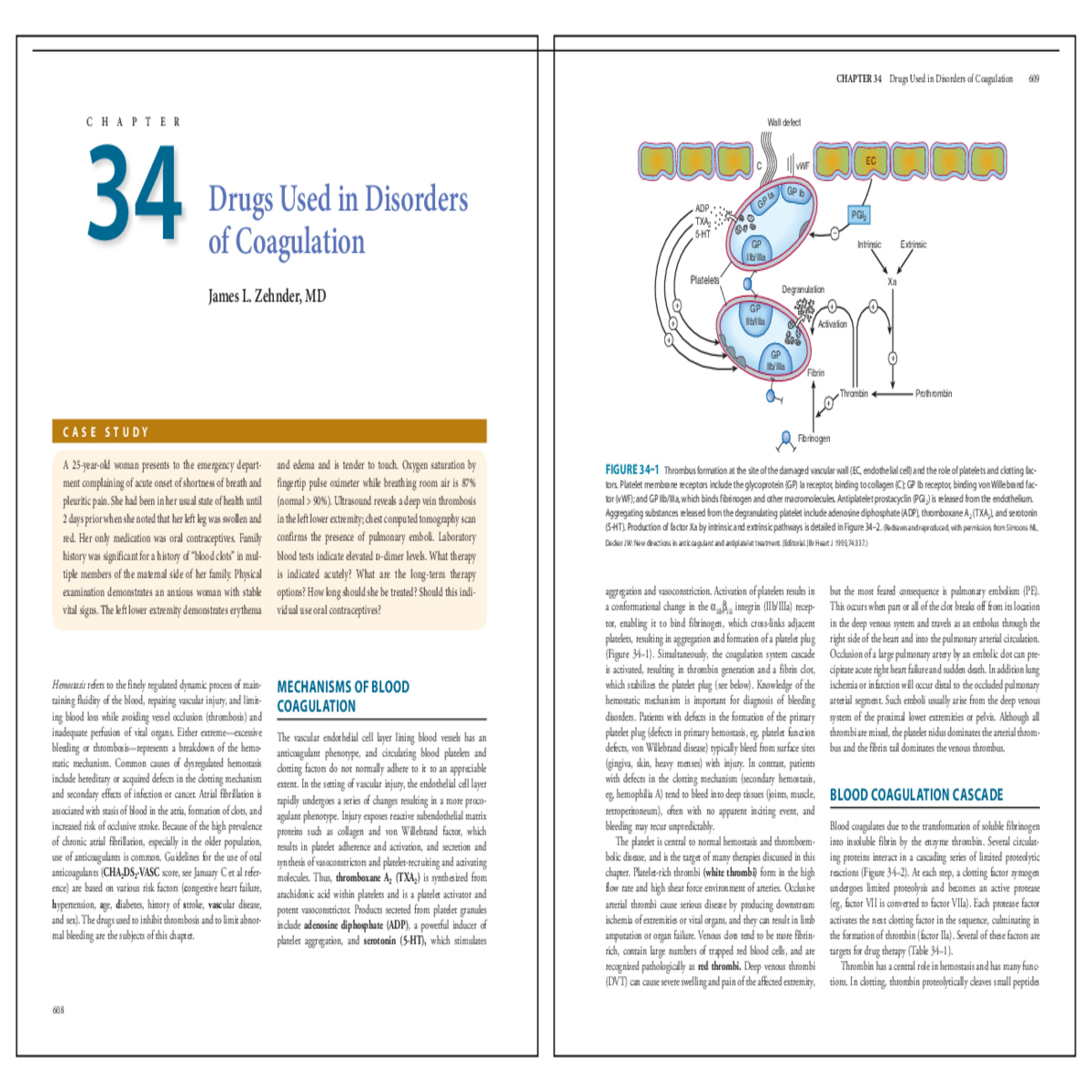
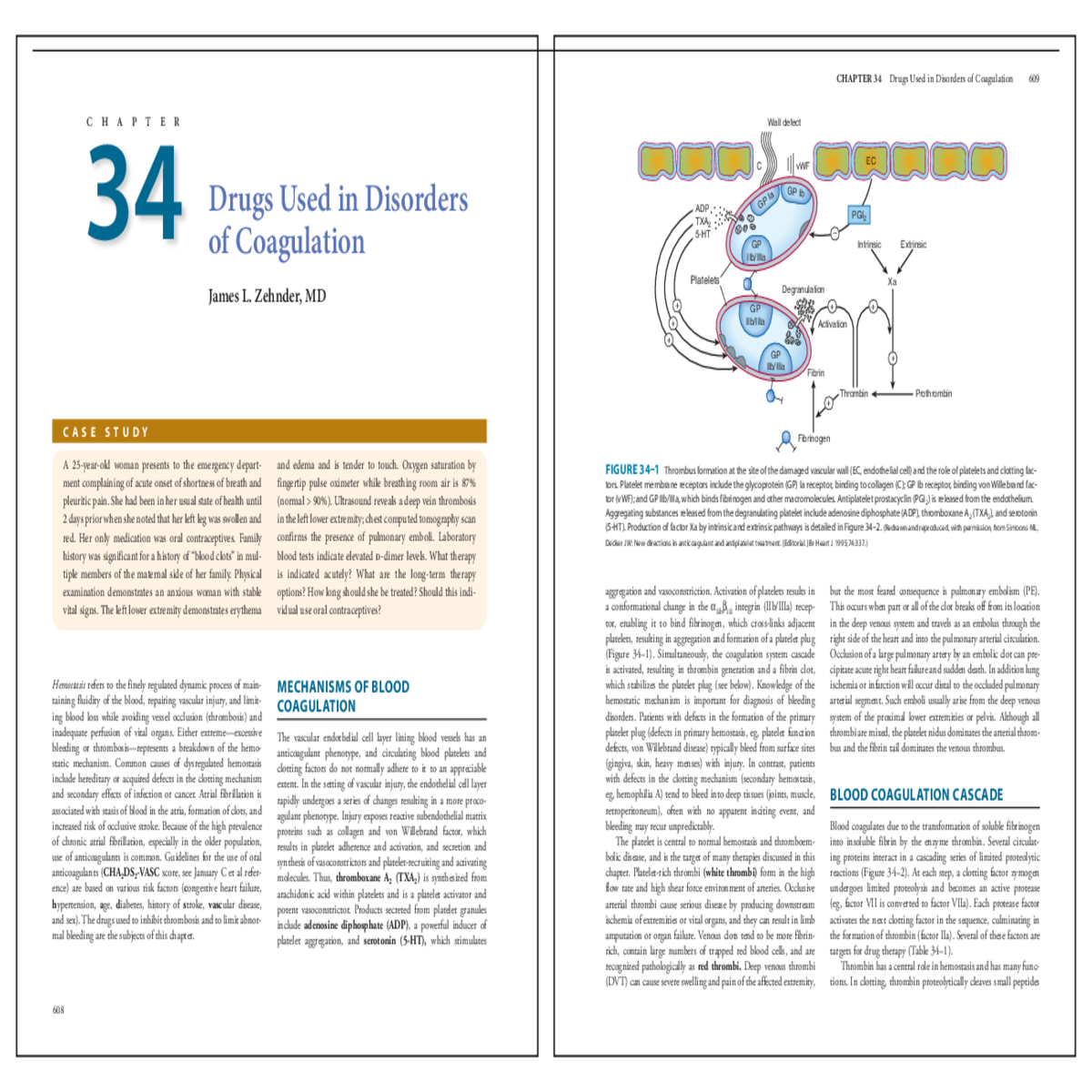
Wall defect
C vWF
5-HT

GP Intrinsic

Extrinsic

IIb/IIIa
Platelets Degranulation Xa
GP
IIb/IIIa

Activation

GP Fibrin +
IIb/IIIa
Thrombin

Prothrombin

and edema and is tender to touch. Oxygen saturation by

ment complaining of acute onset of shortness of breath and

fingertip pulse oximeter while breathing room air is 87%
(normal > 90%). Ultrasound reveals a deep vein thrombosis
in the left lower extremity; chest computed tomography scan
confirms the presence of pulmonary emboli. Laboratory

blood tests indicate elevated d-dimer levels. What therapy

aggregation and vasoconstriction. Activation of platelets results in

is indicated acutely? What are the long-term therapy
options? How long should she be treated? Should this indi-
vidual use oral contraceptives?

a conformational change in the αIIbβIII integrin (IIb/IIIa) recep-

This occurs when part or all of the clot breaks off from its location

Hemostasis refers to the finely regulated dynamic process of main-taining fluidity of the blood, repairing vascular injury, and limit-ing blood loss while avoiding vessel occlusion (thrombosis) and

MECHANISMS OF BLOOD
COAGULATION

(Figure 34–1). Simultaneously, the coagulation system cascade

Occlusion of a large pulmonary artery by an embolic clot can pre-

hemostatic mechanism is important for diagnosis of bleeding

arterial segment. Such emboli usually arise from the deep venous

inadequate perfusion of vital organs. Either extreme—excessive bleeding or thrombosis—represents a breakdown of the hemo-static mechanism. Common causes of dysregulated hemostasis include hereditary or acquired defects in the clotting mechanism and secondary effects of infection or cancer. Atrial fibrillation is associated with stasis of blood in the atria, formation of clots, and increased risk of occlusive stroke. Because of the high prevalence of chronic atrial fibrillation, especially in the older population, use of anticoagulants is common. Guidelines for the use of oral anticoagulants (CHA2DS2-VASC score, see January C et al refer-ence) are based on various risk factors (congestive heart failure, hypertension, age, diabetes, history of stroke, vascular disease, and sex). The drugs used to inhibit thrombosis and to limit abnor-mal bleeding are the subjects of this chapter. The vascular endothelial cell layer lining blood vessels has an anticoagulant phenotype, and circulating blood platelets and clotting factors do not normally adhere to it to an appreciable extent. In the setting of vascular injury, the endothelial cell layer rapidly undergoes a series of changes resulting in a more proco-agulant phenotype. Injury exposes reactive subendothelial matrix proteins such as collagen and von Willebrand factor, which results in platelet adherence and activation, and secretion and synthesis of vasoconstrictors and platelet-recruiting and activating molecules. Thus, thromboxane A2 (TXA2) is synthesized from arachidonic acid within platelets and is a platelet activator and potent vasoconstrictor. Products secreted from platelet granules include adenosine diphosphate (ADP), a powerful inducer of platelet aggregation, and serotonin (5-HT), which stimulates
thrombi are mixed, the platelet nidus dominates the arterial throm-

bus and the fibrin tail dominates the venous thrombus.

(gingiva, skin, heavy menses) with injury. In contrast, patients
with defects in the clotting mechanism (secondary hemostasis,

Blood coagulates due to the transformation of soluble fibrinogen

The platelet is central to normal hemostasis and thromboem- into insoluble fibrin by the enzyme thrombin. Several circulat-

bolic disease, and is the target of many therapies discussed in this

undergoes limited proteolysis and becomes an active protease

arterial thrombi cause serious disease by producing downstream

the formation of thrombin (factor IIa). Several of these factors are

rich, contain large numbers of trapped red blood cells, and are

tions. In clotting, thrombin proteolytically cleaves small peptides

608

composed of d-glucosamine-l-iduronic acid and d-glucosamine-d-glucuronic acid. High-molecular-weight fractions of heparin with high affinity for antithrombin markedly inhibit blood coagulation by inhibiting all three factors, especially thrombin and factor Xa. Unfractionated heparin has a molecular weight range of 5000–30,000 Da. In contrast, the shorter-chain, low-molecular-weight fractions of heparin inhibit activated factor X but have less effect on thrombin than the HMW species. Nevertheless, numerous studies have demonstrated that LMW heparins such as enoxaparin, dalteparin, and tinzaparin are effective in several thromboembolic conditions. In fact, these LMW heparins—in

comparison with UFH—have equal efficacy, increased bioavail-

ing equimolar stable complexes with them. In the absence of

Antithrombin III
(inactive)

Thrombin

of Xa.

The following points should be considered in all patients receiving heparin: Platelet counts should be performed frequently; thrombocytopenia appearing in a time frame consistent with an immune response to heparin should be considered suspicious for HIT; and any new thrombus occurring in a patient receiving hep-arin therapy should raise suspicion of HIT. Patients who develop HIT are treated by discontinuance of heparin and administration of the direct thrombin inhibitor argatroban.

the therapeutic range by protamine titration or anti-Xa activity, as listed above.

Reversal of Heparin Action

Excessive anticoagulant action of heparin is treated by discon-tinuance of the drug. If bleeding occurs, administration of a specific antagonist such as protamine sulfate is indicated. Prot-amine is a highly basic, positively charged peptide that combines with negatively charged heparin as an ion pair to form a stable complex devoid of anticoagulant activity. For every 100 units of heparin remaining in the patient, 1 mg of protamine sulfate is given intravenously; the rate of infusion should not exceed 50 mg in any 10-minute period. Excess protamine must be avoided; it also has an anticoagulant effect. Neutralization of LMW heparin by protamine is incomplete. Limited experience suggests that 1 mg of protamine sulfate may be used to partially neutralize 1 mg of enoxaparin. Protamine will not reverse the activity of fondaparinux. Excess danaparoid can be removed by plasmapheresis.

CH2 CO
OH OH

ONa

C H

CH2
O O
O
Dicumarol

Warfarin sodium

O

COO– CO2 Carboxylase –OOC
CH2
CH

The therapeutic range for oral anticoagulant therapy is defined

CH2 CH2

in terms of an international normalized ratio (INR). The INR

Descarboxy-
prothrombin

the specific reagents and instruments used for the determination.

The ISI serves to relate measured prothrombin times to a World

Edoxaban is a once-daily Xa inhibitor with a 62% oral bio-availability. Peak drug concentrations occur 1–2 hours after dosage and are not affected by food. The drug half-life is 10–14 hours. Edoxaban does not induce CYP450 enzymes. No dose reduc-tion is required with concurrent use of P-glycoprotein inhibitors. Edoxaban is primarily excreted unchanged in the urine.

Administration & Dosage

Assessment of and Reversal of Anti-Xa Drug Effect

Measurement of anti-Xa drug effect is not needed in most situa-tions but can be accomplished by anti-Xa assays calibrated for the drug in question. Andexanet alfa is a factor Xa “decoy” molecule without procoagulant activity that competes for binding to anti-Xa drugs. In clinical trials involving apixaban and rivaroxaban, andexanet given by IV infusion resulted in rapid decrease in anti-Xa effect. Non-neutralizing antibodies occurred in 17% of those treated; the effect of these antibodies with drug re-exposure is not known. Based on the available data, andexanet is likely to be the first antidote approved for use in patients treated with anti-Xa agents who require rapid reversal for surgery or uncontrolled bleeding.

CHAPTER 34 Drugs Used in Disorders of Coagulation 619

cardial infarction to acute coronary occlusion by a thrombus

PCI is not readily available.

created the rationale for thrombolytic therapy of this com-

The proper selection of patients for thrombolytic therapy
clinically and is confirmed by electrocardiography. Patients with
ST-segment elevation and bundle branch block on electrocardi-

was found to reduce mortality. Later studies, with thousands

ography have the best outcomes. All trials to date show the great-

of patients in each trial, provided enough statistical power

est benefit for thrombolytic therapy when it is given early, within
Thrombolytic drugs reduce the mortality of acute myocardial
infarction. The early and appropriate use of any thrombolytic drug

intervention (PCI) now favors catheterization and placement

probably transcends possible advantages of a particular drug.

effects. However, the absence of inhibitors for urokinase and the

also been approved for use in acute ischemic stroke within 3 hours

from plasma antiplasmins; this allows it to lyse the thrombus from

other contraindications, this therapy has been demonstrated to
Plasminogen can also be activated endogenously by tissue

recommended dose is 0.9 mg/kg, not to exceed 90 mg, with 10%

activate plasminogen that is bound to fibrin, which (in theory)

confines fibrinolysis to the formed thrombus and avoids sys- Streptokinase has been associated with increased bleeding risk in

and its use is not recommended in this setting.

from which several amino acid sequences have been deleted.

Administration of fibrinolytic drugs by the intravenous route is indicated in cases of pulmonary embolism with hemodynamic instability, severe deep venous thrombosis such as the superior vena caval syndrome, and ascending thrombophlebitis of the iliofemoral vein with severe lower extremity edema. These drugs are also given intra-arterially, especially for peripheral vascular disease.

Thrombolytic therapy in the management of acute myocardial infarction requires careful patient selection, the use of a specific thrombolytic agent, and the benefit of adjuvant therapy. Strepto-kinase is administered by intravenous infusion of a loading dose of 250,000 units, followed by 100,000 units/h for 24–72 hours. Patients with antistreptococcal antibodies can develop fever, allergic reactions, and therapeutic resistance. Urokinase requires a loading dose of 300,000 units given over 10 minutes and a

omeprazole, should be used with caution.

THIENOPYRIDINES: TICLOPIDINE, CLOPIDOGREL, & PRASUGREL

Ticagrelor is a newer type of ADP inhibitor (cyclopentyl triazo-lopyrimidine) and is also approved for oral use in combination with aspirin in patients with acute coronary syndromes. Cangrelor is a parenteral P2Y12 inhibitor approved for IV use in coronary interven-tions in patients without previous ADP P2Y12 inhibitor therapy.

ticlopidine. The dosage of ticlopidine is 250 mg twice daily orally.

Sources & Preparations

mended whenever possible for factor replacement. The best use of these therapeutic materials requires diagnostic specificity of the deficient factor and quantitation of its activity in plasma. Recently,

several longer-acting factor VIII and IX preparations have been

TABLE 34–3 Therapeutic products for the treatment of coagulation disorders.1

IX concentrates)

1 day

VII

Factor VII deficiency

4–6 hours
Hemophilia A 30–50%

12 hours

Recombinant factor VIII products

100% for major
bleeding or trauma

X

Stuart-Prower defect

Type I patients respond to DDAVP
Cryoprecipitate

2Cryoprecipitate should be used to treat bleeding in the setting of factor VIII defciency and von Willebrand disease only in an emergency in which pathogen-inactivated products

are not available.

treatment of bleeding associated with von Willebrand disease. patient has a documented adequate response. High-dose intrana-

Vonicogalfa is a recombinant von Willebrand factor product sal desmopressin (see Chapter 17) is available and has been shown

K–dependent factors II VII, IX, and X (4F PCC, Kcentra) is avail- factors (Table 34–3). Each unit of factor IX per kilogram of

able for rapid reversal of warfarin in bleeding patients. body weight raises its activity in plasma 1.5%. Heparin is often

Aprotinin is a serine protease inhibitor (serpin) that inhibits fibrinolysis by free plasmin and may have other antihemor-rhagic effects as well. It also inhibits the plasmin-streptokinase complex in patients who have received that thrombolytic agent. Aprotinin was shown to reduce bleeding—by as much as 50%—from many types of surgery, especially that involving extracorporeal circulation for open-heart procedures and liver transplantation. However, clinical trials and internal data from

the manufacturer suggested that use of the drug was associated with an increased risk of renal failure, heart attack, and stroke. A prospective trial was initiated in Canada but halted early because of concerns that use of the drug was associated with increased mortality. The drug was removed from the market in 2007.

Samuelson BT, Cuker A: Measurement and reversal of the direct oral anticoagu-

You are viewing 1/3rd of the document.Purchase the document to get full access instantly

Immediately available after payment
Both online and downloadable
No strings attached
How It Works
Login account
Login Your Account
Place in cart
Add to Cart
send in the money
Make payment
Document download
Download File
img

Uploaded by : Owen Hahessy

PageId: DOC215DDB8