The center frequency set the values and both the integrators


| 660 | Chapter 17 |
|
R | 2C | R | |
|---|---|---|---|---|---|---|
| C | C |
C
C1 C2
| R1 |
|---|
| Vin | OP-AMP | Vout |
|---|
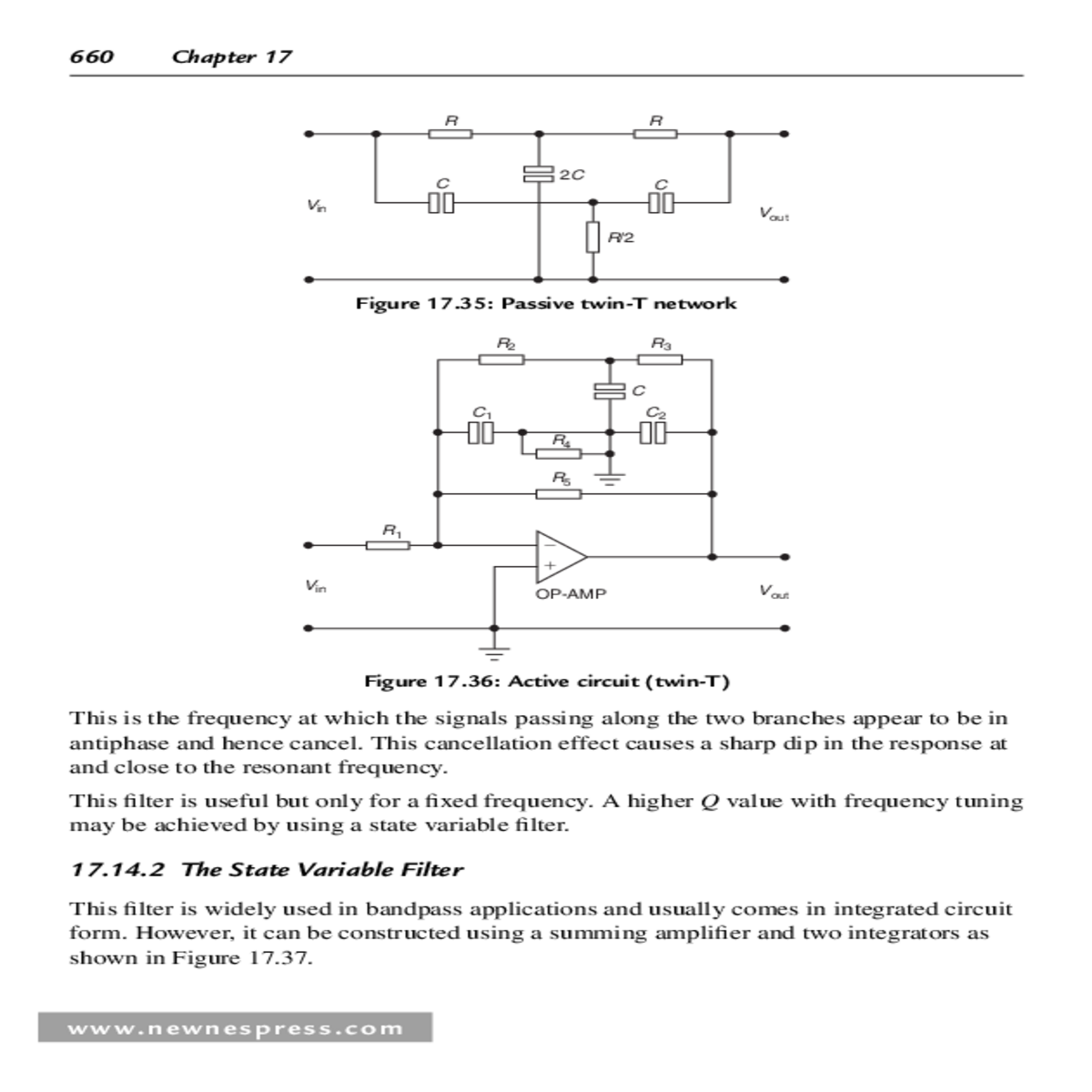
Figure 17.36 : Active circuit (twin-T)
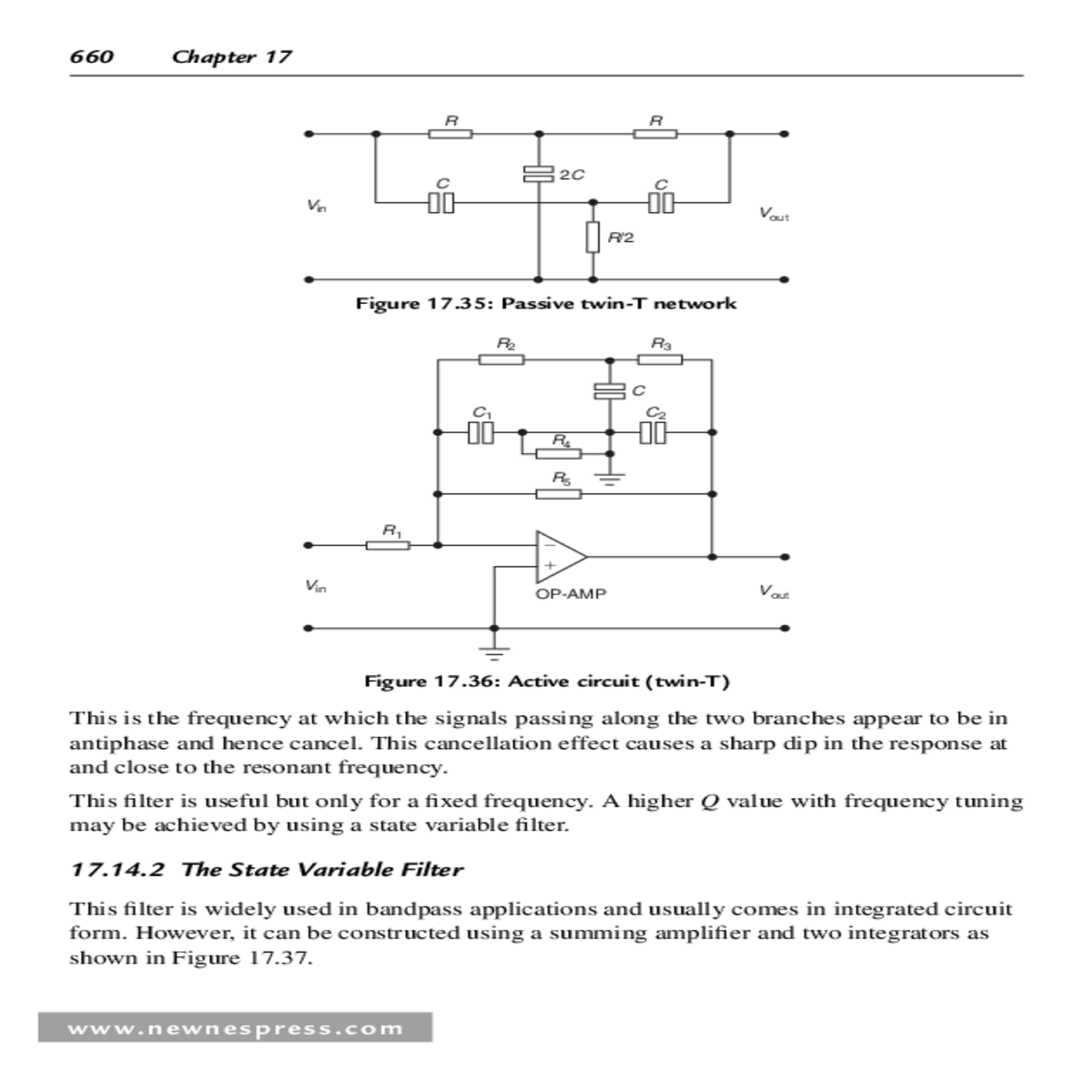
This is the frequency at which the signals passing along the two branches appear to be in antiphase and hence cancel. This cancellation effect causes a sharp dip in the response at and close to the resonant frequency.
| www.newnespress.com |
|---|
|
661 | |||||||||
|---|---|---|---|---|---|---|---|---|---|---|
| R1 | R2 | Vout |
|
C1 | Vout | |||||
| � | R3 | � | R4 | � | Vout | LP | ||||
| � | ||||||||||
| � | ||||||||||
| OP-AMP | ||||||||||
| OP-AMP |
|
|||||||||
R6
For signals above the critical frequency the low-pass response disappears and prevents the input signal from passing through the integrators. This results in the bandpass output peaking sharply at the critical frequency.
The Q factor or selectivity of the fi lter is determined by R5 and R6 in Figure 17.37 and may be calculated from the expression:
| Q | � | 1 | ⎛⎜⎜ | R 5 | � | (1727) | |
|---|---|---|---|---|---|---|---|
| 3 | ⎜⎜⎝ | R 6 | (1727) |
| www.newnespress.com |
|---|