Language:EN
Pages: 76
Rating : ⭐⭐⭐⭐⭐
Price: $10.99
Page 1 Preview
task role play observation checklist and assessmen

Task role play observation checklist and assessment outcome assessment

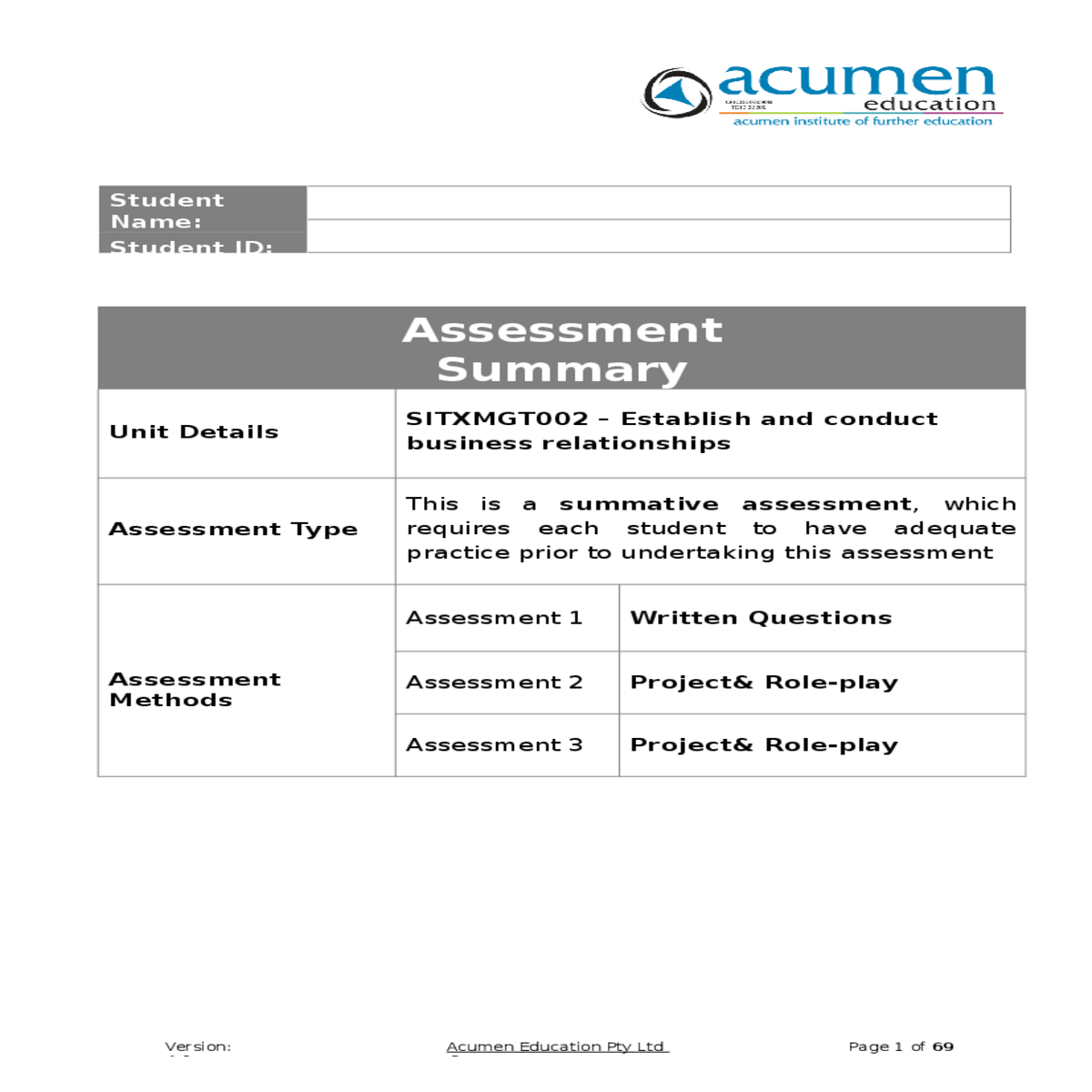
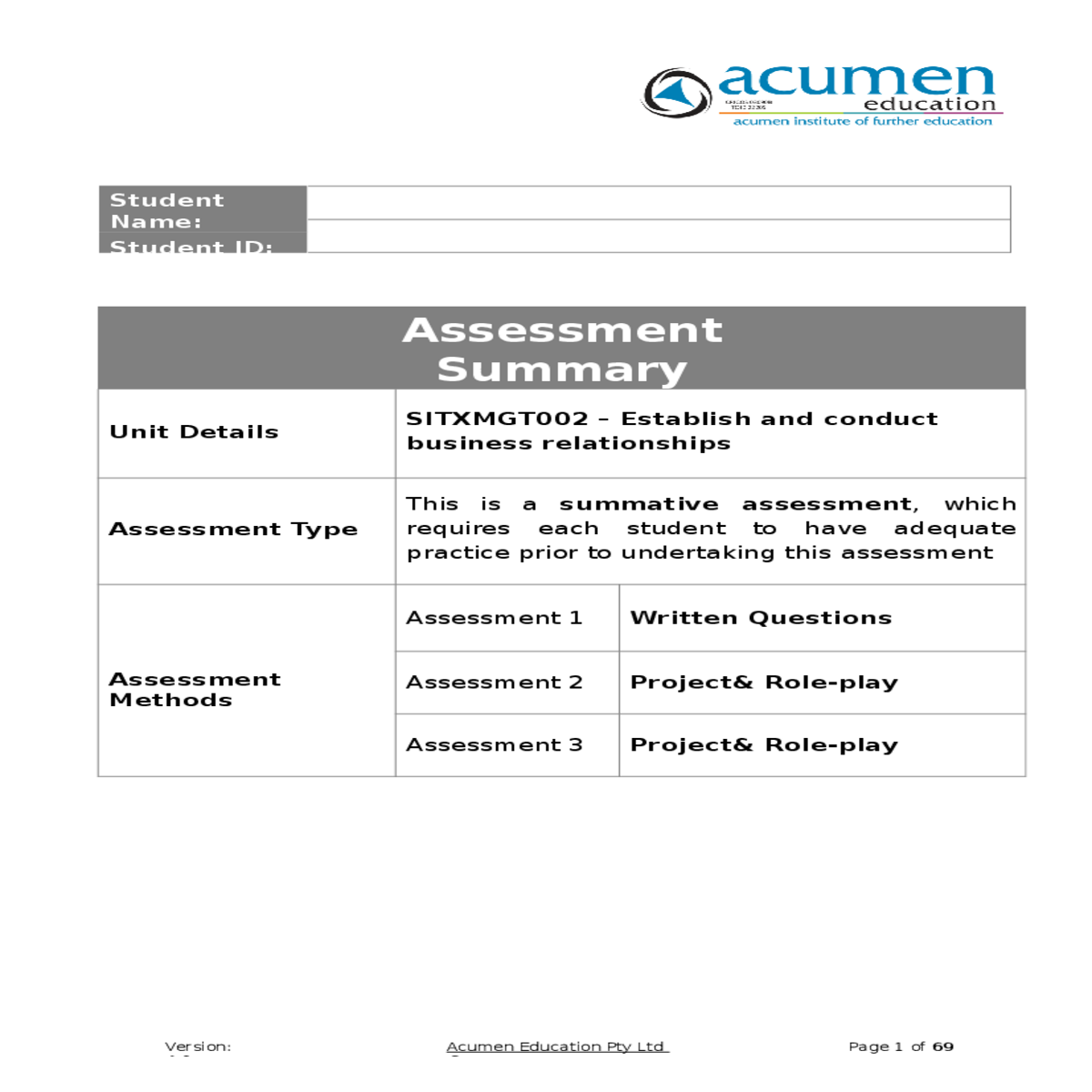
Student Name:

Summary
Version: Acumen Education Pty Ltd Page 1of 69
4.0 ©

Assessment information ................................................................. 4

Purpose .............................................................................................. 4

Performance evidence ....................................................................... 5

Knowledge

and

Instructions ........................................................................................ 7

Required resources ............................................................................ 7

Reassessment

process ....................................................................... 8

Performance Checklist and Assessment Outcome – Assessment 2, Task A

32

Task D 39

Performance Checklist and Assessment Outcome – Assessment 2, Task E

Task G45

Assessment 3 – Project: Establish and Conduct Business Relationships with Customer

Role Play Observation Checklist and Assessment Outcome – Assessment 3, Task

B 52Role Play Observation Checklist and Assessment Outcome – Assessment 3,

59

Role Play Observation Checklist and Assessment Outcome – Assessment 3, Task

Assessment information

Purpose

No occupational licensing, certification or specific legislative requirements apply to this unit at the time of publication.

Key
competencies

Foundationskil ls

Reading skills to:

Interpret potentially complex agreements, conditions and contracts.

Numeracy skills to:

Evaluate commercial data and cost structures.

enterprise skills

to:

o contractor
o customer
o networks
o supplier

 conduct formal negotiations, or make and manage agreements and contracts in relation to the two relationships established above, relevant to the specific business context

o terms and obligations of contract

o methods of contractual agreement

agreements in the relevant industry

Assessment Conditions

ensure access to:

Summary
methods that are
of assessment

us

of

Description

assessmen
t methods

1

Questions

You are required to answer 10 short
and tasks
Instruction answer questions related to this unit.

You can seek clarification regarding the assessment required to be

s:

done.

 You can seek assistance from assessor while using special diagnostic equipment

 Review the observation checklist/decision making rules to know what is expected of you. You may refer to the observation checklist for observation based assessments at any stage prior to the commencement of your assessment. You must not refer to this checklist whilst you are being assessed.

Reasonabl e
adjustment

assessment procedures for students with special needs, such as people with disabilities or with language or literacy difficulties. Assessing knowledge is usually assessed through written or oral, short-answer

tests where assessors seek to determine the extent of the student’s knowledge.

 Offer a separate, quiet room.

4. If a student has submitted and not successfully completed more than 50%* of the assessment tasks for a unit, they will be required to undertake the unit again.

5. In the case of re-submission, the following actions shall occur:

If the student remains ‘Not Competent’ after a third re-submission, he or she will be notified that this result is final and he or she will be unable to successfully complete the course in which they are enrolled at this point.

* Due to the variance in the amount of work completed for each assessment task in a unit, 50% will be determined by the number of assessment tasks submitted as opposed to the amount of evidence submitted.

Assessment submissions and contact details

You must submit this completed assessment tool to your trainer on the due date. Please feel free to contact us if you have any questions regarding the assessment process:
Phone: 03 9044 6402/03 84151244

Student Name: Studen
t ID No:

Contact number :

Unit Code & Title

First Submission
Please attach th
tat ion t

o this form

NS Sat

S
= i
=
f
ry
a

Project

S | NS

Components

Feedback to Student

Date

Assessment 1 – Written Questions

Instructions for Students:

 Read the Assessment description carefully.

 Assessment may be submitted in Microsoft Word format or may be handwritten. Clearly

end date.

 Acknowledge clearly when and how you are drawing on the ideas or phrases of others.

 Seek clarification regarding the assessment required to be done, if you do not

understand the task.

nature of the need.

 Assessment may be completed in your own time and is due one week after the module

2

Association memberships

Satisfactory

Not Satisfactory (Comments)

 Generate a variety of possibilities before making a decision

Negotiators often settle for the first agreement they reach, relieved to have hit upon an outcome that both sides can live with. In principled negotiation, negotiators devote significant time to brainstorming a wide range of possible options before choosing the best one. In , options refer to any available choices parties might consider to satisfy their interests, including conditions, contingencies, and trades. For example, imagine a job negotiation where the candidate values a higher salary, while the hiring organization is concerned about being fully staffed. If so, the job seeker might be willing to make a concession on vacation days in return for the promise of a higher salary.

4

Negotiation is widely recognized to be a four-step process. These are preparation, opening, bargaining and closing.

1. Preparation:
The first stage in a negotiation process relates to planning and preparation. It is the stage where the parties decide what they want, what are their minimum expectations, how much they will yield and how they will go about the negotiations.

3. Bargaining:
It is the stage when the negotiating teams really sit down and talk it out. They state their positions and put forth the supporting arguments. In any negotiation, the question uppermost is, ‘What’s there in it for me?’
Bargaining is nothing but a give and take. You are prepared to concede something provided you get what you want. During the course of hard bargaining, all the relevant negotiation skills we noted earlier are brought into full play

4. Closing:
Finally, you enter the settlement stage and work towards a ‘close’. After completing all the bargaining, the negotiating parties come to the stage of settlement or agreement. The final terms as agreed upon are documented and the agreement gets signed.

You are viewing 1/3rd of the document.Purchase the document to get full access instantly

Immediately available after payment
Both online and downloadable
No strings attached
How It Works
Login account
Login Your Account
Place in cart
Add to Cart
send in the money
Make payment
Document download
Download File
img

Uploaded by : Joshua Todd

PageId: DOCACA92D0