Strength and limitations of qualitative data
Research proposal- To investigate the use of drones in disaster scenarios
Introduction
Technological developments are one of the most important inventions done by mankind today. In the late 1800s, the idea of drones was known as unmanned explosives packed with balloons, which were used to attack the enemy in Austria. During the Vietnam War, the highly confidential UAVs conducted their first military flights. Drones are also known as Unmanned Aerial Vehicles (UAVs), Unmanned Aerial Systems (UAS), Remotely Piloted Vehicles (RPV), and Remotely Piloted Aircraft Systems (RPAS), and are light aircraft that fly alone without the aid of a pilot, but with the support of a ground controller or through the computer-controlled flight with no human involvement (Mohd Daud et al., 2022). A new generation of unmanned aerial vehicles (UAVs) may be useful in emergency situations and data analysis. Drones were generally utilized for military objectives to determine the position of the enemy who was hidden in areas where military personnel were unable to reach. As a result, the usage of drones has quickly grown over the last decade, including a wide range of areas spanning from agriculture to business, and is rapidly being utilized in disaster risk management, humanitarian assistance, and emergency preparedness. In terms of natural catastrophe situations such as earthquakes and floods, the usage of drones is collecting precise information for crisis management all around the world (Jin et al., 2020). According to Chordia (2022), the growing importance of drone use in disaster situations claims that drones have been widely employed for disaster assistance, notably during floods, earthquakes, and other natural disasters. Drones are also employed to track down missing hikers in search and rescue missions. The drone also intends to provide novel and fascinating insights into data collection for disaster management (Deruyck et al., 2018). Drones also assist in the collection of useful and crucial data that allows the disaster management team to assess the extent of damage in a specific region and work on improving the way of addressing the difficulties encountered by the people living in that hazardous area. Many businesses engaged in security use drones for security purposes. This is a fast-growing component of the overall security business. Security drones offer a wide range of applications since they can offer surveillance for remote regions and places that are difficult or dangerous to reach (Rabta et al., 2018).
Research objectives
To understand how drones can be used in initiatives to support disaster management
Examine the significance of drones in disaster identification, intervention, and monitoring.
Literature Review
Drone use to combat COVID-19
| UAVs type | Advantage | Application | Limitations |
|---|---|---|---|
| Rotary wing | Inspection, Supply drops, | Large payload | High price |
| Fixed wing | Offer better aerodynamic performance, structural inspection, and area survey | High speed, large area coverage | Launching, landing, high price |
| Fixed-wing hybrid | Hybrid drone capacity to fly faster and over greater distances | Various commercial and military airborne uses | Highly expensive, not stable |
Figure 1: Use of drones for various purposes (Kapoor, 2022).
Surveillance drones
Cargo drones
Fumigation drones
COVID-19 Screening and Detection
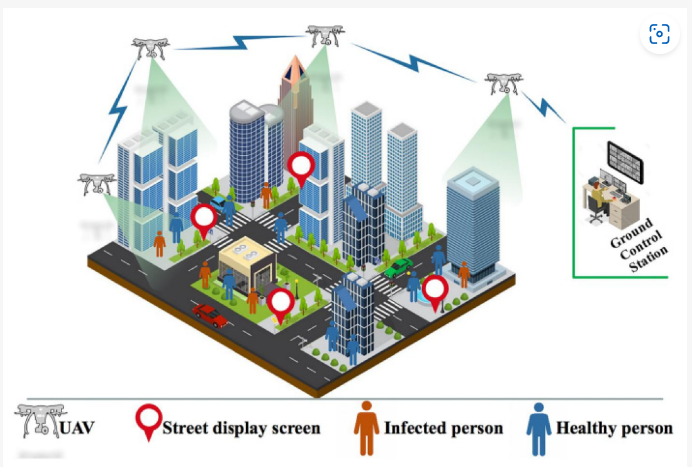
Figure 2: The use of drones in the detection of COVID-19 infection in people (Mohsan et al., 2022).
Drone-Based COVID-19 Monitoring Framework
Layer 4: Artificial intelligence and its components. After collecting data from edge and cloud computing, this aids in the development of patient profiling, which aids in the detection of COVID-19 identity by the use of commuter-based profiles of patients, which aids in the timely detection of causes, symptoms, and changes. As a result, not only commuter-based profile be useful for COVID-19 patients, but also helps in the detection of other infectious diseases as well (Bandaragoda et al., 2020).
Justified methodology
The major purpose of this research proposal is to examine the existing literature on the usage of drones in catastrophe scenarios and to generate research ideas for future studies. The Mono method is an acceptable tool for achieving this goal. As a result, to explore which research methodology is employed in this research proposal, qualitative data analysis was studied for this research project.
Strength and limitations of qualitative data
Systematic literature review (SLR) approach
Validity and Reliability
Systematic literature review (SLR) Limitation
Owens (2021) believes that systematic reviews have limitations related to the risk of biases such as selection bias while researching various research papers related to drones assisting humans in supplying healthcare and food facilities during the COVID-19 crisis because after the outbreak of COVID-19 many articles and research papers are published on the same topics related to drone use in disaster scenarios, which increases the risk of publication bias. A bias is a systematic or methodological inaccuracy that leads the study results to be misrepresented. The rate of increase of systematic reviews has exceeded the rate of increase of research generally. This leads to duplication. A systematic review is jeopardized by selective result presentation. The author or reader may choose to disclose only a subset of findings with statistical significance that interest his or her attention. In a systematic review, the possibility of biased or deceptive interpretation of evidence findings can have major consequences.
Data collection
A qualitative data analysis was carried out to synthesize proof from a variety of research designs to clarify core concepts and identify gaps in the chosen research topic, where the initial set of 500 research papers obtained through the search methodology, a total of 50 papers were finally short-listed after thorough assessment and evaluation, related to the quality of the journal, the use of the UAV in the disaster scenario, and the significance for fulfilling the current research aim to investigate the use of drones in disaster scenarios and to evaluate methods for risk management and the prevention of possible losses to the natural environment. Purposive sampling is widely used in qualitative research for the identification and selection of information-rich published papers related to the use of drones in a disaster scenario, with carrying out extensive a sample size of 40-50 to establish theoretical saturation using a grounded theory methodology to qualitative approach to study the research proposal aim of our study. The four questions for this research proposal on the chosen topic "To investigate the use of drones in a disaster scenario" were based on gaps in the research literature mentioned right below the research objectives.
Research strategy
| Drone related terms |
|
|---|---|
| Disaster-related terms |
|
| Disaster overcoming terms |
|
Ethical consideration
References
Bandaragoda, T. et al. (2020) “Artificial intelligence based commuter behaviour profiling framework using internet of things for real-time decision-making,” Neural Computing and Applications, 32(20), pp. 16057–16071. Available at: https://doi.org/10.1007/s00521-020-04736-7.
Chordia, K. et al. (2022) To study the scope of drone usage for disaster management in India with respect to the USA with a comparison of economic factors including the GDP, the level of unemployment and inflation, and the government regulations. [Preprint]. Available at: https://doi.org/10.21203/rs.3.rs-1473635/v1.
Jin, W. et al. (2020) “Research on application and deployment of UAV in emergency response,” 2020 IEEE 10th International Conference on Electronics Information and Emergency Communication (ICEIEC) [Preprint]. Available at: https://doi.org/10.1109/iceiec49280.2020.9152338.
Kapoor, A.R. (2022) Leveraging drone technology in the fight against COVID-19, Infosys. Available at: https://www.infosysbpm.com/blogs/digital-business-services/leveraging-drone-technology-in-the-fight-against-covid-19.html (Accessed: December 12, 2022).
Mohsan, S.A. et al. (2022) “Role of drone technology helping in alleviating the COVID-19 pandemic,” Micromachines, 13(10), p. 1593. Available at: https://doi.org/10.3390/mi13101593.
Owens, J.K. (2021) “Systematic reviews: Brief overview of methods, limitations, and resources,” Nurse Author & Editor, 31(3-4), pp. 69–72. Available at: https://doi.org/10.1111/nae2.28.
Reddy Maddikunta, P.K. et al. (2021) “Unmanned aerial vehicles in smart agriculture: Applications, requirements, and challenges,” IEEE Sensors Journal, 21(16), pp. 17608–17619. Available at: https://doi.org/10.1109/jsen.2021.3049471.
Restas, A. (2015) “Drone applications for supporting Disaster Management,” World Journal of Engineering and Technology, 03(03), pp. 316–321. Available at: https://doi.org/10.4236/wjet.2015.33c047.