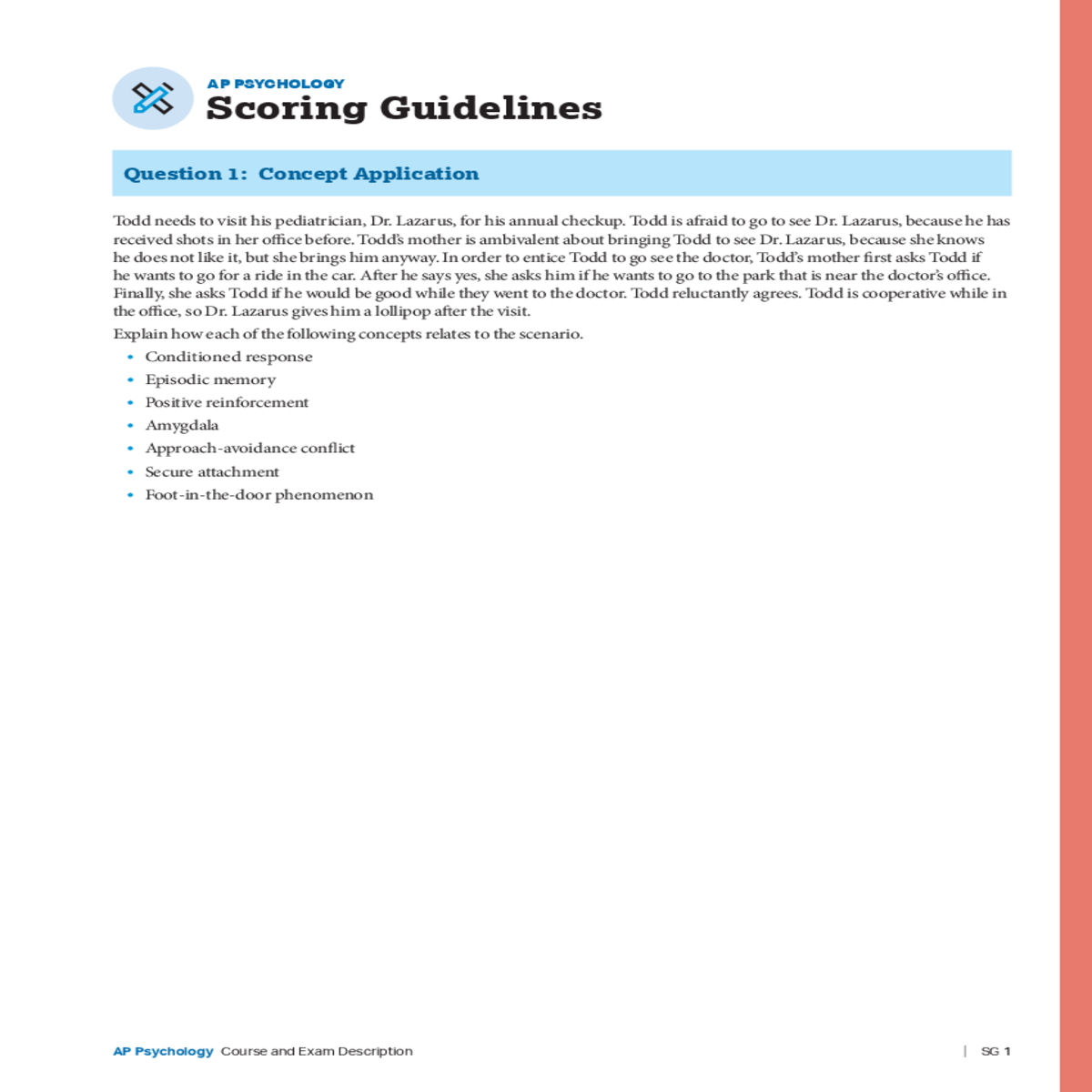
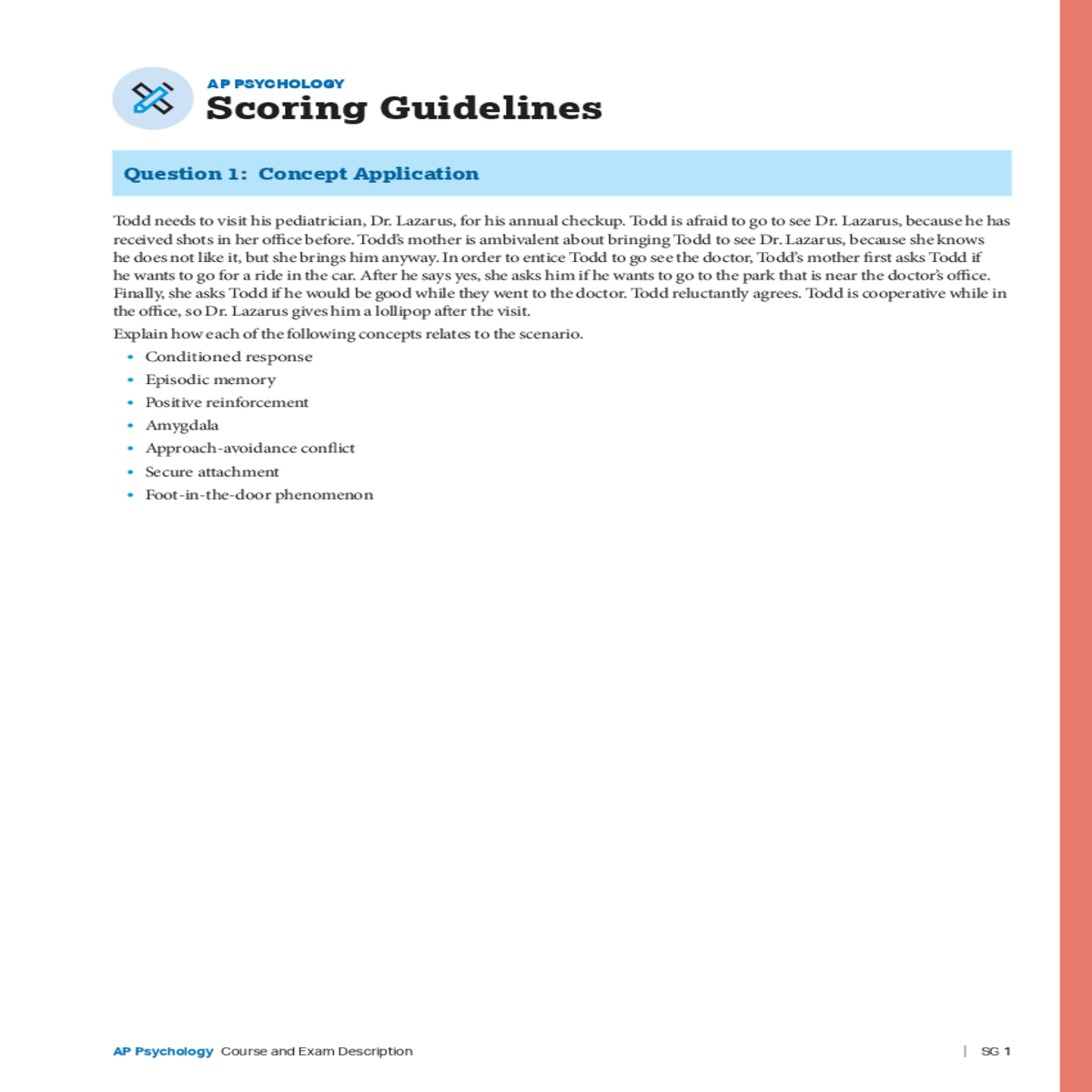
Spelling and grammatical mistakes not reduce the score response
|
|---|
| AP Psychology Course and Exam Description | | SG 1 |
|---|
1. Answers should be presented in sentences cogent enough for the meaning of the response to come through. Spelling and grammatical mistakes do not reduce the score of a response, but spelling must be close enough that the reader is convinced of the word.
2. Do not score any notes made on the question section of the booklet. Score only what has been written in the blanks provided in the booklet.
7. A response can earn a point only if it clearly conveys what part of the question is being answered. It may be possible to infer what part of the question is being
|
| | |
|---|---|---|
| AP Psychology Course and Exam Description |
lol A U
|
Acceptable explanations include: lollipop for cooperating with the doctor. Acceptable explanations include: Unacceptable explanations include: |
orn because she knows she |
|
|---|---|---|---|
|
| | SG 3 | |
| 1 point | |
|---|---|
| 1 point | |
|---|---|
| • |
|
|
|---|---|---|
|
1 point | |
| • | ||
|---|---|---|
| 1 point | ||
|
1 point |
|---|---|
|
| 1 point | |
|---|---|
|
asking him to comply with smaller requests first.
|
|---|
A researcher was interested in studying whether participants who were
angry would become less angry if they had a chance to release their
anger. At 10:00 in the morning, 6 students met individually with a
confederate named Steve. They were each asked to write an essay, which
Steve evaluated. He told each student, “This is the worst essay I ever
read.” They were then asked to sit in a room quietly for 10 minutes. At
1:00 in the afternoon, a second group of 6 students each wrote an essay,
and Steve once again said the essays were the worst he had ever read.
This second group was then asked to punch a punching bag. After either
sitting quietly or punching the punching bag, the students were given
the opportunity to blast a horn when Steve entered the room. The
researcher operationally defined anger as the length of time that the
students blasted the horn. The researcher assumed students who were
given an opportunity to punch the punching bag would be less likely to
blast the horn in Steve’s presence. The table below indicates how long,
in seconds, each subject blasted the horn when Steve was present. Assume
all differences
are significant.
| 0 | 30 |
|---|---|
| 0 | 60 |
| 10 | 15 |
| 0 | 30 |
| 0 | 60 |
| 5 | 15 |
lConfounding variable
lIndependent variable
Calculate the mean length of time the horn was blasted for the group that punched the punching bag.
| • |
|---|
|
1 point |
|---|---|
|
| Part B |
|---|
| 1 point | |
|---|---|
strong negative feelings by punching the punching bag.
Acceptable explanations include:
• The researcher thought by punching the bag, the students would experience catharsis and release their negative energy towards Steve.
| 1 point | |
|---|---|
Acceptable explanations include:
• The hypothesis was not supported. Those students who were given the opportunity to experience catharsis actually ended up angrier at Steve (which you can see because they blew the horn longer) in the end.• The researcher was incorrect. Students who got to take out their anger on the bag did the opposite of what the researcher thought and blasted the horn in Steve’s face for a longer period of time than those who sat quietly.
| 1 point | |
|---|---|
• This scenario never describes any sort of debriefing. The students were likely upset after Steve told them their essay was horrible. The researcher needs to debrief the students and explain to them the true reason for the study.”
|
1 point |
|---|---|