

See articles for the hicks and machlup fest- schrifts samuelson
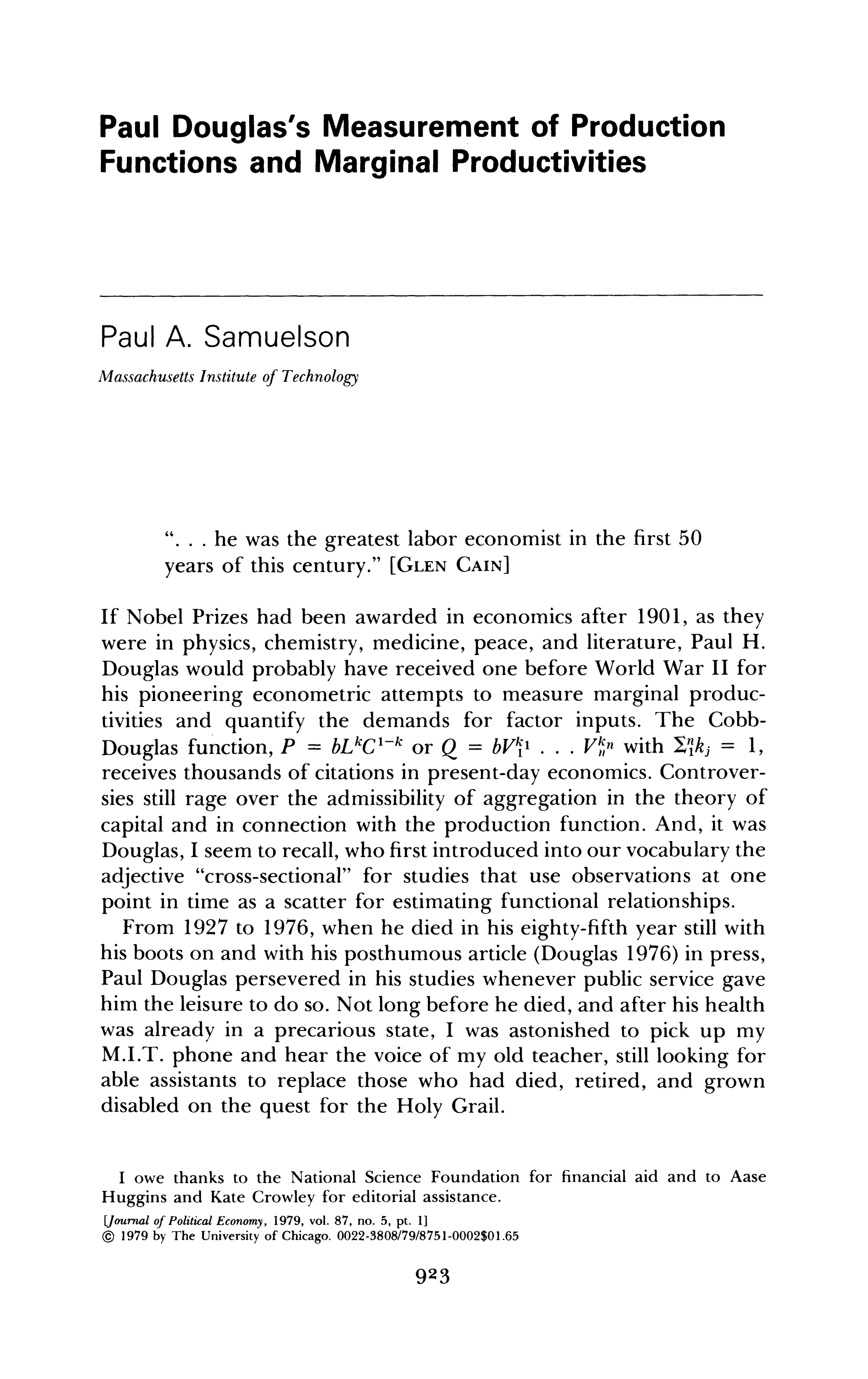
Paul Douglas's Measurement of Production Functions and Marginal Productivities
I owe thanks to the National Science Foundation for financial aid and to Aase Huggins and Kate Crowley for editorial assistance.
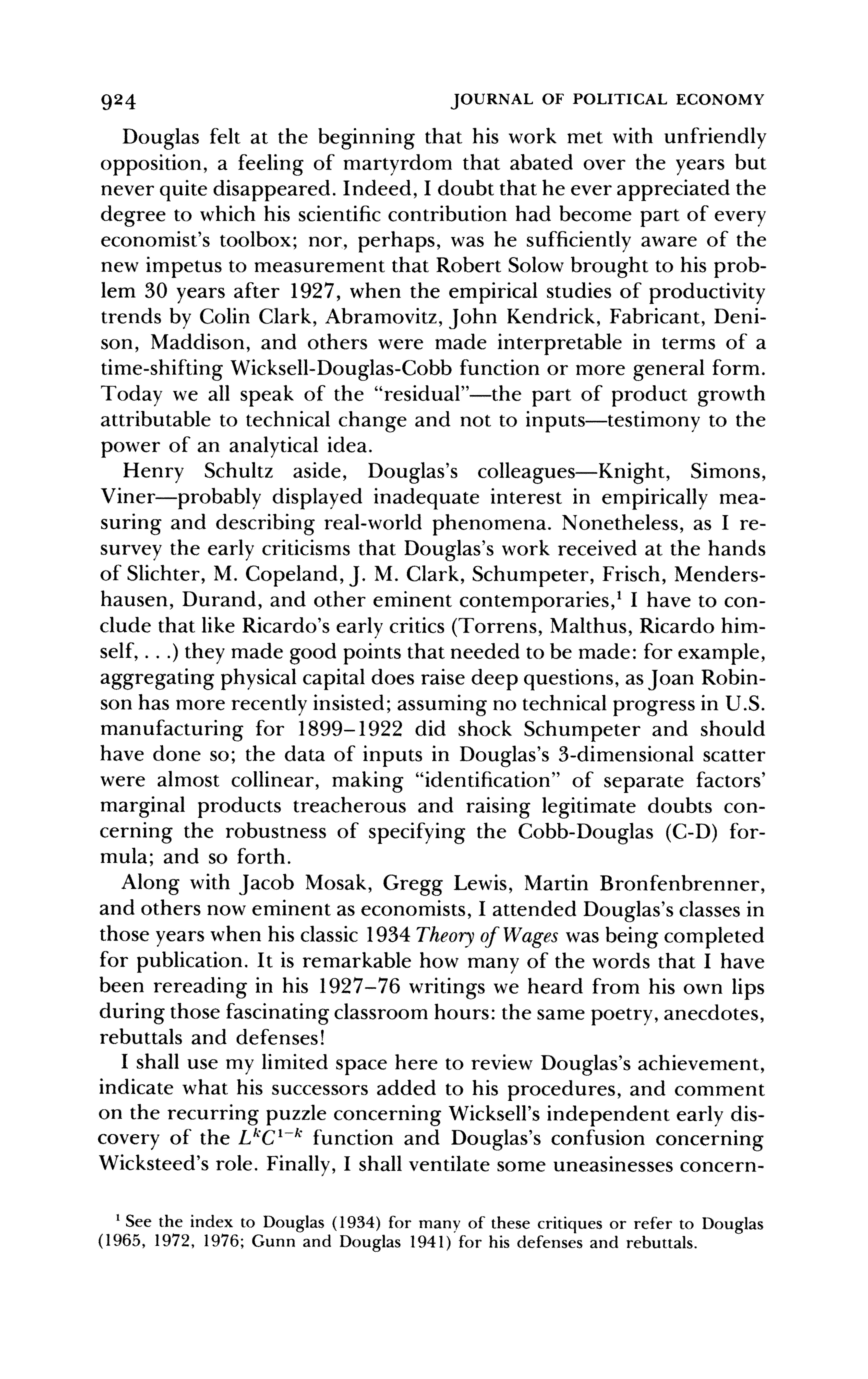
Along with Jacob Mosak, Gregg Lewis, Martin Bronfenbrenner, and others now eminent as economists, I attended Douglas's classes in those years when his classic 1934 Theory of Wages was being completed for publication. It is remarkable how many of the words that I have been rereading in his 1927-76 writings we heard from his own lips during those fascinating classroom hours: the same poetry, anecdotes, rebuttals and defenses!
I shall use my limited space here to review Douglas's achievement,
The 1927 Beginning
However documented was Gilbert's meeting with Sullivan, we know how fame brushed against Cobb when Douglas spent a sabbatical at Amherst in 1927. Out of Douglas's many similar accounts I quote this sample from his 1972 autobiography:
Actually, despite Douglas's many accounts, Wicksteed never used
homogeneous functions
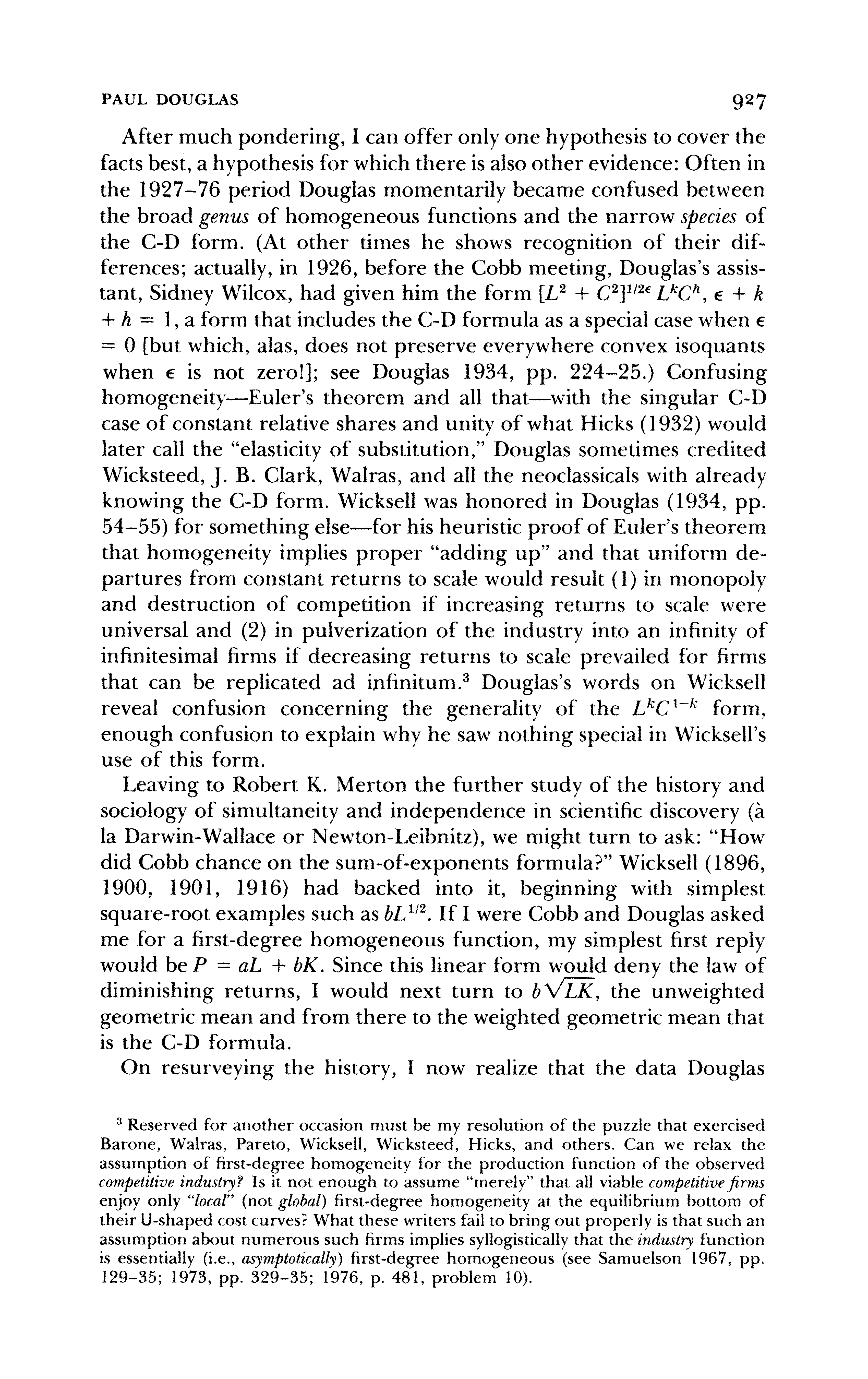
After much pondering, I can offer only one hypothesis to cover the facts best, a hypothesis for which there is also other evidence: Often in the 1927-76 period Douglas momentarily became confused between the broad genus of homogeneous functions and the narrow species of the C-D form. (At other times he shows recognition of their dif- ferences; actually, in 1926, before the Cobb meeting, Douglas's assis-
assumption of first-degree homogeneity for the production function of the observed competitive industry? Is it not enough to assume "merely" that all viable competitivefirms enjoy only "local" (not global) first-degree homogeneity at the equilibrium bottom of
their U-shaped cost curves? What these writers fail to bring out properly is that such an
None of the authors began with the axiom of constant relative
from which one could deduce the formula
The Magnum Opus
Supplementing the 1899-1922 time series, Douglas (1934) presents
series investigations by others for New Zealand and South Africa are
later reported on by Douglas. Although the significance for marginal
Cross-Section Investigations
generous address on Douglas at the University of Wisconsin of Glen Cain (1977), from
History of doctrine to split hairs over what Ricardo (should have) meant is one thing; it
is another to benefit from the many conflicting ideas nominated by past writers.
Let me take the case most favorable to Douglas, unrealistic as it is.
Then there does exist a neoclassical first-degree-homogeneous aggregate function, which out of total labor and capital produces total real product:
weighted average of all industries' relative wage shares should give the aggregate wage share:
But this is a triviality. What warrant is there for putting such a k into
U2(C) = [aLY + bCWyl' or [a(L - 1)y + b(C - 1)Jy-' also, it has the same income elasticity of marginal utility whatever the prices or income. For y = 1, we have infinite
Champernowne, as well as Solow (1956) and Arrow et al. (1961), represent post-
An example will bring this out. Let there be four industries, not
that noncompetitive industries have a common profit rate R and use leets capital (C) in proportion to the (Pjqj - WLj) elements!
Now subject the data to the least-square logarithmic regression
This example of perfect fit is contrived to be overstrong, to bring out dramatically what is less obviously present in more realistic sam- ples. Several suspicions have been uncovered, which will have to be cleared up if future credence is given to such cross-section-of- industries exercises:
robust test of the conditions for competition and the relevance of
7 Bronfenbrenner (1939, 1944) and Reder (1943) have registered understandable qualms; concerning them I have to be overly brief. Bronfenbrenner (1939) makes the
Marshallian demand cannot obtain for (L, WIPE) or for (LIC, &1QI#L). To this Douglas could reply: "Were the observed (L, W/PI) truly inelastic, my attempted fit to it to the scatter of [Wt/C, b(C/)1-'1 would fail for all k. So my method could be self-checking." As referee, I could agree but with a qualification: "Douglas might get what 'looks like' a good fit to the [LI/C, QIC scatter, while not sufficiently noting how poor might still be the more relevant fit to higher derivatives like [jU, OQjOL3." To isolate the main point of Reder (1943), consider firms producing the same product under pure competition in
Reality commanded that technical change, or t itself, be put into the production function, so that it takes the Solow (1957) form
1, where intrafirm technology is of the same q1IC =f(LjIC) = b(LjIC) form, but where zero monopsony obtained and where free entry with zero monopsony of capital equalized the profit rate and made profit's share RCj, Bronfenbrenner would be
Solow, having won theoretical fame in 1956, in 1957 sought empiri-
Solow (1957) showed that U.S. GNP data for 1909-49 were consistent with Hicks-neutral technical change, with
Let me conclude by examining whether Kaldor and neo-Keynesians
share holds, no Clarkian can get a good fit with a function far away from Cobb-Douglas so long as shifts in the C(t)IL(t) ratio are not serendipitously just offset by labor-saving rather than capital-saving biases in technical change!
scholar. For me and my lucky classmates it was dawn of a more
Bergson, Abram. "Real Income, Expenditure Proportionality, and Frisch's 'New Methods of Measuring Marginal Utility.'" Rev. Econ. Studies 4 (Oc- tober 1936): 33-52.
Policy." A.E.R. 29 (December 1939): 793-96.
London: Routledge, 1920.
Douglas, Paul H. The Theory of Wages. New York: Macmillan, 1934. "Are There Laws of Production?" A.E.R. 38 (March 1948): 1-41.
Durand, David. "Some Ihoughts on Marginal Productivity, with Special Reference to Professor Douglas' Analysis." J.P.E. 45, no. 6 (December 1937): 740-58.
1967): 662-64.
Marschak, Jacob, and Andrews, W. H., Jr. "Random Simultaneous Equations
Estimation of Cobb-Douglas Production Functions." Econometrica 33 (Oc- tober 1965): 814-28.
Reder, Melvin W. "An Alternative Interpretation of the Cobb-Douglas Func- tion," Econometrica 11 ( July-October 1943): 259-64.
Rees, Albert. "Douglas on Wages and the Supply of Labor." J.P.E., this
Edinburgh: Edinburgh University Press and Chicago: Aldine, 1968. Repro- duced in The Collected Scientfc Papers of Paul A. Samuelson. Vol. 3.
. "'A Quantum Theory Model of Economics: Is the Coordinating En- trepreneur Just Worth His Profit?" In Development and Planning, Essays in
Man and His Ideas, edited by Jacob S. Dreyer. Lexington, Mass.: Lexington,
Solow, Robert M. "The Production Function and the Theory of Capital." Rev. Econ. Studies 23, no. 2 (1956): 101-8.
". The 'Critical Point' in the Law of Decreasing Agricultural Produc- tivity." Ekon. Tidshrift (1916), pp. 285-92. Reproduced in Selected Papers on Economic Theory.
Macmillan, 1894.