Section 4: uat2 – unit skills test (ust) – unit project (up)
Unit Assessment Pack
|
|
|---|---|
|
|
|
Section 2: Unit Pre-Assessment Checklist (UPAC) 10
Section 3: UAT1 – Unit Knowledge Test (UKT) – Written Questions 11
Unit Assessment Result Sheet (UARS): UAT2 – Unit Skills Test (UST) – Unit Project (UP) 29
Section 5: Student Feedback on unit 32
|
|
|
|---|---|---|
|
||
|
Student’s Signature: Date: / /
|
||
|---|---|---|
|
||
|
ECA GRADUATE INSTITUTE | RTO: 91423 | ABN: 81 128 584 896
Section 1: Assessment Plan
The student’s work has been reviewed and assessed by you.
You have recorded a satisfactory/unsatisfactory result for each assessment task within each unit of competency.
Student name, signature and date
Assessor name, signature and date
No licensing, legislative or certification requirements apply to this unit at the time of publication.
Identify key information sources
PowerPoint presentation
Unit Assessment Pack (UAP)
Academic integrity, plagiarism and collusion
Academic Integrity is about the honest presentation of your academic work. It means acknowledging the work of
Acknowledge the work of others appropriately
Take reasonable steps to ensure other students cannot copy or misuse your work
Copying work either in whole or in part
Presenting designs, codes or images as your own work
Collusion may be with another EGI student or with individuals or students external to EGI. This applies to work assessed by any educational and training body in Australia or overseas.
Collusion occurs when you work without the authorisation of the teaching staff to:
Offer to complete work or seek payment for completing academic work for other students.
Both collusion and plagiarism can occur in group work. For examples of plagiarism, collusion and academic misconduct in group work please refer to the EGI’s policy on plagiarism and collusion.
Students will receive a 'satisfactorily completed' (S) or 'not yet satisfactorily completed (NS) result for each individual unit assessment task (UAT).
Final unit result will be recorded as competency achieved/competent (C) or competency not yet achieved/not yet competent (NYC).
N/A
All assessment tasks will ensure that the principles of assessment and rules of evidence are adhered to.
Assessment tasks are varied and are required to be completed over a period of time and, where required, on a number of occasions.
Practical observations provide opportunities for students to demonstrate both knowledge and skills.
Trainer Assessment Pack provides benchmark performance checklists and answers for each assessment task to ensure accuracy and consistency in the assessment decision-making process.
Flexibility:
Students are required to declare reasonable adjustments if they have any special needs or considerations that may affect their ability to complete the assessments.
Any reasonable adjustments that are required to be made to these assessment tasks must be recorded in the reasonable adjustment strategies matrix section, in the unit pre-assessment checklist for the relevant task.
The Marking Guide provides a set of benchmark performance responses/checklists/answers for each assessment task.
There is a clear relationship between the evidence requirements of the unit of competency and the evidence on which the assessment judgment is made.
Some units may require the student to demonstrate assessment over a period of time and more than once. These requirements will be made clear in the relevant assessment task.
All dimensions of competency are addressed.
Workplace-based related tasks will allow the student to draw from current workplace conditions and experiences, and students will be able to use technology, tools and equipment specific to their workplace.
The Assessor is assured that the assessment evidence demonstrates current competency. This requires the assessment evidence to be from the present or the very recent past.
the autonomy required to demonstrate that achievement.
All assessment tasks must ensure compliance with the requirements of AQF level and the AQF level criteria. For more information, please visit http://www.aqf.edu.au/
Student will be provided with one more attempt to complete this Unit assessment pack (UAP), if trainer/assessor deemed them not yet satisfactorily completed (NS) in any Unit assessment task (UAT).
Unit Pre-Assessment Checklist (UPAC) will be reviewed by the trainer/assessor to ensure the student is ready for the assessment.
Be provided for each Unit Assessment Task (UAT)
Guide students to adapt and adjust their learning strategies
Acknowledge the developmental nature of learning
Please do not provide short/one-word comments, such as “Fantastic” or “Great work!”. Feedback needs to be:
Section 2: Unit Pre-Assessment Checklist (UPAC)
The pre-assessment checklist helps students determine if they are ready for assessment. The trainer/assessor must
review the checklist with the student before the student attempts the assessment task. If any items of the checklist are incomplete or not clear to the student, the trainer/assessor must provide relevant information to the student to ensure they understand the requirements of the assessment task. The student must ensure they are ready for the assessment task before undertaking it.
Please make sure the student has discussed any special needs or reasonable adjustments to be considered during the assessment (refer to the Reasonable Adjustments Strategy Matrix).
Please make sure the student has access to a computer and the internet (if they prefer to type the answers).
Request for an extension to submit assessment work must be made before the due date of this assessment task.
Students with carer responsibilities, cultural or religious obligations, English as an additional language, disability etc. can request for reasonable adjustments.
All evidence and supplementary documentation must be submitted with the assessment pack to the Academic Manager, EGI.
Section 3: UAT1 – Unit Knowledge Test (UKT) – Written Questions
Written Questions
articulate research and resource requirements clearly and direct discussions to elicit the views and opinions of others by using effective listening and open questioning techniques.
use a range of verbal responses and makes comparisons that show an understanding of topics and concepts.
This is the first unit of assessment task student has to successfully complete to be deemed competent in this unit of competency.
The Unit Knowledge Test is comprised of five (5) written questions.
textbooks during the test).
Student must read and respond to all questions.
The trainer/assessor may ask student relevant questions on this assessment task to ensure that this is his/her own work.
Where a student’s answers are deemed not satisfactory after the first attempt, a resubmission attempt will
Trainer/Assessor will provide student further information regarding the location for completing this assessment task.
Student must have to complete a written assessment consisting of a series of questions.
Assessor should not accept answers copied directly from texts without acknowledgement of the text.
This assessment task requires the student to answer all the questions correctly.
The “Assessment Plan” is available with the Unit Assessment Pack (UAP) – Cover Sheet.
Assesses each student’s answers in accordance with the guidelines provided in the “Assessment Pack”.
This is an individual assessment.
You must staple the loose sheets together along with the cover page.
You must attach the loose sheets chronologically as per the page numbers.
MS Word
Printer or e-printer
Answer:
A Business Process Repository is a central location for storing information about how an enterprise operates. This information may be contained in various media including paper, film or electronic form with a storage mechanism appropriate to the medium. Electronic repositories range from passive containers which store process artefact’s (also referred to as process objects) to sophisticated tools that serve as active participants in monitoring, executing, managing and reporting on business processes. They come in the form of Document Management Systems, Process Modelling Tools and Business Process Management Systems. A centralized Business Process Repository is critical to the success of the enterprise’s business process strategy by providing a blueprint to manage and control how process change is introduced and implemented into the enterprise. It also becomes the system of record for information on process ownership, technological enablers, business rules and controls, both financial and operational. Common information objects are authored as a single source and stored in their respective CIR data modules – Optimizes content management and data reuse by eliminating the need for duplication – Avoids complicating the data modules with too much information (common information object descriptions and properties) – Preserves the integrity, quality, and consistency of the data
Open-ended questions allow respondents to determine how they will answer as they invite user involvement and draw out their expertise when not familiar with the area being discussed. One examples of an open-ended question is: What concerns do you have about the proposed new system features?
Closed-ended questions ask the user to select from a predetermined set of answers to a question, such as “yes” or “no,” multiple choice, or ratings scales and are to compare a specific set of predetermined responses from many people.
External critical success factors include environmental factors, such as economic health and vitality, the current business climate and technological advancements. The critical success factors that may help your corporation achieve adjusted goals and meet new challenges in this arena include attracting new customers with value added services or securing financing for a newproduct line. Remaining competitive within the current marketplace also requires keeping an eye on the industry and competition. Capitalizing on new developments, technologies and services may serve as a critical success factor when it comes to securing your share of the market.
Other critical success factors can include everything from maintaining positive cash flow to ensuring controls are in place to satisfy inventory needs while preventing overstocks and out-of-date situations. Critical success factors change over time and require a constant re-evaluation of motives and measures of success.
Transition Requirements: These requirements are described only when the new solution is designed. The project manager must understand the capabilities that the solution must have in order to facilitate the transition from the current state of the organization to a desired future state. It depends on the “readiness” of the organization to make an effective use of the new solution: the more “ready” the organization is, the less Transition Requirements are requested.
Solution and Transition Requirements describe the solutions that will be implemented by the project. These requirements must be traced back to the Business and Stakeholder Requirements. Traceability is fundamental, as it guarantees that the project will implement only the requirements that provide value to the organization.
Datacenter
The editions are suitable for the following application areas:
| Edition | Ideal for... | Virtualization rights | Licensing model | Client Access Licenses | RAM Limit | CPU Limit |
|---|---|---|---|---|---|---|
| Essentials | Small businesses with basic IT requirements; very small or no IT department | no, one physical or one virtual installation | CPU-based | CALs not required * (limited to 25 users / 50 devices) | 64 GB RAM | max. 2 CPUs |
| Standard | For all companies that require advanced features and virtualize to a lesser extent | 2 virtual machines ** or 2 Hyper-V Container | Core-based | CALs required *** | 24 TB RAM | 512 Cores |
| Datacenter | For all companies with high requirements on IT workloads with large number of virtual systems | unlimited virtual machines and Hyper-V Container |
Unit Assessment Result Sheet (UARS): UAT1 – Unit Knowledge Test (UKT) – Written Questions
|
||||||
|
Yes | |||||
| | ||||||
|
|
|
||||
| | ||||||
| | ||||||
|
|
|
||||
|
|
|||||
Section 4: UAT2 – Unit Skills Test (UST) – Unit Project (UP)
use vocabulary, grammatical structures, terminology, diagrams, numerical information, formatting and structure relevant to the job role and organisation to document the analysis.
articulate research and resource requirements clearly and direct discussions to elicit the views and opinions of others by using effective listening and open questioning techniques.
Assessment task description:
This is the second unit assessment task that student has to successfully complete to be deemed competent in this unit of competency.
This skill test is untimed and conducted as an open book test (this means student can refer to textbooks or
other learner materials during the test).
assessment task.
The trainer/assessor may ask student relevant questions on this assessment task to ensure that this is his/her own work.
This assessment task may be completed in a classroom, learning management system (i.e. Canvas or independent learning environment.)
Trainer/Assessor will provide student further information regarding the location for completing this assessment task.
If all assessment tasks are deemed Satisfactory (S), then the unit outcome is Competent (C).
If at least one of the assessment tasks is deemed Not Satisfactory (NS), then the unit outcome is Not Yet Competent (NYC).
Notify each student that they are Satisfactory/ Not Satisfactory via the student portal.
Submit assessed unit assessment pack to student administration within one week of marking so results can be uploaded into the student management system.
You may attach a separate sheet if required.
You must staple the loose sheets together along with the cover page.
Internet
MS Word
Scenario:
Design Excellence is a small interior design business provides consultancy and installation services specialising in kitchen and bathroom designs within the greater Sydney region. They provide these services to both individual clients and a number of architectural firms who sub-contract projects for their clients. They have been in operation for 12 years and have worked extensively on a wide range of contracts.
Recently Design Excellence work premises were extensively damaged in a large fire that started in a neighbouring business. As a result of this, the entire contents of the building including its entire network was destroyed, and insurance costs are currently being assessed. While some business data was lost, most of it can be recovered as the business houses backup facilities offsite.
Because of the recent disaster, and the delays in rebuilding the old premises, Design Excellence has found a newly refurbished premise in the surrounding area, and will be moving to these premises in the near future. The premises have already been pre-cabled with Category 6 Ethernet cable. As this is the case, the hardware components just need to be determined and purchased, along with any software requirements to configure and manage the network, and to allow employees to complete their normal work tasks.
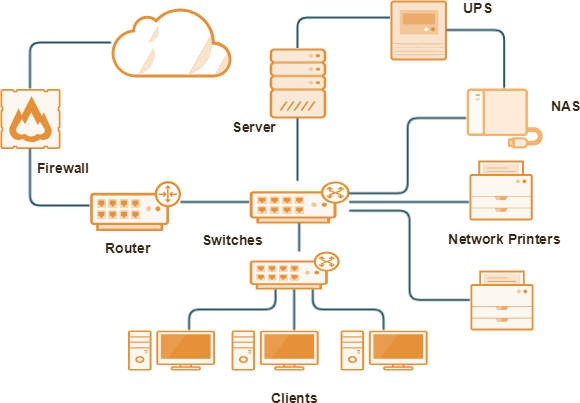
A router which acted as the gateway/firewall for the network
Two 24 port switches to direct network communications
The employees previously used the following software applications on the network:
Adobe Reader
Adobe suite for graphic designer requirements
A summary of the main business processes includes:
Designing kitchens and bathrooms for clients
Vision: to become Australia’s best kitchen and bathroom designers.
Objectives: the current objectives are listed as follows:
Design Excellence has Project Management policies and procedures that outline the organisational standards expected for gathering requirements, planning the project through to implementation and to completion. A portion of the project management work procedure for gathering and analysing requirements is provided below:
Undertaking an interview and analysing the responses
Activity 1: (Information sources)
In this activity you need to review the scenario, and then provide answers to the following in a word processor:
■ Security
■ Manageability
Acquirers Oversee the procurement of the system or product
Assessors Oversee the system’s conformance to standards and legal regulation
Suppliers Build and/or supply the hardware, software, or infrastructure on which the system will run
Support Staff Provide support to users for the product or system when it is running
A product requirements document (PRD) is a document containing all the requirements to a certain product. It is written to allow people to understand what a product should do. A PRD should, however, generally avoid anticipating or defining how the product will do it in order to later allow interface designers and engineers to use their expertise to provide the optimal solution to the requirements.
PRDs are most frequently written for software products, but can be used for any type of product and also for services. Typically, a PRD is created from a user's point-of-view by a user/client or a company's marketing department (in the latter case it may also be called Marketing Requirements Document (MRD)). The requirements are then analysed by a (potential) maker/supplier from a more technical point of view, broken down and detailed in a Functional Specification (sometimes also called Technical Requirements Document).
Switches connect multiple devices (computers, printers, servers) on the same network within a building or campus. A switch enables connected devices to share information and talk to each other. Building a small office network isn’t possible without switches to tie devices together.
Routers tie multiple networks together. When building a small office network, you’ll need one or more routers. A router connects your networked computers to the Internet. This enables all connected computers to share one single Internet connection. A router acts as a dispatcher, choosing the best route for your information to travel. It connects your business to the world, protects information from security threats, and can even decide which computers get priority over others.
Make sure your network is designed with reliability and redundancy in mind. This provides the business continuity you’ll need to bounce back quickly from unforeseen circumstances.
Activity 2: (Conduct Interview)
For the purpose of this activity the assessor will play the role of the stakeholders.
Develop an interview agenda using the organisational template below that includes
factors relating to current and future directions of the organisations network. You should use a mixture of open and closed questions.
A closing statement
Use note taking skills to document the responses for the interview questions.
Document and analysis data gathered during the interview using a word processor. You need to:
Feedback type questions or even closed questions can also be asked.
Develop a survey using the organisational template given below to gather data from the survey takers. You need to:
Once your survey has been completed by your fellow classmates, the assessor will distribute the completed surveys so that you can then analysis the responses and provide analysis notes and calculations on the responses using the organisational template provided below.
For feedback type questions this analysis should detail whether the response is pertinent to the project or not, and its importance if it is.