Relative the original drawing shown figure st-
Evolution and Biodiversity Laboratory Systematics and Taxonomy
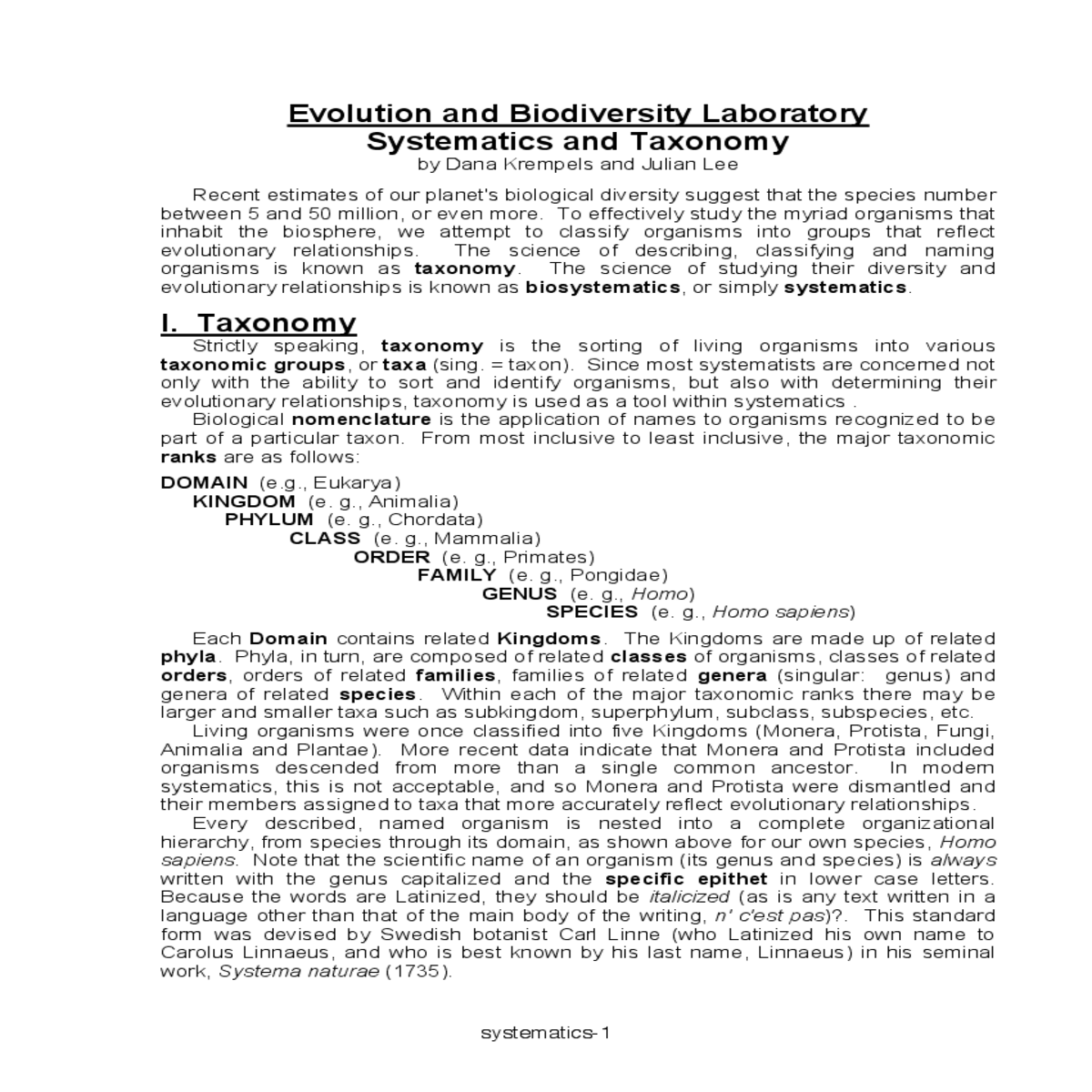
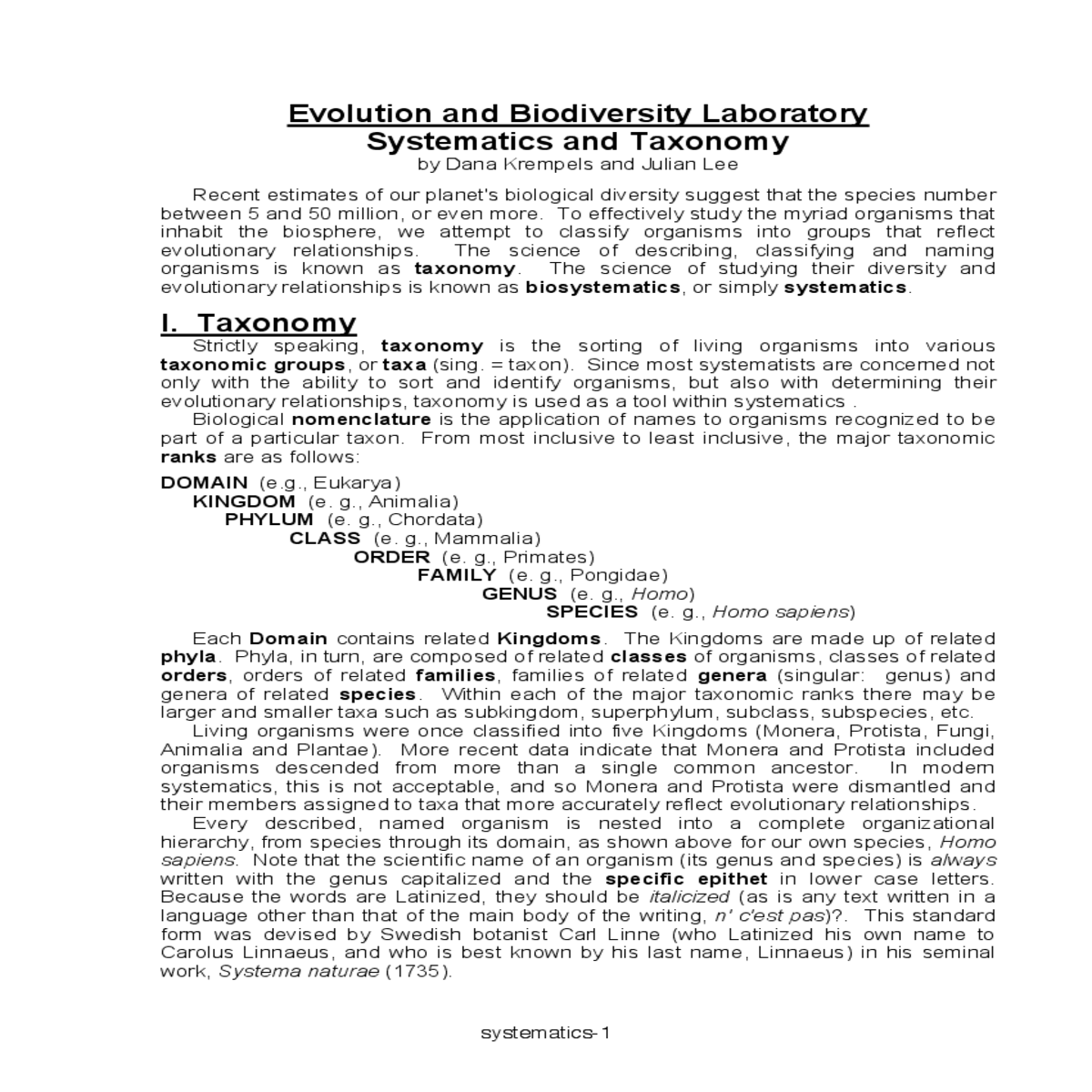
by Dana Krempels and Julian LeeRecent estimates of our planet's biological diversity suggest that the species number between 5 and 50 million, or even more. To effectively study the myriad organisms that inhabit the biosphere, we attempt to classify organisms into groups that reflect evolutionary relationships. The science of describing, classifying and naming organisms is known as taxonomy. The science of studying their diversity and evolutionary relationships is known as biosystematics, orsimply systematics.
Living organisms were once classified into five Kingdoms (Monera, Protista, Fungi, Animalia and Plantae). More recent data indicate that Monera and Protista included organisms descended from more than a single common ancestor. In modern systematics, this is not acceptable, and so Monera and Protista were dismantled and their members assigned to taxa that more accurately reflect evolutionary relationships.
Every described, named organism is nested into a complete organizational hierarchy, from species through its domain, as shown above for our own species, Homo sapiens. Note that the scientific name of an organism (its genus and species) is always written with the genus capitalized and the specific epithet in lower case letters. Because the words are Latinized, they should be italicized (as is any text written in a language other than that of the main body of the writing, n' c'est pas)?. This standard form was devised by Swedish botanist Carl Linne (who Latinized his own name to Carolus Linnaeus, and who is best known by his last name, Linnaeus) in his seminal work, Systema naturae (1735).
2. The taxon's rank. For example, the taxon Mammalia is assigned the taxonomic rank of Class. Like the taxon's name, the taxon's rank has no true biological significance. It serves only to help the biologist locate the taxon within the hierarchy.
You may notice throughout this semester that a given taxon's rank may vary, depending upon the source you're reading. For example, some publications may list "Zygomycetes," "Ascomycetes" and "Basidiomycetes" as classes within Phylum Mycota, whereas others assign each of those three taxa the rank of phylum (Phylum Zygomycota, Phylum Ascomycota and Phylum Basidiomycota) within Kingdom Fungi. Classifications change as new data become available, and older publications are not changed to reflect the more recent classifications.
systematics-2
Organisms are not randomly classified into the various taxa. The systematist uses morphological characters, DNA sequencing, protein analysis, developmental biology, karyology, ultrastructure and other information and techniques to determine evolutionary relationships to the best of his/her ability. It's an ongoing quest--and one in which you might some day participate. Let's start with some simple exercises right now.
Most taxonomic keys are arranged phylogenetically, largely because related organisms share morphological characters, and it makes sense to identify them on the basis of these characters. But some taxa show tremendous morphological variability even among closely related groups. These may be very difficult to sort and classify accurately. (Please don't ask us to key out anything from Family Chenopodiaceae, the "Goosefoot" family of flowering plants. They are %$^@# impossible.)
Let's key out (yes, this is the verb commonly used to describe the process of identifying things with a taxonomic key) some pasta! Select one individual from your container, and use the taxonomic key below to identify its species. Once you have done this, identify each different "species" of pasta in your container.
systematics-3
4a. Skin lined with small, symmetrical ridges ……….......................… Conchus crispus 4b. Skin not lined with ridges ………………………..…….......................……………… 5
5a. Body cylindrical in overall shape ……………..............................…… Rotinii spiralis 5b. Body dorsoventrally flattened in shape ……...................................... Farfalla aurea
A Key to the Hardware of Southern Florida
1a.
| ………….. |
|---|
| ………….. | |
|---|---|
| ………….. | |
| ………….. | |
|
|
| ………….. | |
|
|
| ………….. | |
| ………….. |
1. Comparison of morphology
2. Comparison of biochemistry and physiology
3. Comparison of chromosomes
4. Comparison of cell ultrastructure
5. Comparison of cellular metabolism and pathways
6. Comparison of nucleic acid sequences and protein composition 7. Studies of geographical distribution (biogeography)
8. Comparison of behavioral patterns
9. Comparison of embryological development…to name just a few. As new technologies arise, our ability to study evolutionary relationships will evolve.
All living things share these most basic symplesiomorphies:
1. Organization of structure (anatomy)
2. Capacity to generate more organisms like themselves (reproduction)
3. Growth and development
4. Ability to utilize energy to do work (metabolism)
5. Response to environmental stimuli (reaction)
6. Regulatory mechanisms to keep the internal environment within tolerable limits (homeostasis)
7. Populations that change in gene composition over time (evolution)
systematics-6
Note: the characters you have listed above--if they are exhibited only by animals and by no other living organisms--are considered symplesiomorphies only with respect to Animalia. But if you are considering all living things, then the very same animal characteristics on your list are considered synapomorphies that set animals apart from all other living organisms. This means that any given character cannot be "primitive" or "derived" on its own. It can be described as "primitive" or "derived" only in relation to characters in other taxa.
With this in mind, now list three derived characters that set mammals (Mammalia, of which you are a member) apart from all other animals (you should already know two!): 1.
List three derived characteristics shared by all primates (Primates, of which you are a member), but not shared by other mammals. (You might have to do some searching!)
1.
2.
3.
Finally, list as many derived characters as possible that make Homo sapiens different from all other great apes. Be sure to restrict your list to truly BIOLOGICAL characters--not cultural ones. (This is where it gets really challenging, and sometimes there is simply not a clear line to draw, especially where cultural influences ("nurture") interact with a truly genetic and heritable ("nature") character.)
1.
2.
3.
4.
5.
6.
List five homologous characters you share with all other vertebrates that perform the same function in you as they do in all other vertebrates:
1.
2.
3.
4.
5.5.
Of the five characters you just listed, which are unique to Homo sapiens, and which are shared with at least some other vertebrates? What does this say about the recency of your common ancestry with those other vertebrates?
List five characters you have that are analogous to characters with the same function but of different ancestral origin in any other species. Discuss the evolutionary significance of each of these in your group.
1.
2.
3.
4.
5.
2. Classical Evolutionary System
The Evolutionary Classification System is the one most commonly encountered by the student new to biology. Like the phenetic system, this classification groups organisms according to basic similarity, but unlike the phenetic system, it demands an evolutionary explanation for these similarities. Evolutionary taxonomists regard phenotypic specialization and degree of change after divergence from a common ancestor as important components of classification. This is perhaps the system's greatest weakness.Traditionally, classical evolutionary taxonomists have considered a taxon worthy of separate status if its members show a high degree of specialization relative to those of a closely related taxon. The problem arises in the subjectivity of this judgment.
Cladists believe that differences in evolutionary rate of change among branches of organisms are irrelevant to their classification. For example, the cladist recognizes that birds--despite their plumage (modified scales homologous to reptile scales) and "warm-bloodedness"--share a most recent common ancestor with the crocodiles (Reptilia), and so would place birds in Reptilia, along with the other reptilian descendants of the common ancestor.
Although some systematists feel that the cladistic system's weakness is its failure to consider unequal rates of evolution, the cladist would argue that this is one of cladism's greatest strengths. The cladistic system is the most objective and quantitative of modern classification systems, and it is to its tenets that we will adhere this semester.
…and so on.
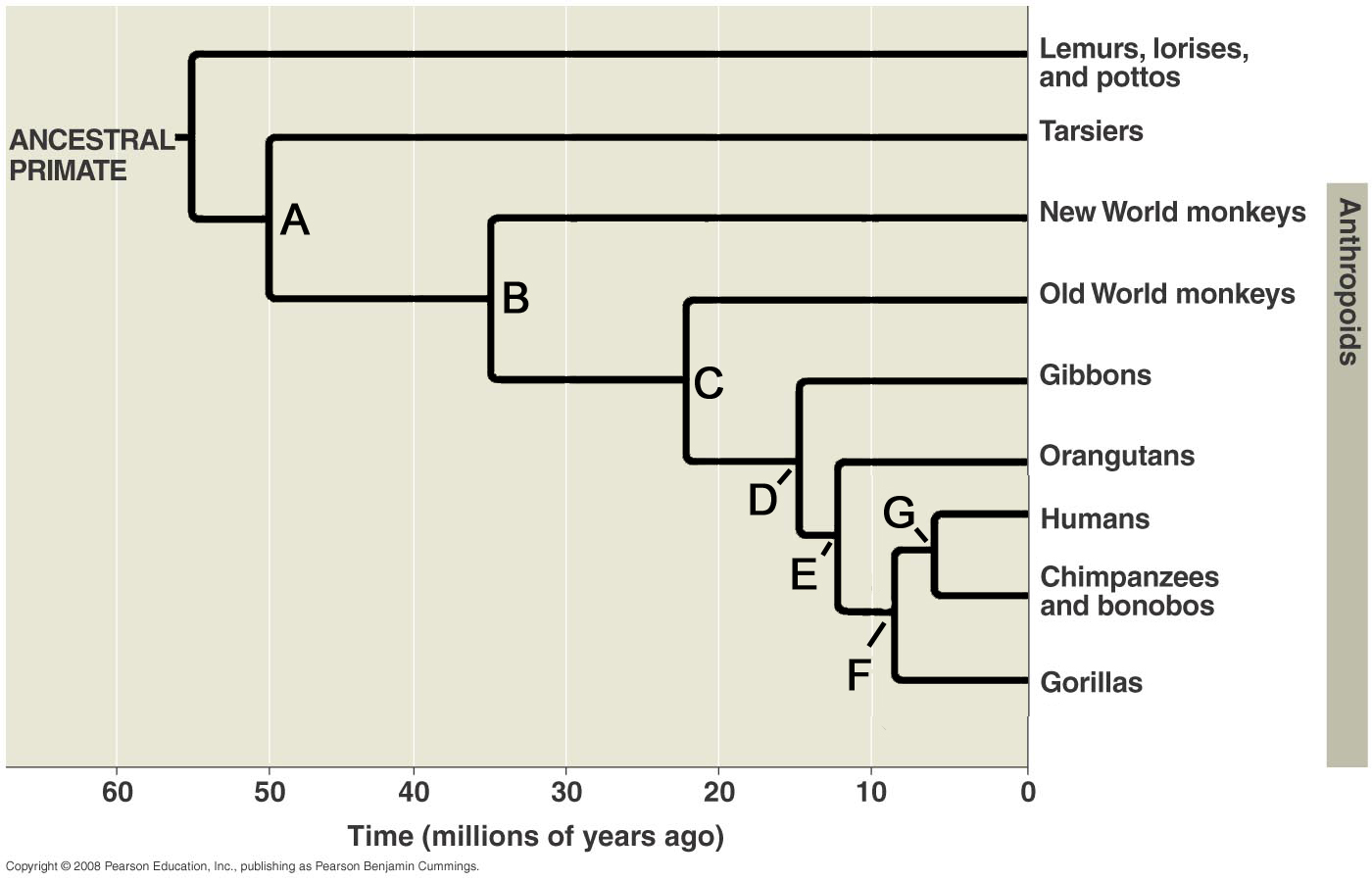
Note that this phylogenetic tree shows only recency of common descent. It does not indicate which species might be (subjectively) described as "primitive" or "derived" (Those terms are meaningless when applied to an entire species.)
Note also that two lineages branching from the same ancestor arose at the same geological time. Many people have the misconception that Homo sapiens is the “most highly evolved” species, or even the most recently evolved. Neither is true. Always remember…
Figure ST-1a. Phylogeny of primates. The nodes from which branches emerge represent the hypothetical common ancestor of all taxa above that node on the tree. The endpoints of the branches represent the descendants of that ancestor. Some phylogenetic trees include both extinct and extant (still living) taxa. In modern systematics, extinct taxa (represented by fossils) are treated the same way as extant taxa, and are not considered ancestral to extant taxa.
A paraphyletic taxon fails to include all descendants of a particular common ancestor. A polyphyletic taxon includes members that have descended from more than one different ancestor, but the common ancestor of those has not been included. These are illustrated in Figure ST-2.
Using some of the characteristics of the pasta you met earlier in this exercise, we have constructed a hypothetical phylogenetic tree showing their possible evolutionary relationships. (Figure ST-3) This may not be the only possible tree, and the more different data sets used to construct a tree that show congruency between them, the more likely it is that the tree reflects actual evolutionary relationships.
systematics-14
The hypothetical animals used in this exercise are called Caminalcules and were created and "evolved" by J. H. Camin, Professor of Biology at the University of Kansas in the 1960's. They have served as test material for a number of experiments concerning systematics, its theory and practice. Use of imaginary organisms for such studies offers a distinct advantage over using real groups, because preconceived notions and biases about classifications and evolutionary relationships can be eliminated.
Results of a cladistic analysis are usually summarized in a phylogenetic tree called a cladogram (from the Greek clad meaning "branch"), an explicit hypothesis of evolutionary relationships.
systematics-15
A Sample Procedure
We will examine the eight Caminalcules in Figure ST-4, this time in an attempt to infer the evolutionary relationships among them, as follows.Step One. Select a series of characters that can be expressed as binary (i.e., two-state). For example:
Character a: "eyes present" (+) versus "eyes absent" (-)
Character b: "body mantle present" (+) versus "body mantle absent" (-)
Character c: "paired, anterior non-jointed appendages present" (+) versus "paired, anterior non-jointed appendages not present" (-)
Character d: "anterior appendages flipperlike" (+) versus
"anterior appendages not flipperlike" (-)
Character e: "eyes stalked" (+) versus "eyes not stalked" (-)
Character f: "body mantle posterior bulbous" (+) versus
"body mantle posterior not bulbous" (-)
Character g: "eyes fused into one" (+) versus "eyes separate" (-)
Character h. "forelimbs with digits" (+) versus "forelimbs without digits" (-)
common ancestry among these three OTUs.. The same reasoning argues for common ancestry among OTUs 1, 4, and 6 (character f), and for OTUs 3 and 5 (character h), and so on.
Table ST-4. Character states of characters a - h in Caminalcules in Figure ST-4.
| character |
|
|
||||||
|---|---|---|---|---|---|---|---|---|
|
|
|
||||||
|
|
|
||||||
|
|
|
||||||
|
|
|
||||||
|
|
|
||||||
|
|
|
||||||
|
|
|
||||||
|
|
|
Figure ST-8. A cladogram based on synapomorphies in Caminalcules 1 - 8.
This is not the only possible phylogeny consistent with the character distribution among the OTUs. In practice, there are often several, or even many, cladograms that can be constructed, all of which are consistent with the data. In such cases, systematist generally applies a parsimony criterion for selecting the "best" cladogram. The rule of parsimony states that when two or more competing hypotheses are equally consistent with the data, we provisionally accept the simplest hypothesis. This is not to say that evolution is always parsimonious, only that our hypotheses should be.
A Family consisting of only OTUs 2 and 7 would not be monophyletic, because it does not include all the descendants of the common ancestor (at the branch point just below character d). Such a group would be considered paraphyletic (containing some, but not all, of a particular ancestor's descendants).
A Family consisting of OTUs 2 and 7 plus OTUs 3 and 5 would be considered polyphyletic (consisting of species derived from more than one most recent common ancestor). This is because such a taxon would be made up of groups descended from both the ancestor just below the appearance of character h, and the one just below the appearance of characters c and e.
Figure ST-9. Incorporated results of a cladistic analysis showing Linnaean relationships among the OTUs.
systematics-18
OTUs
|
||||||||
|---|---|---|---|---|---|---|---|---|
|
||||||||
|
||||||||
Use the following page to draw your cladogram. This page and your cladogram will be turned in to your TA for grading.
systematics-19