Read the mentioned-above article and write summary about
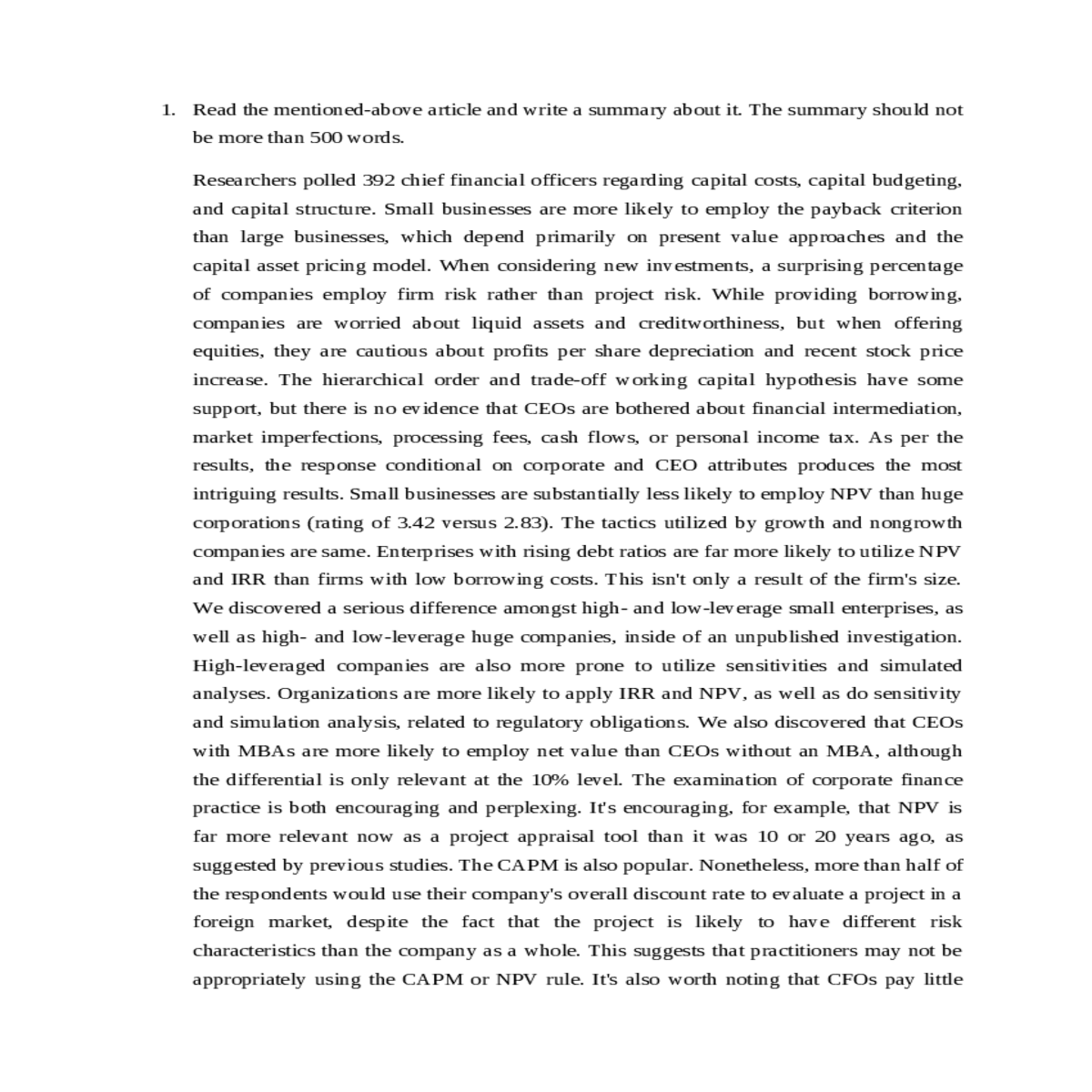
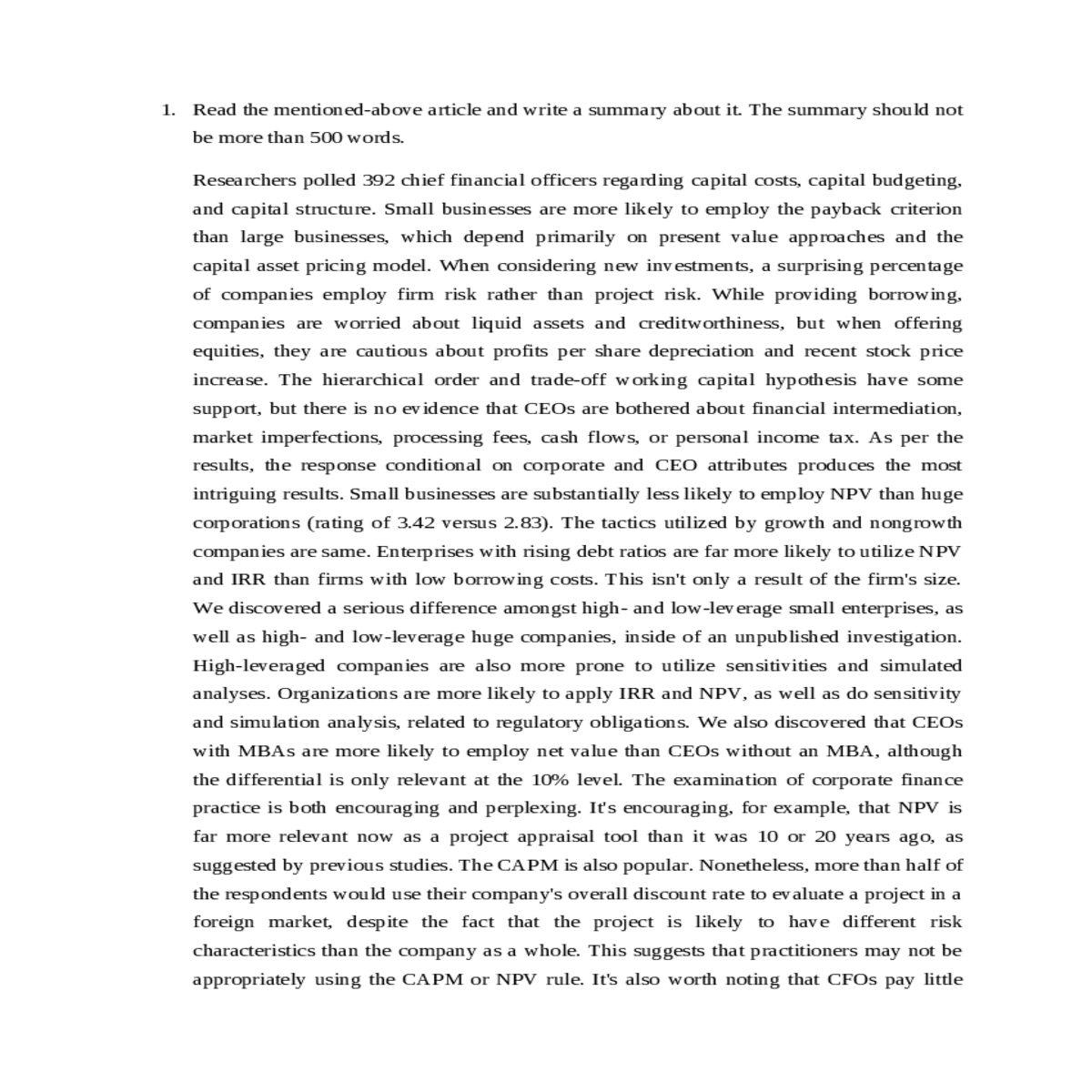
Read the mentioned-above article and write a summary about it. The summary should not be more than 500 words.
Researchers polled 392 chief financial officers regarding capital costs, capital budgeting, and capital structure. Small businesses are more likely to employ the payback criterion than large businesses, which depend primarily on present value approaches and the capital asset pricing model. When considering new investments, a surprising percentage of companies employ firm risk rather than project risk. While providing borrowing, companies are worried about liquid assets and creditworthiness, but when offering equities, they are cautious about profits per share depreciation and recent stock price increase. The hierarchical order and trade-off working capital hypothesis have some support, but there is no evidence that CEOs are bothered about financial intermediation, market imperfections, processing fees, cash flows, or personal income tax. As per the results, the response conditional on corporate and CEO attributes produces the most intriguing results. Small businesses are substantially less likely to employ NPV than huge corporations (rating of 3.42 versus 2.83). The tactics utilized by growth and nongrowth companies are same. Enterprises with rising debt ratios are far more likely to utilize NPV and IRR than firms with low borrowing costs. This isn't only a result of the firm's size. We discovered a serious difference amongst high- and low-leverage small enterprises, as well as high- and low-leverage huge companies, inside of an unpublished investigation. High-leveraged companies are also more prone to utilize sensitivities and simulated analyses. Organizations are more likely to apply IRR and NPV, as well as do sensitivity and simulation analysis, related to regulatory obligations. We also discovered that CEOs with MBAs are more likely to employ net value than CEOs without an MBA, although the differential is only relevant at the 10% level. The examination of corporate finance practice is both encouraging and perplexing. It's encouraging, for example, that NPV is far more relevant now as a project appraisal tool than it was 10 or 20 years ago, as suggested by previous studies. The CAPM is also popular. Nonetheless, more than half of the respondents would use their company's overall discount rate to evaluate a project in a foreign market, despite the fact that the project is likely to have different risk characteristics than the company as a whole. This suggests that practitioners may not be appropriately using the CAPM or NPV rule. It's also worth noting that CFOs pay little heed to momentum and book-to-market value risk indicators. The most relevant debt policy elements, according to our research of financial performance, are informally criteria such as liquid assets and ratings agencies. The much more important elements affecting equity offering are several other unstructured criteria such as EPS reduction and historical stock price gain. Researchers find minority support for enterprises adhering to the trade-off approach and aiming for a certain debt to equity ratio. Additional findings, such as the significance of equity underestimation and financial strength, support the pecking-order theory. The evidence for these hypotheses, nevertheless, does not stand up under inspection (for example, the data is typically not compatible with knowledge asymmetry driving pecking-order-like behavior), and it is much weaker for more sophisticated theories. Communicating, prepayment penalties, chronic underfunding costs, asset substitution, negotiating with workers, net income calculations, and market growth concerns all have mixed or no evidence that they influence relationship between capital structure.
Historical return of financial asset- The previous rate of return and performance of a financial instrument, such as a bond, stock, security, index, or fund, is known as its historical return. In financial analysis, historical data is frequently employed. Historical returns can be utilized to anticipate future data points when it comes to standard deviations.