Push fluid orally and maintain the fluid balance chart
NUR250 Medical Surgical Nursing-Neville Nursing Care Plan
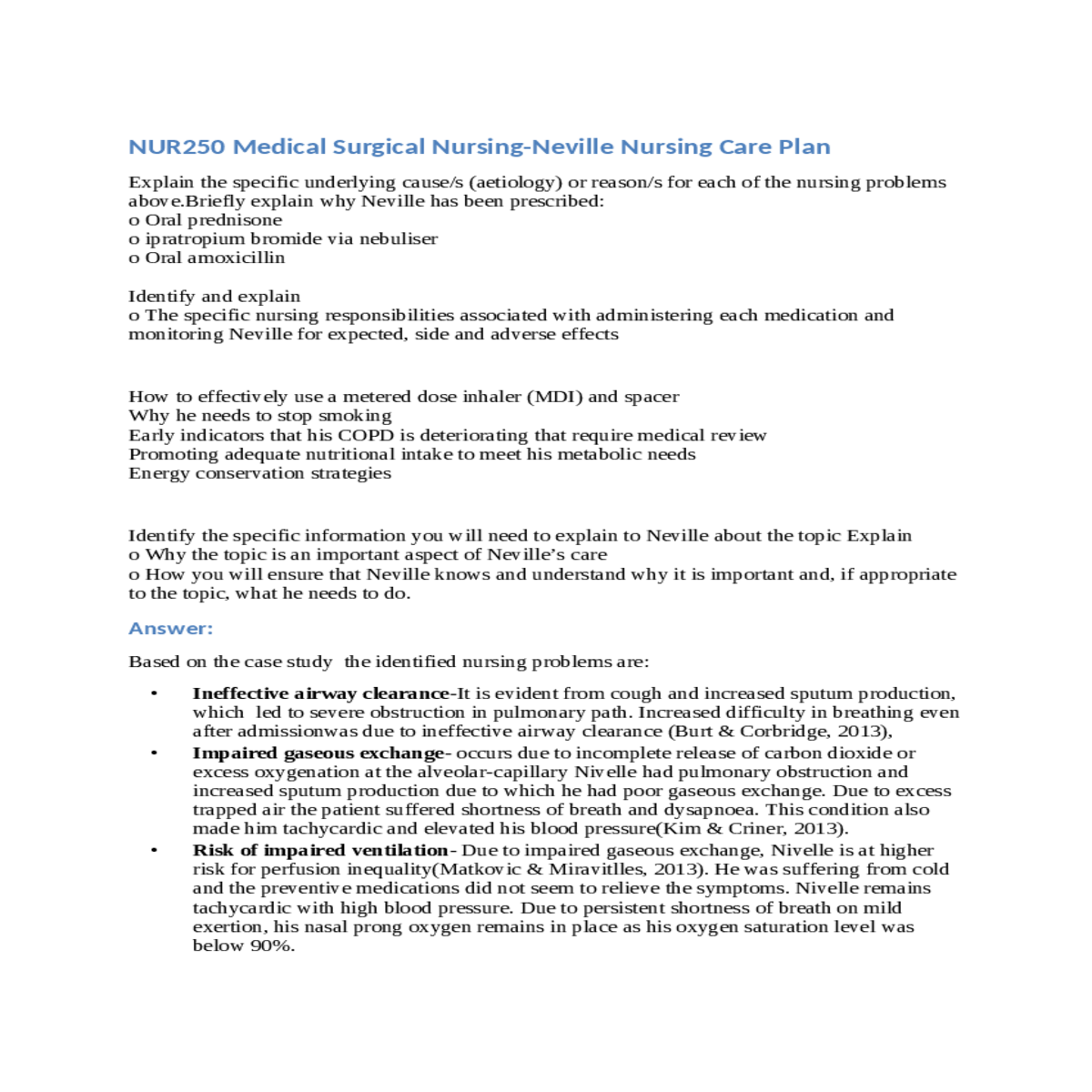
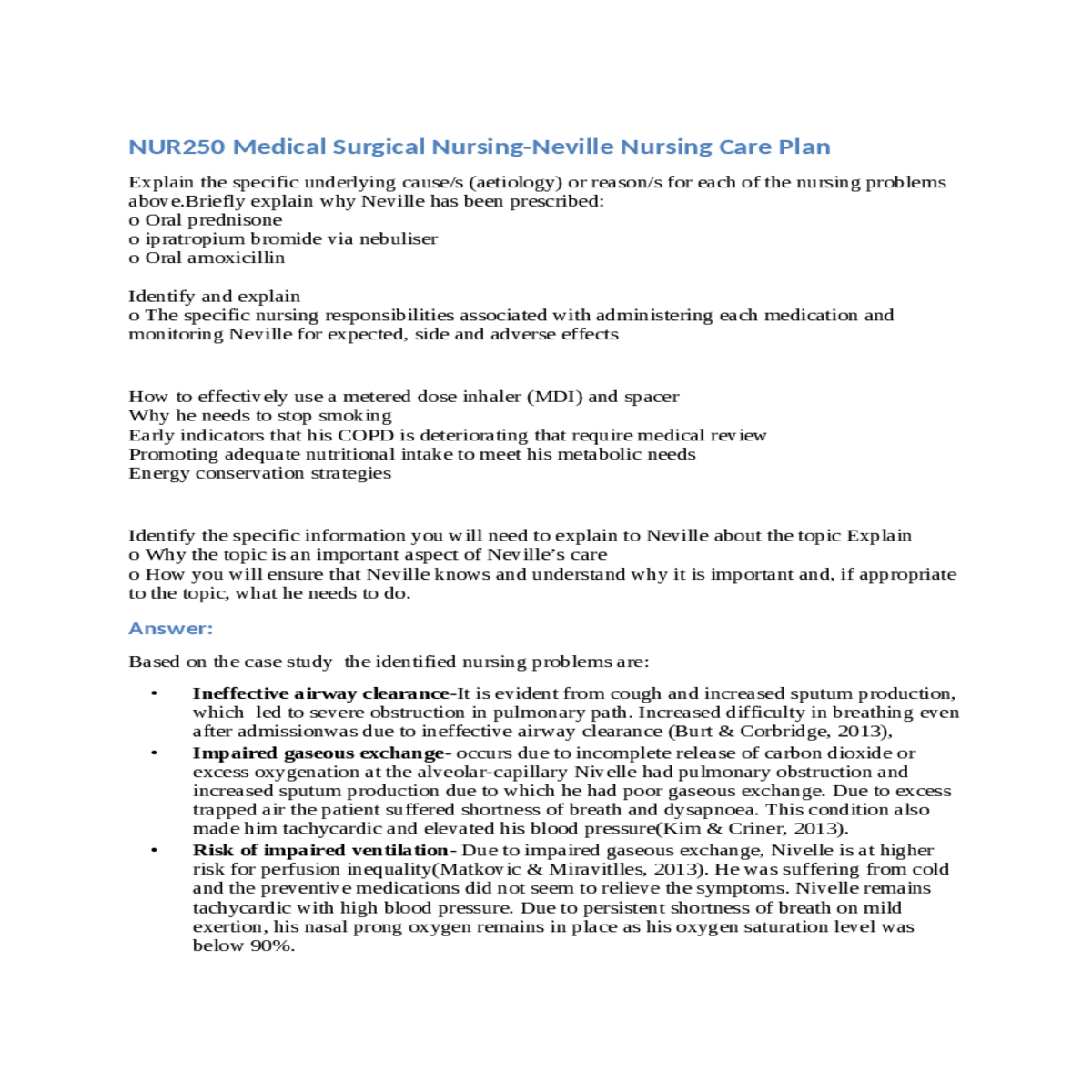
Explain the specific underlying cause/s (aetiology) or reason/s for
each of the nursing problems above.Briefly explain why Neville has been
prescribed:
o Oral prednisone
o ipratropium bromide via nebuliser
o Oral amoxicillin
Identify and explain
o The specific nursing responsibilities associated with administering
each medication and monitoring Neville for expected, side and adverse
effects
Answer:
- Ineffective airway clearance-It is evident from cough and increased sputum production, which led to severe obstruction in pulmonary path. Increased difficulty in breathing even after admissionwas due to ineffective airway clearance (Burt & Corbridge, 2013),
- Impaired gaseous exchange- occurs due to incomplete release of carbon dioxide or excess oxygenation at the alveolar-capillary Nivelle had pulmonary obstruction and increased sputum production due to which he had poor gaseous exchange. Due to excess trapped air the patient suffered shortness of breath and dysapnoea. This condition also made him tachycardic and elevated his blood pressure(Kim & Criner, 2013).
- Risk of impaired ventilation- Due to impaired gaseous exchange, Nivelle is at higher risk for perfusion inequality(Matkovic & Miravitlles, 2013). He was suffering from cold and the preventive medications did not seem to relieve the symptoms. Nivelle remains tachycardic with high blood pressure. Due to persistent shortness of breath on mild exertion, his nasal prong oxygen remains in place as his oxygen saturation level was below 90%.
- Imbalanced nutrition-The patient is experiencing acute respiratory distress. In addition, current medication, dyspnoea, and increased sputum production had increased the risk of anorectic conditions. The patient is having poor diet due to pulmonary obstruction and shortness of breath on exertion even after admission.Nivelle, is having poor diet due to this condition and his body is not meeting its basic metabolic requirements adequately. He was ordered to push oral fluids and had high requirement of protein and carbohydrates. Consequently, it led to nutritional imbalance (Hsieh et al., 2016).
- Risk for infection-Being COPD patient, Nivelle’s innate immune system is very weak. This impaired immune system makes him highly vulnerable to infection in respiratory tract. Due to inadequate first line of defence the patient has reduced ciliary secre
- tions increasing the susceptibility of bacterial colonisation (Matkovic & Miravitlles, 2013). Further, malnutrition added to this vulnerability and acute exacerbations.
Nursing Care Plan: Neville
Note: Dot points recommended in care plan. Click and type in each cell, click enter in a cell to make it longer
A reminder that all information must be referenced
| Nursing problem: To keep the patient safe | |||
| Goal of care | Nursing interventions/actions | Rationale | Indicators your plan is working |
|
1.Correct equipment care
|
It prevents oxygen saturation to decrease below 90%. It prevents condition of hypoxemia (Corrado et al., 2016). |
Oxygen saturation of 88-90% achieved. |
Nursing problem: dehydration |
|||
| Underlying cause or reason: Neville is at greater risk of dehydration. It will increase the viscosity of secretions. Fluid balance is essential to increase in pressure on diaphragm. It helps aid in gastric distension. | |||
| Goal of care | Nursing interventions/actions | Rationale | Indicators your plan is working |
Adequate intake of fluid before, during after meals. Push fluid orally and maintain the fluid balance chart. Give oral warm fluid to the patient |
|||
Nursing problem: Malnutrition and therefore need to fed |
|||
| Underlying cause or reason: There is an increase in resting energy expenditure as the patient has to put effort while breathing. Patient has dyspnoea which increases difficulty in swallowing and sometimes alteration of taste due to mouth breathe | |||
| Goal of care | Nursing interventions/actions | Rationale | Indicators your plan is working |
| To fed the patient for nutrition needs and help Neville to gain weight | Assess the nutritional needs Assess the food intake, dietary behaviour (Melo, Albuquerque & Aragão, 2012) |
During anorexia caused by the respiratory distress, extra calories are required (Bailey et al., 2012). | Increase in body weight |
Nursing problem: Poor mobility |
|||
| Goal of care | Nursing interventions/actions | Rationale | Indicators your plan is working |
Improve mobility to improve activities of daily living and quality of life of the patient |
1.Explain the tripod position to Neville, that is how stand or sit leaning forward and forcing the diaphragm downwards and stabilising the chest (Brien et al., 2016) |
1.Reduce the work of breathing 2. Supporting arms when performing daily activities reduces demand for neck and chest muscles and arms when breathing. It will reduce dyspnea development (Rutten et al., 2014) |
Patient will be able to walk or stand without difficulty patient does not indulge in strenuous activities, it indicates of careful implementation of the plan. Improved breathing is evidence of effective coping. |
Nursing problem: Risk of infection |
|||
| Underlying cause or reason: In the case study, Nevlle is highly susceptible to infection as he has long history of smoking, which is sure to exacerbate the COPD symptoms and destroy the lung function. In addition, he is also prone to infections by indoor and outdoor pollution. Other risks that may hamper patient safety are nutritional and emotional distress and lower economic status. | |||
| Goal of care | Nursing interventions/actions | Rationale | Indicators your plan is working |
1. Ensure that the patient’s belongings, clothes living area are free of dust or pollution both at hospital and in home after discharge 2.Regulary monitor the vital signs |
Normal vital signs and no indicatefever, allergy found. | ||
Medication management
Oral amoxicillin is administered as Nevile is highly susceptible to bacterial infection in current situation. This medication needs intake of plenty of fluids. The patient will be educated about the contraindications such as gastrointestinal pain, irritation of eyes, nausea and vomiting which may occur as side effects of oral amoxicillin. There are adverse effects if used for prolonged period. This drug is found to have interactions and hence will be closely monitored (Brusse-Keizer et al., 2015).
While administering this medication it will be ensured that appropriated dosage will be given as recommended by the physician and take the approval of the doctor prior to change of dosage as a part of professional communication (Scotten et al., 2015).
Patient teaching
Clinical judgement and handover
- Assessment of lungs sound and vital signs- to ensure proper functioning of lungs
- Check ECG and pulse rythm- Since patient already had high blood pressure and tachycardic
- Increase brightness of light in room and rise bed rails-to reduce restlessness in patient and provide comfortable breathing
- Monitor auscultation of the lungs to identify bronchospasms
Identify-
- Registered nurse appointed to care for patients with pulmonary disorders
- Nivelle is a 62 year old man admitted with established COPD
- Patient had history of excessive smoking
Situation-
- Improvement in upper respiratory symptoms
- Shortness of breath and dyspnea
- Tachycardia
- High blood pressure
- Malnutrition
- Nnasal prong remains in place
- Currently administered with oral prednisone, ipratropium bromide, and oral amoxicillin
Patient was admitted with worsening dyspnoea, cough and increased sputum production
- Excessive smoking history
- Persistent cough and cold
- Low respiratory rate
- Shortness of breath on exertion
- Unable to take more than few steps before rest
- Tachycardia and high blood pressure
Agreed plan-
The patient has established moderate chronic obstructive pulmonary disorder (COPD)
- Continue nasal prong oxygen @ 2L/min
- Maintain oxygen saturation between 88-92%
- spirometry before and after nebulisers
- Diet to prevent malnutrition
- Continue with current medication
- Administer Pneumococcal and flu vaccines prior to discharge
Read Back-
Patient and family needs must follow up with attending physician and registered nurse for optimising treatment. A healthy lifestyle modification in addition to smoking cessation is required (Scotten et al., 2015).
References
Brusse-Keizer, M., VanderValk, P., Hendrix, R., Kerstjens, H., & van der Palen, J. (2014). Necessity of amoxicillin clavulanic acid in addition to prednisolone in mild-to-moderate COPD exacerbations. BMJ open respiratory research, 1(1), e000052.
Burt, L., & Corbridge, S. (2013). COPD exacerbations. AJN The American Journal of Nursing, 113(2), 34-43.
Ignatova, G. L., & Antonov, V. N. (2017). Impact of vaccination on the course of bronchial and systemic inflammation in patients with COPD and CHD. Terapevticheskii arkhiv, 89(3), 29.
Jellington, M. O., Sørensen, E. E., & Overgaard, D. (2016). Nursing challenges in relieving dyspnoea experienced by patients with COPD during hospitalization.
Melo, E. M., Albuquerque, M. P., & Aragão, R. M. (2012). Nursing diagnosis prevalence in patients at an intensive care unit of a public hospital. Revista de enfermagem UFPE on line-ISSN: 1981-8963, 6(6), 1361-1368.
Miguel Padilha, J., Sousa, A. P., & Pereira, F. M. (2016). Participatory action research: A strategy for improving self-care management in chronic obstructive pulmonary disease patients. Action Research, 14(3), 240-256.
Sewell, L., Mitchell-Issitt, C., Barley, K., Chebbout, C., Msimanga, S., Clinch, L., ... & Singh, S. J. (2014). S84 Is There A Relationship Between Acceptance Of Referral To Smoking Cessation Services Or Pulmonary Rehabilitation And Readmission Rates For Patients With Copd?.
Spencer, P., & Hanania, N. A. (2013). Optimizing safety of COPD treatments: role of the nurse practitioner. Journal of multidisciplinary healthcare, 6(53-63).