Product life cycle analysis
International Business

Faculty, Strategy
in partial fulfillment of the course requirements of International Business
Sriram Varanasi [PGP/09/102]
Suma Kamath [PGP/09/103]
Table of Contents
3.2 Marketing Experiences and Difficulties 6
Article on “Strategies for Entering and Developing International Markets” by David Arnold 9
6.4 Product Life Cycle Analysis 14
8 Does “Made in India” Matter? 19
Executive Summary
About Titan Industries
Established in 1984 as a joint venture between the Tata Group and the Tamil Nadu Industrial Development Corporation (TIDCO), Titan Industries is India's leading watch manufacturer. Its business activities cover watches, clocks and jewellery. The company has built, in a relatively short span of time, an enviable reputation for its corporate practices, products and services.
After entering the watch segment in 1987, Titan entered the precious jewellery segment in 1995 under the brand name Tanishq. It is India’s only fine jewellery brand with a national presence and is an acknowledged business leader in the country’s $10-billion jewellery market. Tanishq jewellery is sold exclusively through a company controlled retail chain which now has 69 outlets spread over 53 Indian cities and is still expanding. Tanishq jewellery is also exported to Europe, the US, the Middle East and Australia.
Titan makes and markets a range of decorative table clocks incorporating both classic and contemporary designs, including some ethnic styles.
Titan plans watches that give stock prices, news
Internationalization at Titan
Marketing Experiences and Difficulties
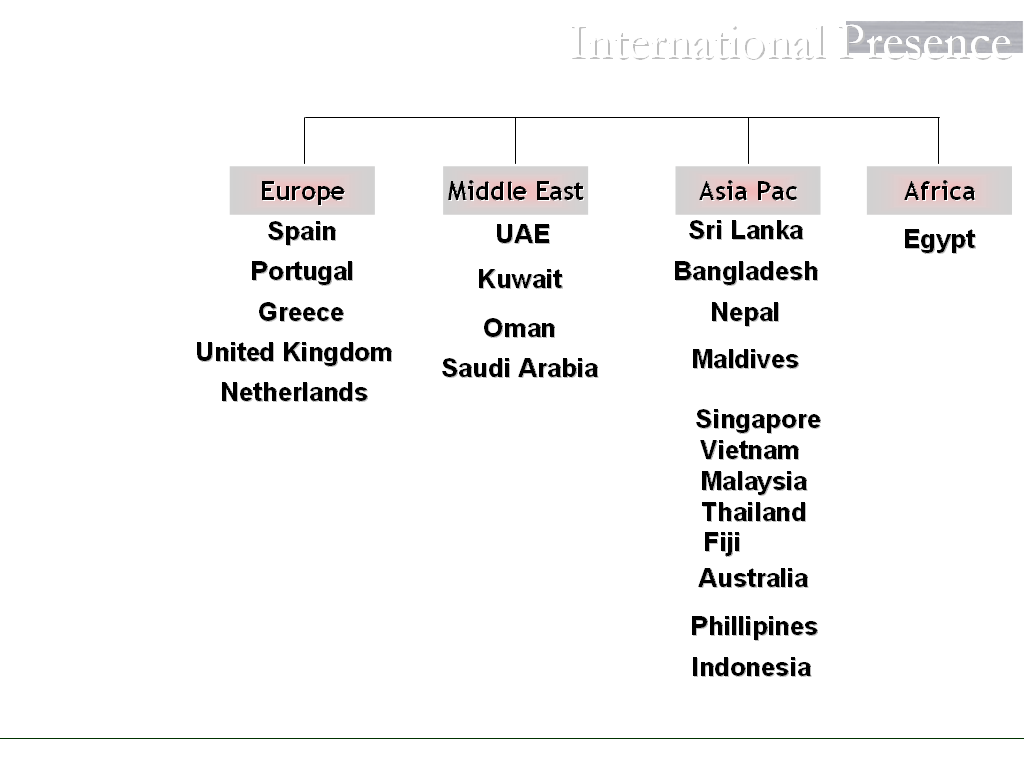
After tasting success in these markets, the company set its sights on Europe. It decided against the soft option of driving its sales through private label exports. It launched its watches under its own brand name in the UK in 1993. However, the company realized that a mature market like Europe required a specific campaign for each country, a strategy that would require huge investments. The Mecca of Swiss watches was a huge challenge in every sense of the word. A direct sales route was employed in UK and a distributor-led route in other markets. With brands jostling for shelf space, retailers needed good reasons to stock the brand. The need of the hour was also to create strong consumer demand. So the company unleashed a massive advertising campaign to create brand awareness. Thus, the investments were huge and the returns meager. The efforts were arduous and time consuming. Also, in the time taken to launch, the initial designs created had to be augmented with a new collection. So the company went back to the drawing boards and created a completely new collection for the European market.
Results and Remedies
The company discovered that the returns failed to meet the expectations. The cumulative losses of its European operation touched £ 9 million. Titan had underestimated the investments required for the European market and overestimated the returns. It did not have the financial wherewithal to continually invest in the market1.
Future Plans
Problem Statement
Rational Behind Selecting Titan
TIME achieved significant growth in turnover to $15.89 million in 2003-04 from $7.86 million in the previous year. The Singapore company saw sales at SGD seven million and the operation posted a profit of SGD 0.49 million. However, the funds employed in the European operations aggregate to $39.50 million and TIML clocked losses to the tune of £9 million in its European operations.
In order to understand internationalization efforts of a company, Titan was the ideal choice because of its experiences in different markets and its diverse customer segments. Of particular interest to us, was its foray into the European market and its attempts to create a demand for low priced premium watches against the apparent tastes of the European consumers. A study of its strategies and the reasoning behind them would give us invaluable insights on the concept of internationalization as a means of growth.
Hypothesis/ Scope of the Study
Methodology
In case of a smaller domestic market, internationalization can help by increasing economies of scale
Exploit a distinctive and differentiating asset (often protected as intellectual property), such as a brand, service model, or patented product
Licensing
From the prior sections we can see that Titan was trying to increase its economies of scales by targeting international markets. In the case of Titan, the company did not enjoy high brand equity in the international markets that it targeted. We can also infer from the problem statement that the markets were heterogeneous – i.e. the expectations of different markets were different with respect to the product and promotion mix. We can also infer that for a product category like watch – brand has a vital role to play.
Analysis
Titan had been itching to go global way back in the early ’90s, soon after tasting success in the Indian market. At the time, it had even toyed with the idea of turning into a contract manufacturer for a global watch brand. This would mean minimum investment, cost and manufacturing efficiencies, and substantial profits. Besides, it would be totally risk-free. Yet, the idea died a quiet death. Titan felt there was no glory in being a contract manufacturer who would be constantly driven down in terms of price. This meant that to take Titan to the world, the company would have to take the arduous route of brand building and large investments. Titan was looking at building a brand abroad and creating value and booking a high return on investment in the long run.
The European watch market is one of the world’s most advanced and sophisticated ones and has very high barriers to entry due to the presence of very strongly rooted local brands of Swiss origin that were global leaders in their respective categories. Also, Titan had created its distributorship structure on the basis of its prior experience in doing the same in the Indian market. However what it did not realize was the fact that European distributors expected much higher returns and expected them much faster with little or nil loyalty to the brand or the organization.
Brand – Market Fitment
Brand – Market Fitment
Based on the parameters defined above, we can consider four quadrants as shown in the above diagram. Quadrant I shows that, when a company with high brand equity is trying to launch a product in a homogeneous market, the promotional expenses and investments required to gain the acceptability of the customers is relatively less. Similarly quadrant II shows that, when a company with low brand equity is trying to launch a product in a homogeneous market, the investment in promotion is moderately high but not too high because it is relatively easy to position the product for the homogeneous market. Further, it is easier to gain the acceptability of the entire market with the portrayal of a single brand image.
Competing on Price
Product – Market Fitment
In fundamental terms, entering a new country-market is very like a start-up situation, with no sales, no marketing infrastructure in place, and little or no knowledge of the market. Despite this, companies usually treat this situation as if it were an extension of their business, a source of incremental revenues for existing products and services. Two aspects of the typical approach are particularly striking. First, companies often pursue this new business opportunity with a focus on minimizing risk and investment—the complete opposite of the approach usually advocated for genuine start-up situations. Second, from a marketing perspective, many companies break the founding principle of marketing—that a firm should start by analyzing the market, and then, and only then, decide on its offer in terms of products, services, and marketing programs. In fact, it is far more common to see international markets as opportunities to increase sales of existing products and so to adopt a “sales push” rather than a market-driven approach. Given this overall approach, it is not surprising that performance is often disappointing2.
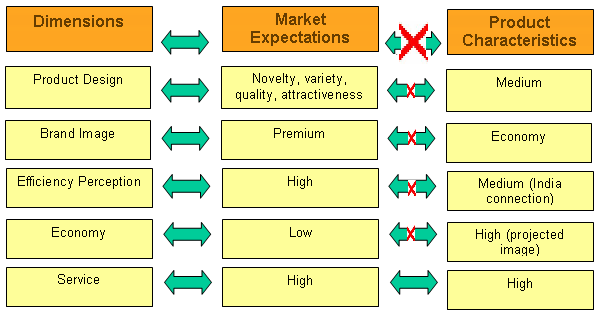
In any market where a company tries to foray, it must do due diligence before launching its products. The company must try to match its product specifications with respect to the market expectations on a number of dimensions. (This list of dimensions is only suggestive and not exhaustive as some of the dimension criteria will be of paramount importance in one culture while at the same time might not command the same importance in other cultures). Thus, there must be Market-Product fitment on various dimensions that are deemed important for a particular market.
Premium brand image: A watch, in Europe, is more of a fashion accessory product than a functional one. For this reason a premium brand image enhances the product’s appeal. Titan, on the contrary had positioned itself in the European market as an economy brand. This was one of the biggest reasons for its failure.
Product Life Cycle Analysis
For new markets such as European and US, the products are located in the introduction stage of the PLC. It is important to note that the Titan’s brand name is continually used to name and launch new products (Titan finally decided not to go for contract manufacturing after initially toying with the idea for sometime, primarily because that would have meant no visibility for their brand and it would constantly have been under pressure from the big international contractor to cut down on prices and hence margins)3.
BCG Matrix Analysis
Sales and Distribution
Modes of Market Entry
Low intensity mode of entry minimizes risk but looses control over market information and customer feedback.
Thus, contracting with a local distributor requires no investment in the country-market in the form of offices, distribution facilities, sales personnel, or marketing campaigns. Under the normal arrangement, whereby the distributor takes title to the goods (i.e., buys them) as they leave the production facility of the international company. Even credit risk is not there, assuming that the distributor has offered a letter of credit from its bank. However, this also minimizes control, since the international company will have little or no involvement in most elements of the marketing plan, including how much to spend on marketing, distribution arrangements, and service standards. In particular, effective control over marketing operations is impossible without timely and accurate market information, such as customer behavior, market shares, price levels, and so on. In many cases, low-intensity modes of market participation cut off the international firm from this information, since third-party distributors or agents jealously guard the identity and buying patterns of their customers for fear of disintermediation.
Channel Design
We propose the following generalized framework that can be used to analyze what type of sales and distribution force should a company use, while it plans to enter a new international market.
On the other hand, when the market is fragmented (as in the customers are geographically dispersed and are small) and the product is standardized (as in the product is specialized), we should use the Distributor’s sales force. The advantage of using distributor is that not much amount needs to be incurred in setting up the distribution channel. But the company looses out on important information about customer behavior etc.
Channel Management
In case of Titan, as we have already noted, a direct sales route was employed in UK and a distributor-led route in other markets. With brands jostling for shelf space, retailers needed good reasons to stock the brand and they had loyalty only for brands that gave them margins. Titan’s strategy might have been in keeping with taking low risk while it entered the un-chartered terrain of new European market. But as has already been stated, this is where most of the company’s do a mistake because they do not realize that by minimizing the financial risk, they have in fact maximized their marketing risk, by relinquishing effective control over marketing operations which makes it impossible to get timely and accurate market information, since third-party distributors or agents jealously guard the identity and buying patterns of their customers for fear of disintermediation4.
Does “Made in India” Matter?
the proximity of the market,
stage of development of the market,
Thus, we can infer that the “Made in India” tag affects different company’s differently depending upon which sector they are into. And again, their credibility depends on whether they market products or services.
Again, depending up on the stage of the development of the market, it so happens, that the same company might be recognized as a leader in some countries (e.g. in growth markets of developing countries) but not in others (e.g. matured markets of developed countries).
Conclusion
Based upon the analysis and frameworks developed above, we suggest the following recommendations along with relevant reasons (in brief) for Titan to establish a solid footprint in European watch market:
Brand-Market fitment: We have seen that Titan’s experience is typical of the third quadrant as it has low perceived brand equity in Europe and is operating in heterogeneous markets. As a result, the promotional expenditure will be huge. We suggest that Titan should change its strategy to focus on two top markets. This will bring the company’s European operations to fourth quadrant (please refer Brand-Market Fitment framework), resulting in relatively lower promotional expenditure to build up the brand.
PLC Analysis: Aggressive advertisement to establish brand value is needed in European markets as the company’s product is in the introductory stage there.
BCG Analysis: This analysis again suggested divesting Titan’s unprofitable ventures and focusing on top two markets.
Notes
Titan’s Internal-External Analysis Using SWOT
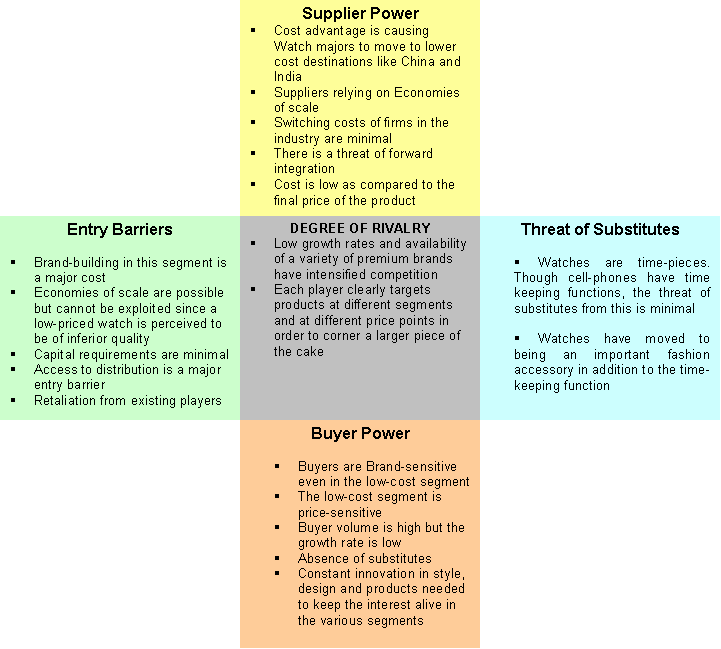
Porters Five Forces Analysis for Global Watch Industry
Sources of Information
Online Sources
www.titanworld.com
Other Sources
Coughlan & Anderson, “Marketing Channels”, Sixth Edition PHI
(http://www.thehindubusinessline.com/2004/11/09/stories/2004110901420200.htm)↩︎
The PLC above has been focused upon the Titan’s watches category, as Tanishq jewellery would be at an entirely different stage of the PLC.↩︎