Prime factorization arrange the primes that and exponentsi
1
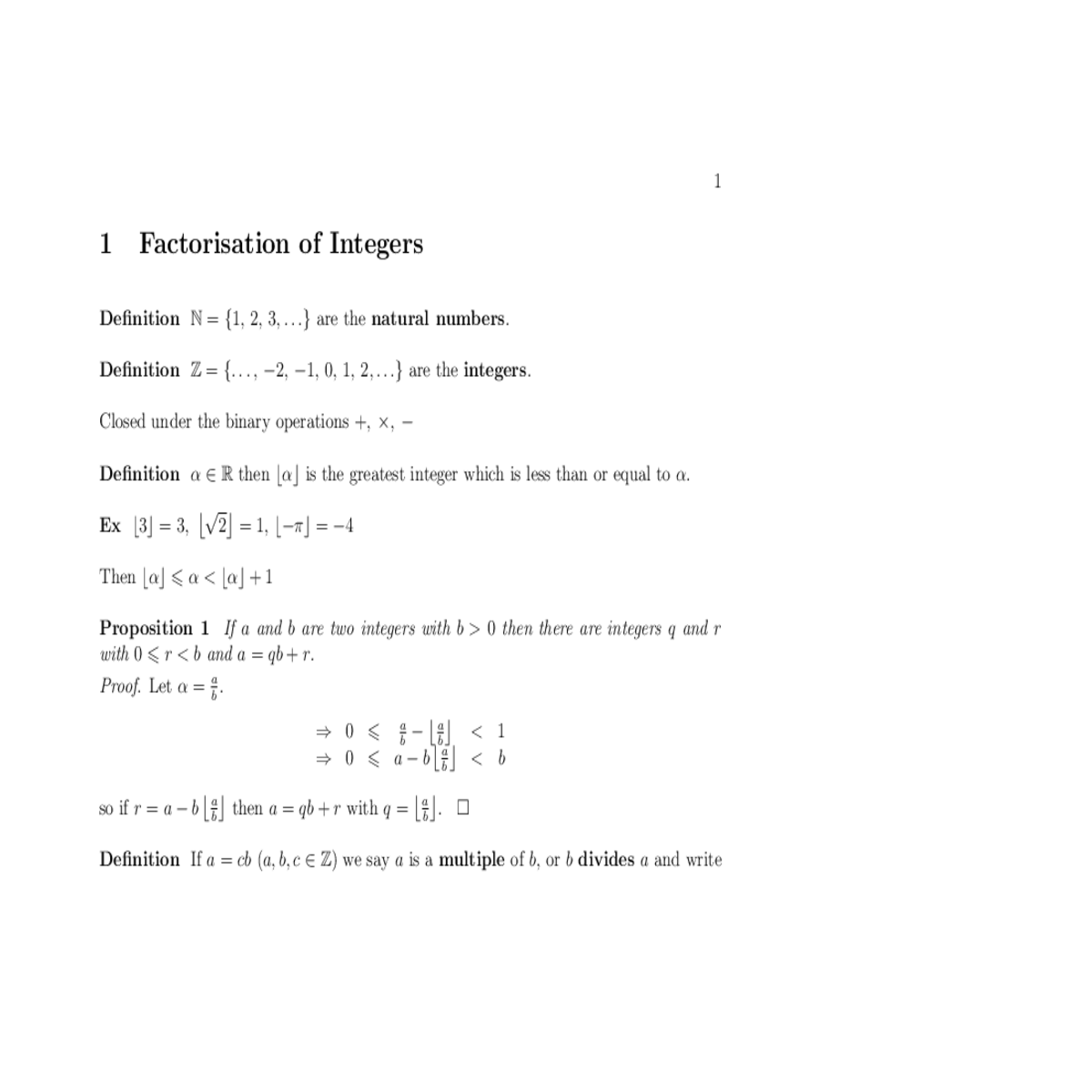
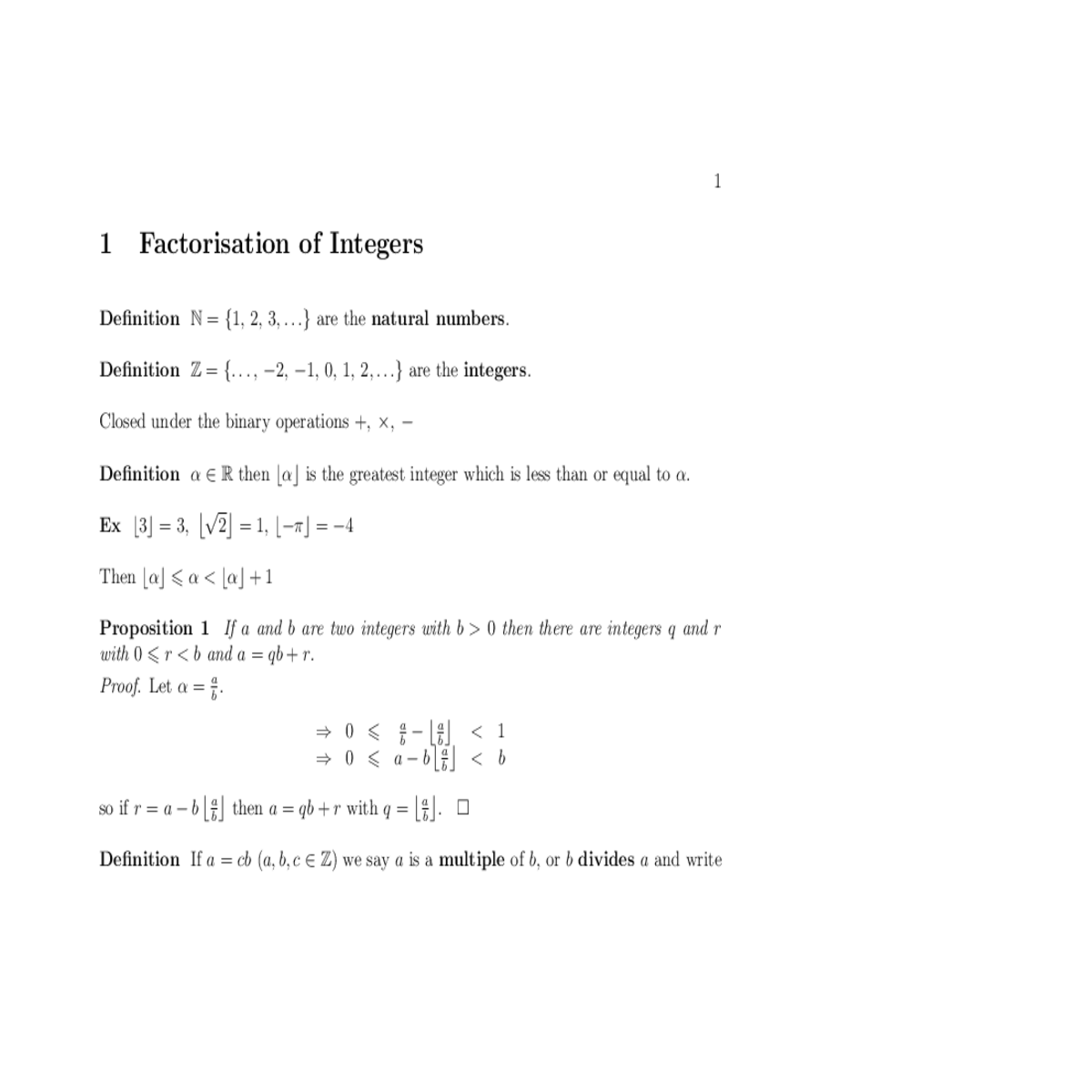
1 Factorisation of Integers
| Definition α ∈R then ⌊α⌋is the greatest integer which is less than or equal to α. | ||
|---|---|---|
| Ex ⌊3⌋= 3, | √2 | |
Then ⌊α⌋⩽α < ⌊α⌋+ 1
Proposition 1 If a and b are two integers with b > 0 then there are integers q and r
| so if r = a −b | a | 0 | ⩽ ⩽ |
a | □ | < |
|
|||
|---|---|---|---|---|---|---|---|---|---|---|
|
||||||||||
| 0 | < | |||||||||
| b | ||||||||||
| then a = qb + r with q = | a b |
. | ||||||||
| b | ||||||||||
Proposition 2 If b ̸= 0, c ̸= 0 then
(a)
Definition If b|a and b ̸= 1 or a then we say b is a proper divisor of a. If b does not divide a write b ∤a.
Definition P = {p ∈N : p > 1
and the only divisors of p are 1 and p} are the
prime numbers. Then N \ (P
∪{1}) are the composite
numbers.
P = {2, 3, 5, 7,
11, 13, 17, 19, 23, . .
.}.
This process must terminate in less than n steps. Hence n = q1q2 . . . qs with s < n. □
Ex 10725 = 3 · 5 · 5 · 11 · 13
k
αj
We can use the sieve of Eratosthenes to list the primes 2 ⩽p ⩽N.
| If n ⩽N and n is not prime, then n must be divisible by a prime p ⩽and p2 >√N ⇒p1p2 > N). | √N (if p1 > | √ |
|
|---|
(ii) 9, 15, 21, 27, . . . multiples of 3 from 32on
(iii) 25, 35, 55, 65, . . . multiples of 5 from 52on
| Ex N = 16, |
|---|
{2, 3, ̸4, 5, ̸6, 7, ̸8, ̸9, ̸10, 11, ̸12, 13, ̸14, ̸15, ̸16}
√N. We are left with all
How many primes are there ?
Note:
| ∞ | 1 | |||||
|---|---|---|---|---|---|---|
| n=1 | n | |||||
| ∞ | 1 |
|
||||
| n=1 | n2 | |||||
| We can show | ∞ | 1 |
|
|---|---|---|---|
| j=1 | pj |
|
| If x > 0, let S(x) = #{n ∈N : n2⩽x}. Then S(x) = ⌊√x⌋. We can show | ||
|---|---|---|
| π(x) | = | |
| ∼ | ||
{0}. If a ∈Z then M = {na : n ∈Z} is a modulus.
Proposition 4 If M is a modulus with a, b ∈M and m, n ∈Z then ma + nb ∈M.
Proof. Let d be the least positive integer in M with 0 < d.
Claim: every element of M is a multiple of d. If not (???) let n ∈M have d ∤n. Then
(i)
(ii)
Algorithm. From Proposition 5: (a = 323, b = 221)
| 323 | = |
|
|
|---|---|---|---|
| 221 | = | ||
| 102 | = |
| 17 | = | |
|---|---|---|
| = | ||
| = |
7
Proposition 7 If p ∈P and p|ab then p|a or p|b.
Proposition 8 If c > 0 and (a, b) = d then (ac, bc) = dc.
| Proof. ∃x, y ∈Z so | xa + yb | = |
|
||
|---|---|---|---|---|---|
| ⇒dc = (ac, bc). (ac, bc) | dc. Also d | a□ | = | ||||
| ⇒ | cd | ca (and similarly cd | cb) ⇒ | ||||
a number n ∈N is unique.
Proof.
p1 < p2 < · · · < pk and q1 < q2 < · · · < qk, pℓ= qℓfor 1 ⩽ℓ⩽k. If β1 < α1, divide n by pβ1 1to get pα1−β1 pα2 2· · · = pβ2 2· · · ⇒α1= β1etc. □
8
| a = |
|---|
| and | b = | m |
|
|---|
j=1
| with αj ⩾0, βj ⩾0 then | (a, b) = | m |
|---|
| Ex | a | = | |
|---|---|---|---|
| b | = |
|
|
| ⇒(a, b) | = |
|
m
| Proposition 11 | {a, b} = | j=1 |
|
|
|---|---|---|---|---|
| m |
|
|
|
|---|---|---|---|
| LHS = |
| m | |||||||
|---|---|---|---|---|---|---|---|
| LHS = | j=1 | = | j=1 | αj p j· |
j=1 | ||
□
Alternative Characterisation of the GCD
to sign.
Proof. If g1 and g2 satisfy this property, then g1 and g2 are both common divisors with
= {±1, ±2, ±3, ±4, ±6, ±12} = D12 {±1, ±2, ±3, ±6, ±9, ±18} = D18
common divisors = {±1, ±2, ±3, ±6} = D12 ∩D18So ±6 satisfies the property. Hence, fixing the sign, 6 = (12, 18).
| Proposition 13 x, y ⇔(a, b)|n. |
|---|
(⇒) By Proposition 6 (ii), (a, b)|ax + by = n. □
Proposition 14 Let (a, b) = 1 and let x0, y0 be a solution to ax + by = n (a solution
| x | = | |
|---|---|---|
| y | = |
= n
so each such x and y is a solution. If ax0 + by0 = n and ax + by = n also, then
Proof. By Proposition 14,
| x | = |
|
|---|---|---|
| y | = | |
⇒(x0 + bt) > −1
⇒(x0 + bt) ⩾ 0.Hence n is representable. Finally suppose ax + by = ab −a −b (???) x ⩾0, y ⩾0.
| σ(n) | = | |
|---|---|---|
| = |
d|n
Ex σ(12) = 1 + 2 + 3 + 4 + 6 + 12 = 28
| n = |
|
|
|---|
| Proposition 15 If n =m j=1p | αj | |||||||||
|---|---|---|---|---|---|---|---|---|---|---|
| j | ||||||||||
| σ(n) = | m |
|
||||||||
| j=1 | ||||||||||
| Proof. All divisors of n have the form d = px1 1· · · pxm mwith 0 ⩽xj⩽αj. Hence | ||||||||||
| α1 |
|
|||||||||
| σ(n) | = | x1=0 | · · · | xm=0 | ||||||
| α1 | ||||||||||
| = | x1=0 | · · · |
|
|||||||
| = |
|
|||||||||
Proof. This follows from Proposition 15. □ Theorem 5 |
||
|---|---|---|
| σ(m) | = | |
| = | ||
| = | ||
| = |
|
|
so m is perfect. Let a be an even perfect number. a = 2n−1u, u > 1, 2 ∤u. (Note that
| since a is perfect. Hence | σ(u) = |
|---|
15
| But u|u and□ | 2n−1|u so u has just two divisors hence u ∈P and |
|
|---|
If a = 2 and n = jℓ, where j is a
proper divisor of n, then 2n−1 =
(2j)ℓ−1 is divisible by 2j−1 (a =
2jin the equation above). Hence n ∈P. □
web: http://www.utm.edu/research/primes/mersenne.shtml
Theorem 7 If 2m+ 1 ∈P
then m = 2n.
Proof. If m = qr, where q is odd,
then
2qr+1 = (2r)q+1 =
(2r+1)(2r(q−1)−2r(q−2)+·
· ·+1) and 1 < 2r+1 <
2qr+1 so 2qr+1 cannot be prime. Hence m has
no odd prime factor. Hence m = 2n, n ∈N.
□Note The factorization
an−bn= (a −b)(an−1+ an−2b +
an−3b2+ · · · + bn−1)
| an+ 1 | = | |
|---|---|---|
| = | ||
| = |
Definition The nth Fermat number, Fn = 22n+ 1
F0 = 3, F1 = 5, F2 = 17, F3 = 257, F4 = 65537.
Proof. Let
| a | = |
|
|---|---|---|
| b | = | |
| = | ||
| = |
Therefore
| and 1 + ab = 641. | □ | 225+ 1 | = |
|
|---|---|---|---|---|
| = | ||||
| = | ||||
| = | ||||
| = | ||||
| = | ||||
| = |
| n | + | n | + | n |
|
|
|---|---|---|---|---|---|---|
| p | + | p2 | + | p3 |
|
| Thre re | n | n! | = | |
|---|---|---|---|---|
| multpl fp | n | |||
| Thre re | p | multpl fp | p2 |
|
Each multiple of p contributes 1 to α. Each multiple of p2has already contributed 1,
| n | + | n | ||||||||
|---|---|---|---|---|---|---|---|---|---|---|
| p | + | p2 | + | |||||||
| etc. Hence | α= | n | + | n | + | n | ||||
| α= | p | + | p2 | p3 | · · · + | |||||
| where r is the first N such that pr+1> n. So | n |
|
||||||||
| pβ | ||||||||||
19
| 12 | 12 | ||||||||
|---|---|---|---|---|---|---|---|---|---|
| 12! | = | α | 3 | + | 9 | + | |||
| = |
|
||||||||
| = |
|
||||||||
Definition a ≡b (mod m) if m|a −b, m ̸= 0, a, b, m ∈Z. If so we say a is congruent to b modulo m. We call m the modulus.
Proposition 17 ≡is an equivalence relation on Z and the set of equivalence classes
| a1 | ≡ ≡ |
b1 | (mod m) | ⇒ | a2 + a2 a1 · a2 | ≡ ≡ |
b1 · b2 b1 + b2 |
|
|---|---|---|---|---|---|---|---|---|
| (mod m) |
|
|||||||
| a2 | b2 |
| ⇒a ≡b | |||
|---|---|---|---|
|