Prepare closing journal entries and post the ledger
Chapter 1
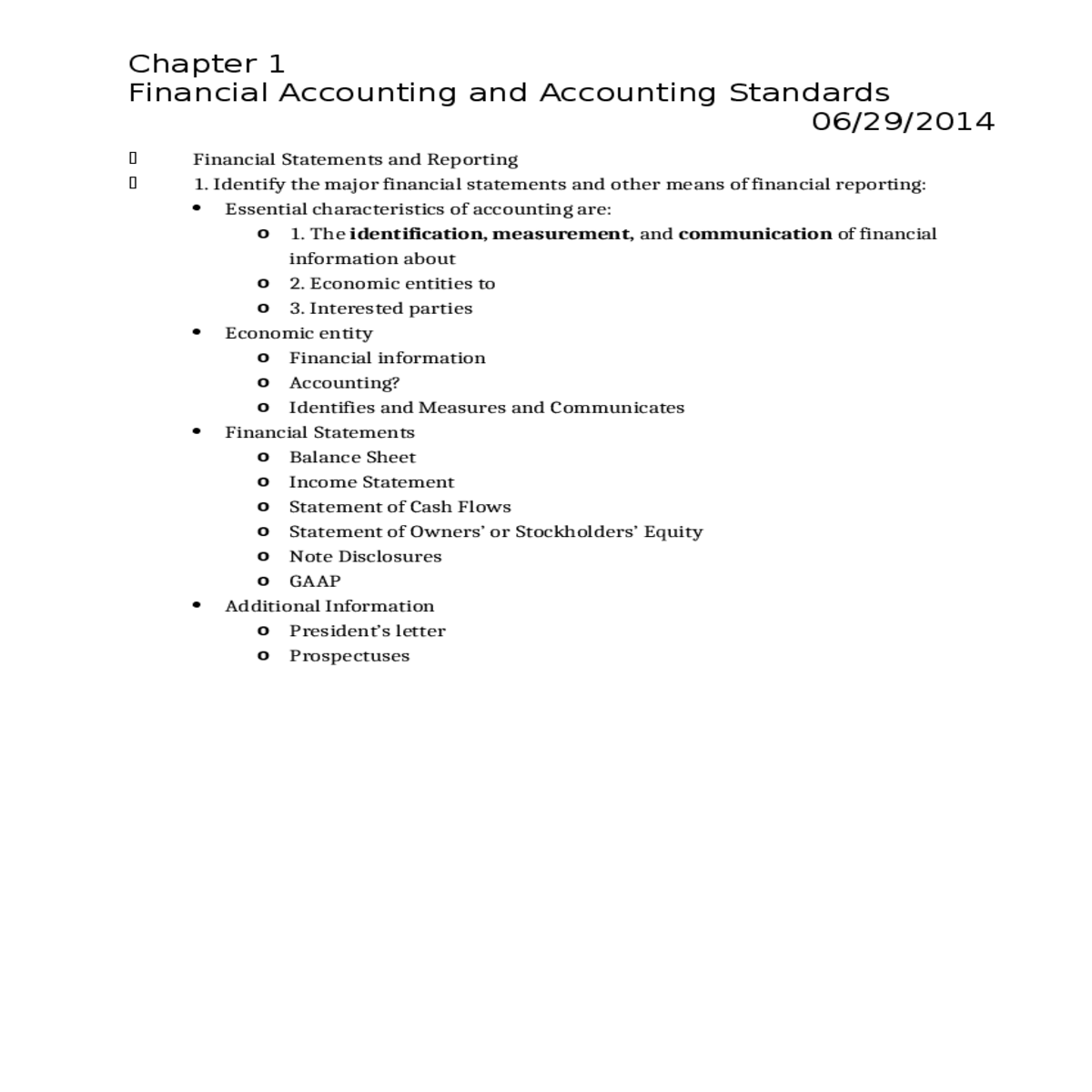
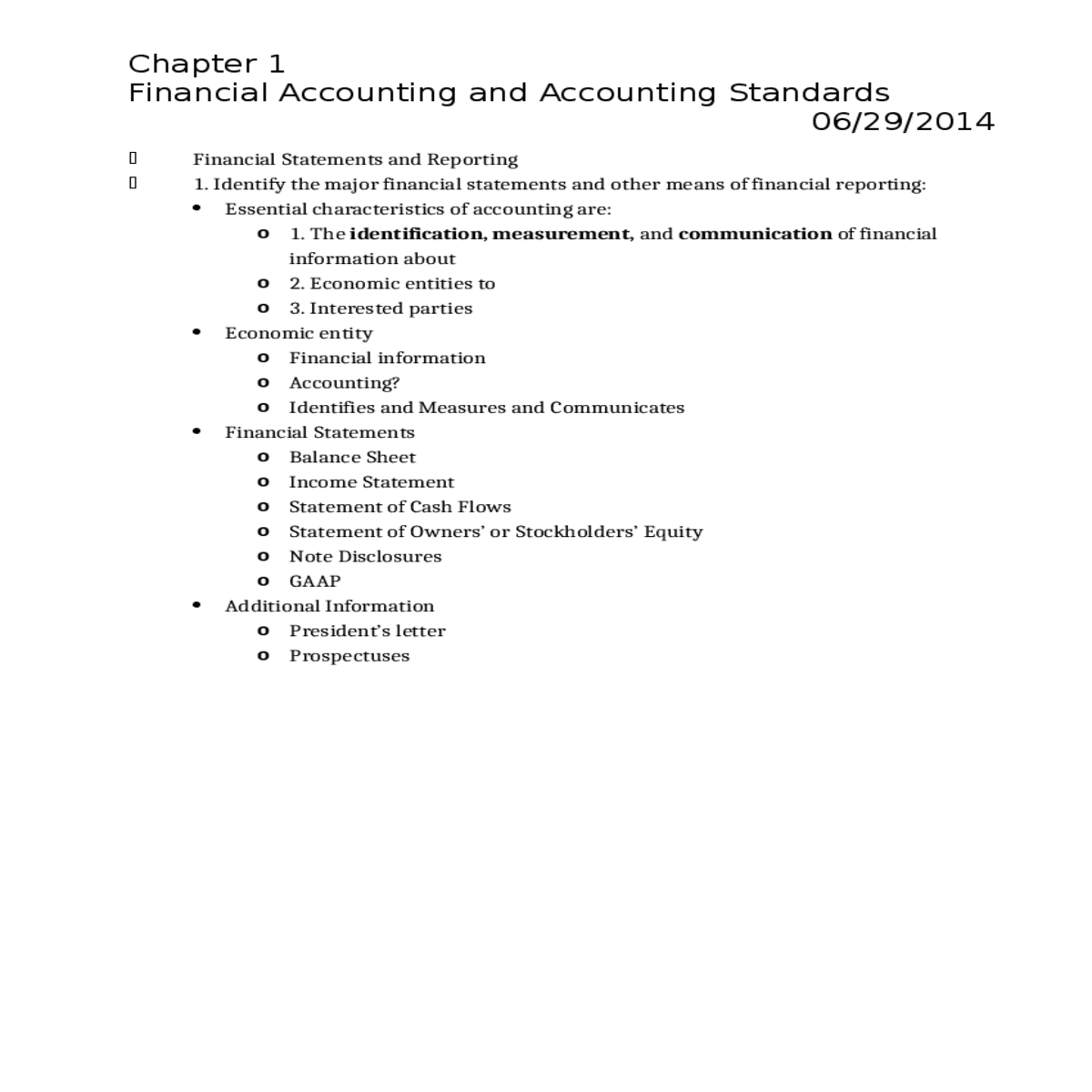
Financial Accounting and Accounting Standards
06/29/2014� Financial Statements and Reporting
� 1. Identify the major financial statements and other means of financial reporting: Essential characteristics of accounting are:
o 1. The identification, measurement, and communication of financial information about
o 2. Economic entities to
o 3. Interested parties
Economic entity
Financial information
o o Accounting?o Environmental impact statements
What is the purpose of information presented in notes to the financial
Accounting and Capital Allocation
o Resources are limited. Efficient use of resources often determines
reports to make their capital allocation decisions.
o Capital Allocation: the process of determining how and at what cost
Relevant and reliable financial information is necessary for markets to be
efficient.
Lenders, and
Other creditors
o Equity Investors and Creditors
Investors are the primary user group.
1. Ability to generate net cash inflows and
2. Management’s ability to protect and enhance the capital
Ex: Hershey’s stewardship responsibilities
Usually affects its ability to generate net cash inflows, financial
o Various users need financial information
o Financial Statements
Generally Accepted Accounting Principles (GAAP)
� 5. Identify the major policy-setting bodies and their role in the standard-setting
American Instituted of Certified Public Accountants (AICPA)
Financial Accounting Standards Board (FASB)
o SEC requires public companies to adhere to GAAP
o SEC Oversight
Committee on Accounting Procedures
1939-1959
Issued 31 Accounting Principle Board Opinions (ARBOs)
Wheat Committee recommendations adopted in 1973
Funds their activities
Exercises general oversight
Consult on major policy issues
o Mission is to establish and improve standards of accounting and
Increased Independence
Broader Representation
Public hearing on proposed standard.
Board evaluated research and public response and issues exposure
Accounting Standards Updates
Financial Accounting Concepts
o Principles that have substantial authoritative support.
o Major sources of GAAP:
o FASB Statement of Financial Accounting Concepts
o FASB Technical Bulletins
� 7. Describe the impact of user groups on the rule-making process.
Issues in Financial Reporting
GAAP in a Political Environment o
GAAP is as much a product of political action as they are of careful logic or empirical findings.o Financial Reporting Challenges
Non-financial measurements
Forward-looking information
Soft assets
Timeliness
Understandability
o International Accounting Standards
Two sets of standards accepted for international use:
U.S. GAAP, issued by the FASB
International Financial Reporting Standards (IFRS), issued by the IASB
� 9. Understand issues related to ethics and financial accounting.Ethics in the Environment of Financial Accounting
o In accounting, we frequently encounter ethical dilemmas GAAP does not always provide an answer
Doing the right thing is not always easy or obvious o A conceptual framework underlying financial accounting is important because it can lead to consistent standards and it prescribes the nature, function, and limits of financial
accounting and financial statements.2. Describe the FASB’s efforts to construct a conceptual framework.�
Development of Conceptual Framework
o The FASB has issued seven Statements of Financial Accounting Concepts (SFAC) for business enterprises.of financial accounting and reporting.
� 3. Understand the objective of financial reporting.
entity that is useful to present and potential equity
investors, lenders, and other creditors in making
� 4. Identify the qualitative characteristics of accounting information.
Second Level: Fundamental Concepts
information for decision-making purposes”
o Fundamental Quality- Relevance
has value as an input to predictive processes used
by investors to form their own expectations about
Materiality
Information is material if omitting it or misstating it could influence decisions that users make on the basis of the reported financial information.
o Enhancing Qualities
Information that is measured and reported in a similar manner for different companies is considered
comparable. Verifiability occurs when independent measurers, using the same methods, obtain similar results.
o “Moment in Time”
Assets, Liabilities, Equity
o “Period of Time”
Investment by owners, Distribution to owners, Comprehensive income, Revenue, Expenses, Gains, Losses According to the FASB conceptual framework, an entity’s revenue may result from
o A decrease in a liability from primary operations
� 6. Describe the basic assumptions of accounting.� 7. Explain the application of the basic principles of accounting.
Third Level: Basic Principles
o Measurement Principle – The most commonly used measurements are based on historical cost and fair value.o Expense Recognition – “Let the expense follow the revenues”
o Full Disclosure – providing information that is of sufficient importance to influence the judgment and decisions of an informed users. Provided through:
accounting information.
Third Level: Constraints
� 1. Understand basic accounting terminology
Accounting Information System
o Collects and processes transaction data
o Disseminates the financial information to interested parties o Helps management answer questions
Basic Terminology
o Event, Transaction, Account, Real Account, Nominal Account, Leger, Journal, Posting, Trial Balance, Adjusting Entries, Financial Statements, Closing Entries
� 2. Explain double-entry rules
Debits and Credits
o An account shows the effect of transactions on a given asset, liability, equity, revenue, or expense account.Double-entry accounting system (two-sided effect) o
o Recording done by debiting at least one account and crediting another
o Debits must equal Credits
o
Account – an arrangement that shows the effect of transactions on the account
Debits and Credits Summary
o Normal Balance Debit
Assets, Expense
Normal Balance Credit o
Liabilities, Stockholders’ Equity, Revenue
Financial Statements and Ownership Structure
o Ownership structure dictates the types of accounts that are part of or affect the equity section Common Stock
Paid-in Capital in Excess of Par
o Transactions
o Journalizing
o Statement Preparation
o Closing
The FASB used the phrase “transactions and other events and circumstances that affect a business enterprise.”
o Types of Events:
External – between an entity and its environment Internal – event occurring entirely within an entity� 4. Record transactions in journals, post to ledger accounts, and prepare a trial balance
Journalizing
o
General Journal – a chronological record of transactions Posting
o Posting – transferring amounts from journal to ledger
The purpose of transaction analysis is o
1. To identify the type of account involved, and 2. To determine whether a debit or a credit is required� 5. Explain the reasons for preparing adjusting entries and identify major types of adjusting entries
Adjusting Entries
o Makes it possible to:
Report on the balance sheet the appropriate assets, liabilities, and owner’s equity at the statement date.Report on the income statement the proper revenues
and expenses for the period. 1. Prepaid Expenses: expenses paid in cash before they
are used or consumed
but not yet received in cash or recorded.
4. Accrued Expenses: expenses incurred but not yet
o Cash Payment before Expense Recorded
o Prepayments often occur in regard to:
as a liability called unearned revenues.
o Cash Receipt before Revenue Recorded
o Revenues recorded for services performed but cash has yet to
be received at the statement date are accrued revenues.
Expense Recorded before Cash Payment
Accrued expenses often occur in regard to:
Rent, interest, taxes, salaries, (bad debts)
Adjusted Trial Balance
o Shows the balance of all accounts, after adjusting entries, at the end of the accounting period.6. Prepare financial statements from the adjusted trial balance�
Preparing Financial Statements
o Financial Statements are prepared directly from the Adjusted Trial Balance
�
7. Prepare closing entries Closing Entries
o Basic Process
To reduce the balance of the nominal (temporary) accounts to zero in order to prepare the accounts for the next period’s transactions.o 1. Enter the transactions of the period in appropriate journals.
o 2. Post from the journals to the ledger.
balance.
o 7. Prepare closing journal entries and post to the ledger.
Most companies use accrual-basis accounting. They
o Recognize revenue when the performance obligation is
o Record revenue only when they receive cash, and
o Record expenses only when they disperse cash
the credit phenomenon.
o Investors, creditors, and other decision makers seek timely
original cash transaction to an expense or revenue account
should be reversed.
Using a worksheet
o A company prepares a worksheet either on
To prepare financial statements
The worksheet: