Posting procedure step including chart accounts


Isabela State University-CBAPA 1
Introduction
The module, Recording Business Transaction, contains materials and activities related to explaining the sequential steps in the accounting cycle, analyzing business transactions and preparing the journal entries, developing a chart of accounts, posting procedures and preparing the trial balance.
4. Outline the steps in analyzing transactions and state the role of source documents.
5. Analyze the impact of transactions on the elements and the specific accounts. 6. Apply the rules of debits and credits in analyzing business transactions.
11. Develop chart of accounts.
12. Prepare and explain the use of a trial balance.
Department of Accountancy & Management Accounting
Accty 111- FINANCIAL ACCOUNTING & REPORTING
General management: Imagine running Ford Motors, Philippine General Hospital, University of Santo Tomas, a McDonalds franchise, a Trek bike shop. All general managers need to understand where the enterprise’s cash comes from and where it goes in order to make wise business decisions.
Marketing: A marketing specialist at a company like Procter & Gamble develops strategies to help the sales force be successful. But making a sale is meaningless unless it is a profitable sale. Marketing people must be sensitive to costs and benefits, which accounting helps them quantify and understand.


Isabela State University-CBAPA 3
The steps in the cycle and their aims follow:
During the Accounting Period
STEP 1 Identification of Events to be Recorded
AIM: To gather information about transactions or events generally
through the source documents.
STEP 7 Adjusting Journal Entries are Journalized and
Posted
AIM: To record the accruals, expiration of deferrals, estimations and
other events from the worksheet.
STEP 8 Closing Journal Entries are Journalized and
Posted
AIM: To close temporary accounts and transfer profit to owner’s
equity.
SOURCE DOCUMENTS
Source documents identify and describe transactions and
events entering the accounting system. They can be in hard copy or
electronic form. Examples are sales receipts, checks, purchase orders,
bills from suppliers, payroll records, and bank
Dr.jeanettegonzales.cpa
statements. For example, cash registers record each sale on a tape or electronic file. This record is a source document for recording sales in the accounting system. Source documents are objective and reliable evidence about transactions and events and their amounts.
Transactions and events are the starting points in the accounting cycle. By relying on source documents, transactions and events can be analyzed as to how they will affect performance and financial position. Source documents identify and describe transactions and events entering the accounting process. These original written evidences contain information about the nature and the amounts of the transactions. These are the bases for the journal entries; some of the more common source documents are sales invoices, cash register tapes, official receipts, bank deposit slips, bank statements, checks, purchase orders, time cards and statements of account. Specimens and discussions on some of these documents will in Module 7.
Application of Double-Entry: T accounts show how the transaction affects the accounting equation. Note that this is not part of the accounting records but is undertaken before recording a transaction in order to understand the effects of the transaction.
Journal Entry: A journal entry is a notation that records a single transaction in the chronological accounting record known as a journal (sometimes called the book of original entry because it is where transactions first enter the accounting records).
3. Determine whether each account is increased or decreased by the transaction. 4. Using the rules of debit and credit, determine whether to debit or credit the account to record its increase or decrease.
Dr.jeanettegonzales.cpa
Transactions (business transactions) are a business’s economic events recorded by accountants. Transactions may be external or internal.
External transactions involve economic events between the company and some outside enterprise. For example, Campus Pizza’s purchase of cooking equipment from a supplier, payment of monthly rent to the landlord, and sale of pizzas to customers are external transactions.
| EXAMPLE: |
|---|
TRANSACTION: On August 1, Lanz Red invests P400,000 in cash to form
Red Design Studio. ANALYSIS: The journal entry to record an owner’s
investment in the business
INCREASES asset account CASH with a debit
INCREASES the owner’s equity account L. Red, capital with a
credit
(apply the rules of debit and credit)
APPLICATION OF DOUBLE ENTRY |
|
|
|---|
as the appropriate asset account (for example, Equipment).
Lesson 3Business Transactions are Journalized (STEP 2)
Isabela State University-CBAPA 6
Department of Accountancy & Management Accounting
3. It helps to prevent or locate errors because the debit and credit amounts for each entry can be easily compared.
JOURNALIZING
Entering transaction data in the journal is known as
journalizing. Companies make separate journal entries
for each transaction. A complete entry consists of: (1) the date of the
transaction, (2) the accounts and amounts to be debited and credited,
and (3) a brief explanation of the transaction.
5. Credit. The credit amount for each account is entered in this column.
Dr.jeanettegonzales.cpa
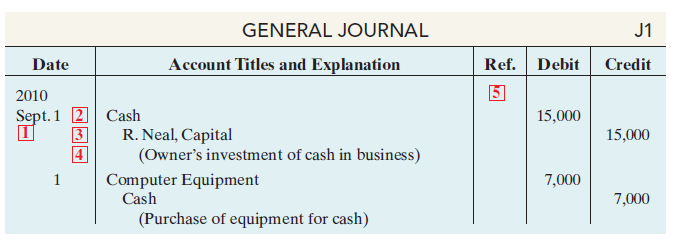
Assume that Maria Concepcion Jennifer Perez-Manalo established her own wedding consultancy with an initial investment of P250.000 on May 1.
The journal entry is shown below:


Isabela State University-CBAPA 8
2 The debit account title (that is, the account to be debited) is entered first at the extreme left margin of the column headed “Account Titles and Explanation,” and the amount of the debit is recorded in the Debit column.
3 The credit account title (that is, the account to be credited) is indented and entered on the next line in the column headed “Account Titles and Explanation,” and the amount of the credit is recorded in the Credit column.
After the transaction or event has been identified and measured, it is recorded in the journal. The process of recording a transaction is called journalizing. The following are the transactions for Wedding Planner during the month of May. The double-entry system will be used.
To understand the nature of the affected accounts, the letter A (for asset), L (liability) or OE (owner's equity) is inserted after each entry. In addition, owner's equity is further classified into OE:I (income) and OE:E (expenses).


Isabela State University-CBAPA 9
Rules Increases in assets are recorded by debits. Increases in owner's equity are recorded by credits.
Entry Increase in assets is recorded by a debit to cash. Increase in owner's equity is recorded by a credit to Cruz, Capital.
Entry Increase in assets is recorded by a debit to prepaid rent. Decrease in assets is recorded by a credit to cash.
Dr. Cr.
Dr. Cr.
Cash (A) 210,000
Notes Payable (L) 210,000
___________________________________________________________________
Department of Accountancy & Management Accounting
Accty 111- FINANCIAL ACCOUNTING & REPORTING
Dr. Cr.
Service Vehicle (A) 420,000
Cash (A ) 420,000
___________________________________________________________________
Insurance Premiums Paid (Exchange of Assets)
May 4 Paid Prudential Guarantee and Assurance, Inc. P14,400 for a
one-year comprehensive insurance coverage on the service vehicle.
Prepaid Insurance (A) 14,400
Cash (A) 14,400
___________________________________________________________________
Office Equipment Acquired on Account (Exchange and Source of
Assets)
May 5 Acquired office equipment from Fair and Square Emporium for
P60,000; paying P15,000 in cash and the balance next month. Note: A
compound entry is needed for this transaction.
Analysis Assets increased. Assets decreased. Liabilities increased.
Office Equipment (A) 60,000
Cash (A) 15,000
Accounts Payable (L) 45,000
___________________________________________________________________
Supplies Purchased on Account (Source of Assets)
May 8 Purchased supplies on credit for P18,000from San
Jose Merchandising.
Analysis Assets increased. Liabilities increased.
Department of Accountancy & Management Accounting
Accty 111- FINANCIAL ACCOUNTING & REPORTING
Analysis Assets decreased. Liabilities decreased.
Rules Decreases in assets are recorded by credits. Decreases in liabilities are recorded by debits.
Rules Increases in assets are recorded by debits. Increases in owner's equity are recorded by credits.
Entry Increase in assets is recorded by a debit to cash. Increase in owner's equity is recorded by a credit to consulting revenues.
Entry Decrease in owner's equity is recorded by a debit to salaries expense. Decrease in assets is recorded by a credit to cash.
Dr. Cr. .
Department of Accountancy & Management Accounting
Accty 111- FINANCIAL ACCOUNTING & REPORTING
Dr. Cr.
Cash (A) 10,000
Unearned Referral Revenues (L) 10,000
___________________________________________________________________
Revenues Earned on Account (Source of Assets)
May 19 Coordinated and finalized elaborate bridal arrangements for three
couples and billed fees of P12,000 per couple. Additional services
include documents preparation, consultation with a feng shui expert as
to the ideal wedding date for prosperity and harmony, provision for
limousine service and honeymoon trip.
Accounts Receivable (A) 36,000
Consulting Revenues (OE:I) 36,000
___________________________________________________________________
Withdrawal of Cash by Owner (Use of Assets)
May 25 Cruz withdrew P14,000 for personal expenses.
Analysis Assets decreased. Owner's equity decreased.
Analysis Assets decreased. Owner's equity decreased.
Dr.jeanettegonzales.cpa
Rules Decreases in assets are recorded by credits. Decreases in owner's equity are recorded by debits.
Entry Decrease in owner's equity is recorded by a debit to salaries expense. Decrease in assets is recorded by a credit to cash.
Entry Decrease in owner's equity is recorded by a debit to utilities expense. Increase in liabilities is recorded by a credit to utilities payable.
Dr. Cr.
Cash (A) 24,000
Accounts Receivable (A) 24,000
___________________________________________________________________
Expenses Incurred and Paid (Use of Assets)
May 31 Settled the electricity bill of P3,000 for the month.
Analysis Assets decreased. Owner's equity decreased.
Dr.jeanettegonzales.cpa

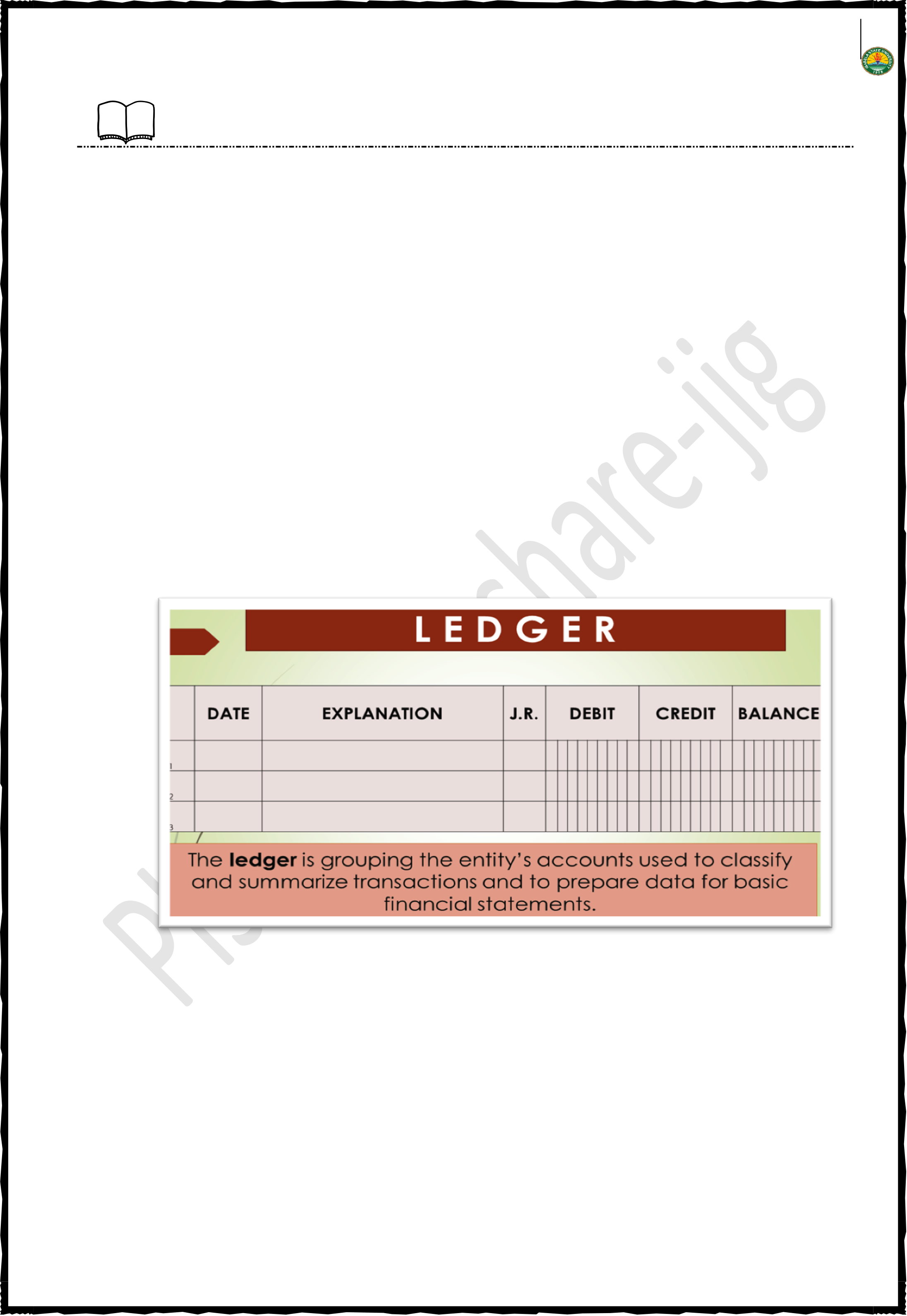
THE LEDGER-Book of Final Entry
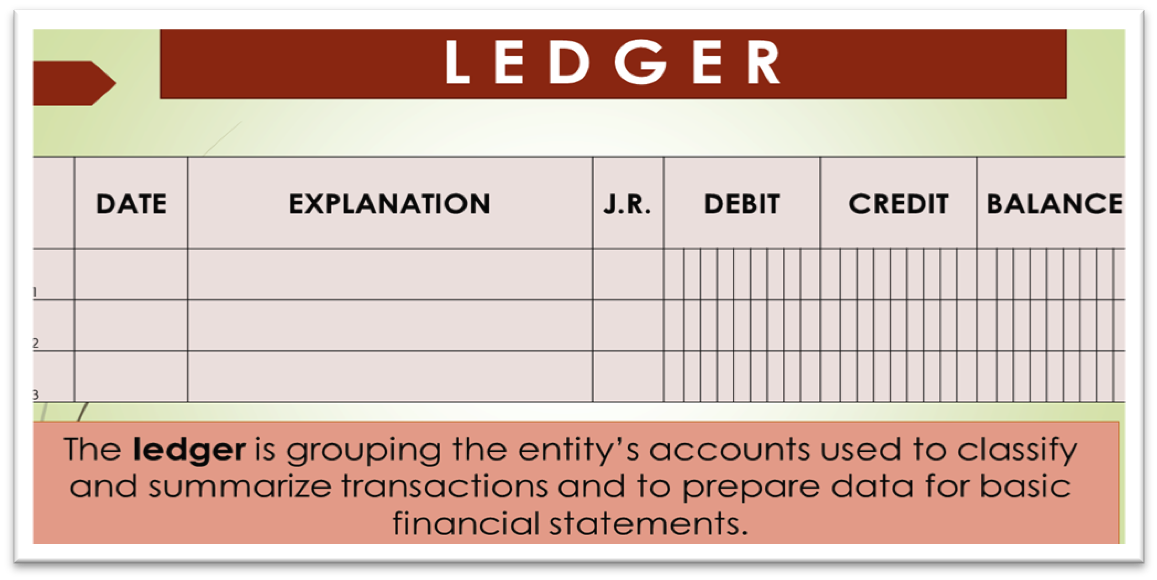
The entire group of accounts maintained by a company is the ledger. The ledger keeps in one place all the information about changes in specific account balances. Although some firms may use various ledgers to accumulate certain detailed information, all firms have a general ledger. A general ledger is the "reference book" of the accounting system and is used to classify and summarize transactions, and to prepare data for basic financial statements.. A general ledger contains all the asset, liability, and owner’s equity accounts. Whenever we use the term “ledger” in this module, we are referring to the general ledger, unless we specify otherwise.
ACCOUNTING
Each account has its own record in the ledger. Every account in the
ledger maintains the basic format of the T-account but offers more
information (e.g. the account number
Dr.jeanettegonzales.cpa
at the upper right corner and the journal reference column). Compared to a journal, a ledger organizes information by account.
CHART OF ACCOUNTS
POSTING (Step 3)
Wedding Planner
420 Referral Revenues
Expenses
550 Utilities Expense
560 Depreciation Expense-
590 Interest Expense
Posting means transferring the amounts from the journal to the appropriate accounts in the ledger. Debits in the journal are posted as debits in the ledger, and credits in the journal as credits in the ledger.
Accty 111- FINANCIAL ACCOUNTING & REPORTING
The steps are illustrated as follows:
1. Transfer the date of the transaction from the journal to the
ledger.
At the end of an accounting period, the debit or credit balance of each account must be determined to enable us to come up with a trial balance.
a. Each account balance is determined by footing (adding) all the debits and credits.
Isabela State University-CBAPA 17
Department of Accountancy & Management Accounting
| May 1 8,000 4 420,000 4 14,400 5 15,000 9 10,000 13 6,600 25 14,000 27 7,200 31 3,000 498,200 |
|
|
|
|---|---|---|---|
Office Equipment
May 5 60,000
Balance 60,000
Liabilities
Owner’s Equity
Cruz, Capital
May 1 250,000
Balance 250,000Cruz, Withdrawals
May 25 14,000
Balance 14,000
Accty 111- FINANCIAL ACCOUNTING & REPORTING
|
|---|
The Recording Process Illustrated
Study the transaction analyses carefully. The purpose of transaction analysis is first to identify the type of account involved, and then to determine whether to make a debit or a credit to the account. You should always perform this type of analysis before preparing a journal entry.
Accty 111- FINANCIAL ACCOUNTING & REPORTING
Lesson 5Trial Balance Preparation (Step 4)
left column and credit balances in the right column. The trial balance is a list of all
accounts with their respective debit or credit balances. The primary purpose of a trial
preparing financial statements.
The procedures in the preparation of a trial balance follow:
4. Compare the totals.
The trial balance is a control device that helps minimize accounting errors. When the
overstated.
The trial balance for the illustration follows:
Accounts Receivable 12,000
Supplies 18,000
Notes Payable P210,000
Accounts Payable 53,000
Consulting Revenues 62,400
Salaries Expense 13,800


Isabela State University-CBAPA 20
balance would bring this error to light.
Lesson 6Locating Errors
LOCATING ERRORS
An inequality in the totals of the debits and credits would
automatically signal the presence of an error. These errors
include:
1. Error in posting a transaction to the ledger:
• a balance was entered in the wrong balance column.
3. Error in preparing the trial balance:
2. If the error does not lie in addition, determine the exact amount by which the trial balance is out of balance. The amount of the discrepancy is often a clue to the source of the error. If the discrepancy is divisible by 9, this suggests either a transposition (reversing the order of numbers) error or a slide (moving of the decimal point). For example, assume that the cash account
Dr.jeanettegonzales.cpa