Past health history and family history
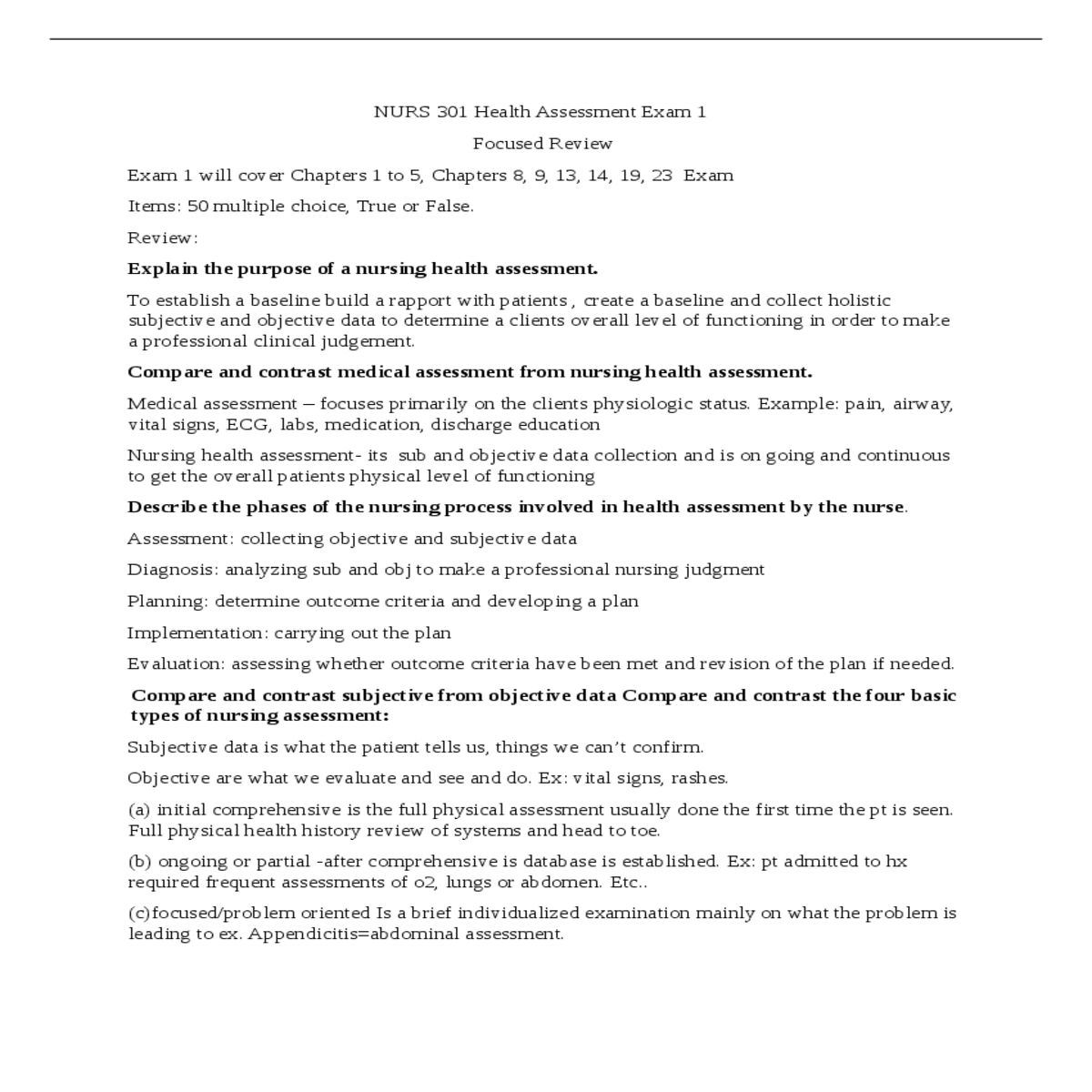
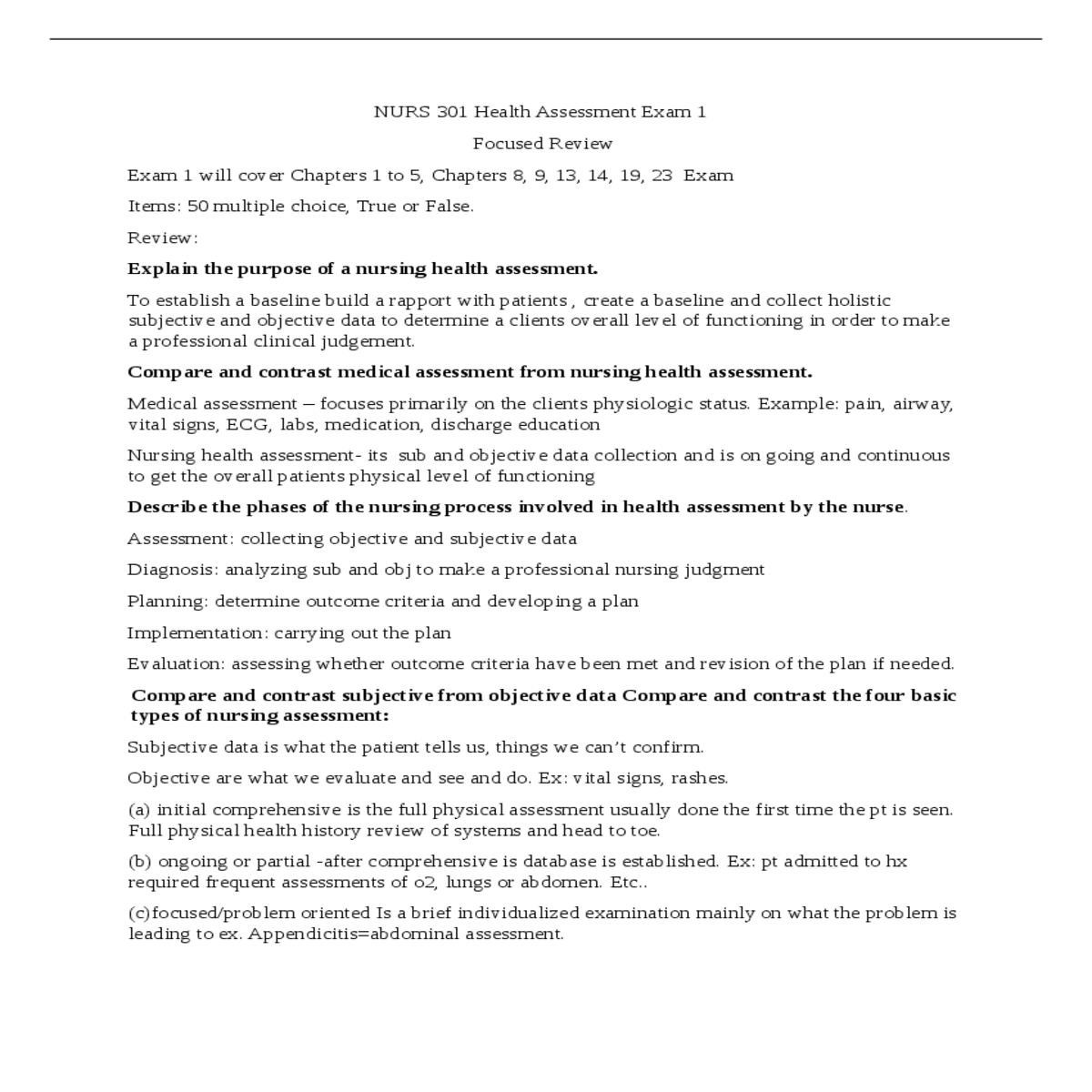
NURS 301 Health Assessment Exam 1 Focused Review
Exam 1 will cover Chapters 1 to 5, Chapters 8, 9, 13, 14, 19, 23 Exam Items: 50 multiple choice, True or False.Review:
Explain the purpose of a nursing health assessment.Objective are what we evaluate and see and do. Ex: vital signs, rashes.
(a) initial comprehensive is the full physical assessment usually done the first time the pt is seen. Full physical health history review of systems and head to toe.
Introductory: introduction, explaining the purpose, types of questions that will be asked, assuring confidentiality, making sure the client is comfortable and privacy. Developing trust and rapport Working: bio data, reason for seeking care, past health history and family history, review of body systems. Lifestyle and health practices.
Summary and closing-summarizing information validating problems and goals, identifying and discussing plans to resolve problems with clients, is there anything else the client needs or any questions.
Helps organize and illustrates the clients family history. It helps us see if there are health problems that run in the family and those of genetic predisposition.
Summarize the ways that the nurse can prepare the client for
a physical examination Keep room temp comfortable, private
area, quiet and adequate lighting, firm examination table or bed,
bedside table/tray to hold equipment
Explain the 4 physical assessment techniques and sequence of
physical assessment. Inspection, Palpation, percussion,
Auscultation.
What is SBAR?
Sbar is used to translate information to one personal to the next.
Discuss the assessment of pain as a fifth vital sign. How is pain assessed? When does the nurse perform a pain assessment? What is COLDSPA?
Pain is subjective and is what the person tells us. Observing the client for grimacing or holding onto an area or guarding is signs of pain as well. The nurse will perform the pain assessment initially in the general assessment and periodically assess the pain. We use a numerical scale from 0-10. COLDSPA is used to get more information regarding the pain.
Identify the pain assessment tools that is best for children
and older adults
For infants it would be the FLACC scale, children they have a FACES
scale and for older adults we use the numeric scale.
Identify the risk factors for skin cancer
Three types of skin cancer: melanoma, basal cell carcinoma, squamous
cell carcinoma (Asians less susceptible) risks include: sun exposure UV
radiation, medical therapies, family hx, moles, fair skin, age, actinic
keratosis(age spots), males, HPV, chemical exposure, alcohol, smoking,
diet, depressed immune system.
Pressure Ulcers:
Stage 1-red non-blanchable
Stage 2- broken skin, blister
Stage3- tissue lost subcutaneous fat may be seen but no tendon or
bone
Stage 4- full loss of skin with visible tendon or bone
Unstageable- necrosis (eschar)
Risk reduction: inspect daily and use Braden scale, moisturize skin, low
humidity and cold air.
Move pt every 2 hours by turning and avoiding shear and friction. Protein deficient. Clean methods for incontinence to keep dry and avoid over drying.
Assessment: inspect, auscultate, percuss, palpation is last.
Describe the age-related changes of the skin, hair and nails, abdomen and thorax and lungs