pac learning decision lists answers and explanation
PAC Learning Decision Lists Step by step Solution with Explanation
Your question:
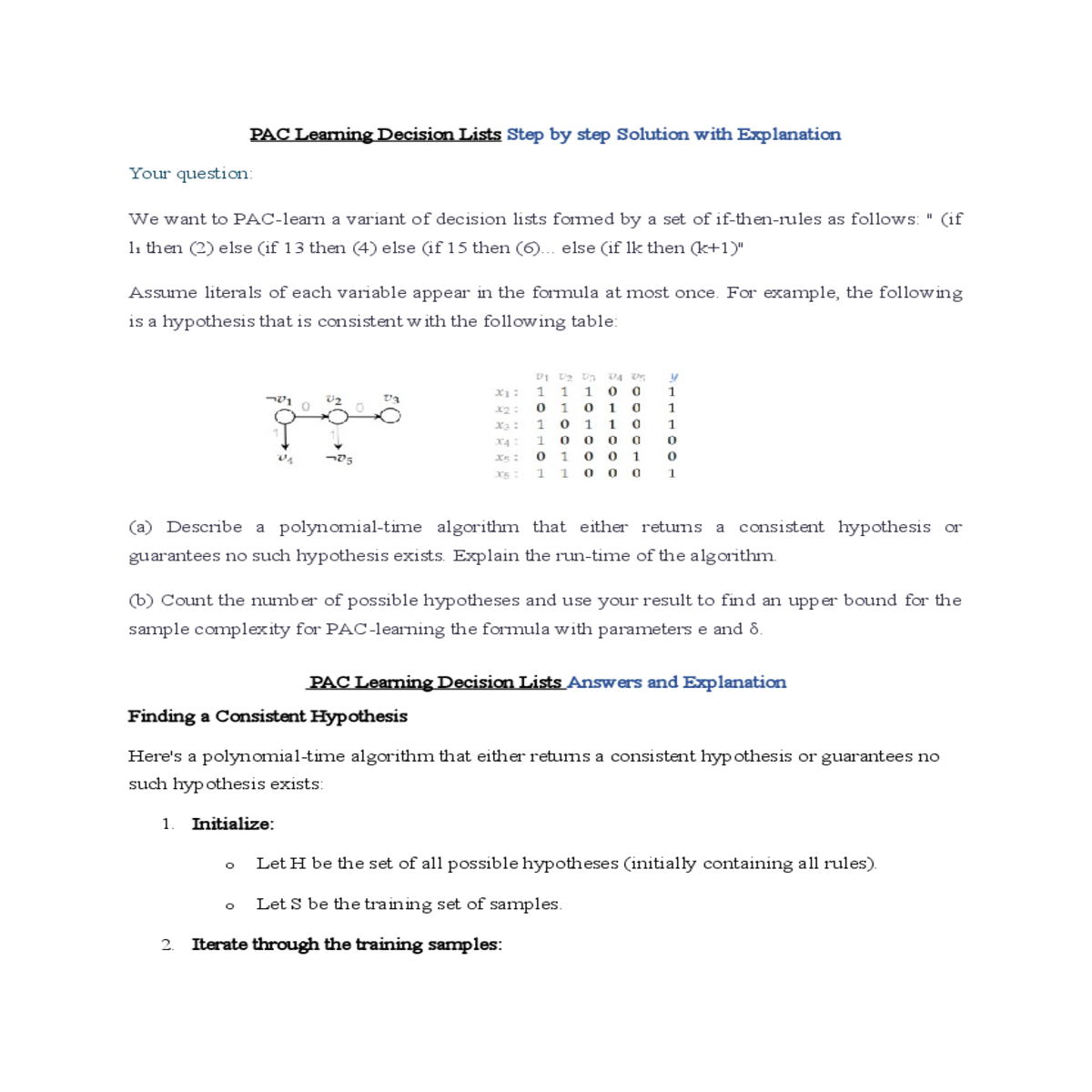
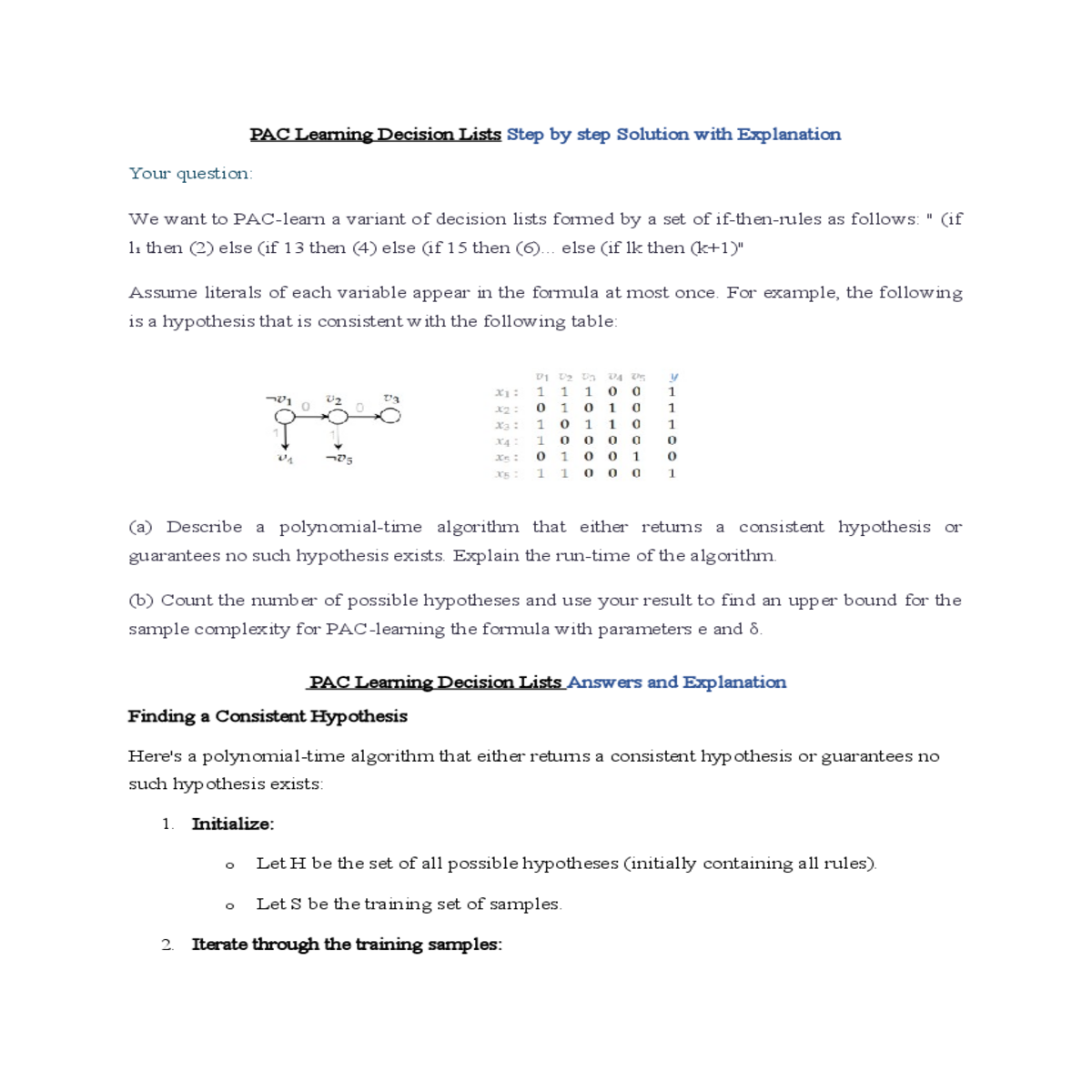
We want to PAC-learn a variant of decision lists formed by a set of if-then-rules as follows: " (if l₁ then (2) else (if 13 then (4) else (if 15 then (6)... else (if lk then (k+1)"
Assume literals of each variable appear in the formula at most once. For example, the following is a hypothesis that is consistent with the following table:
PAC Learning Decision Lists Answers and Explanation
Here's a polynomial-time algorithm that either returns a consistent hypothesis or guarantees no such hypothesis exists:
Initialize:
Iterate through the hypotheses h in H:
If h(x) doesn't match y, remove h from H.
In the worst case, the algorithm iterates through all training samples and all possible hypotheses.
The number of training samples is denoted by |S|.
(b) Counting the number of possible hypotheses is crucial to determine the sample complexity for PAC learning.
Number of possible single rules:
Each hypothesis is a sequence of at most k single rules (one for each variable).
For the first rule, we have 2 * k choices.
Sample Complexity Bound
Given sample complexity:
m>ln+2kln(2k)−2k
Therefore, the updated sample complexity expression, changing nnn to kkk, would be: