Now posit the usual exponential growth the labour force
The Review of Economic Studies Ltd.
The Pasinetti Paradox in Neoclassical and More General Models
Author(s): Paul A. Samuelson and Franco Modigliani
Source: The Review of Economic Studies, Vol. 33, No. 4 (Oct., 1966), pp. 269-301 Published byudies Ltd.Each copy of any part of a JSTOR transmission must contain the same copyright notice that appears on the screen or printed page of such transmission.
JSTOR is a not-for-profit service that helps scholars, researchers, and students discover, use, and build upon a wide range of content in a trusted digital archive. We use information technology and tools to increase productivity and facilitate new forms of scholarship. For more information about JSTOR, please contact support@jstor.org.
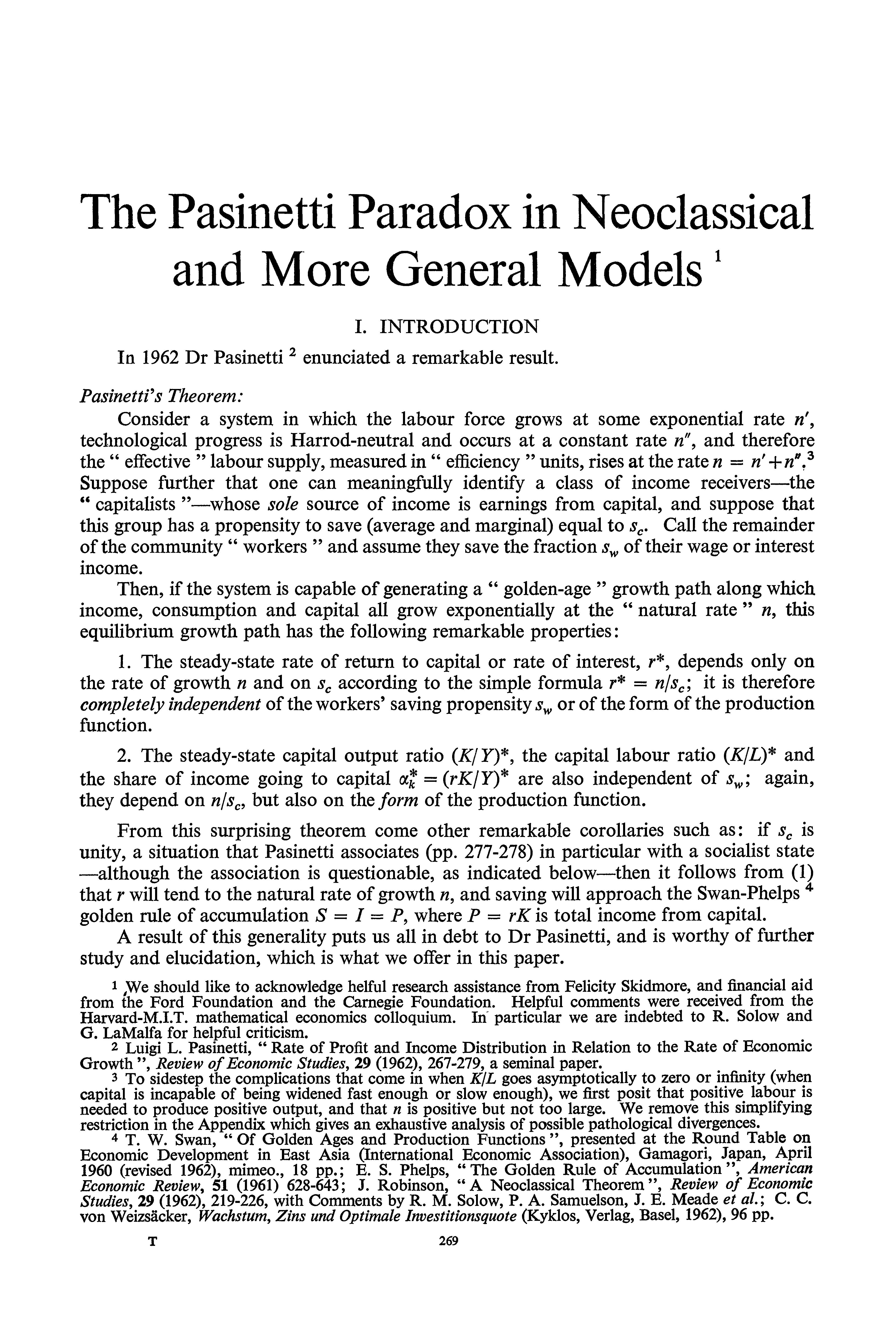
Pasinetti's Theorem:
Consider a system in which the labour force grows at some
exponential rate n',
A result of this generality puts us all in debt to Dr Pasinetti, and is worthy of further study and elucidation, which is what we offer in this paper.
from the Ford Foundation and the Carnegie Foundation. Helpful comments were received from the Harvard-M.I.T. mathematical economics colloquium. In' particular we are indebted to R. Solow and G. LaMalfa for helpful criticism.
(a) First, we shall show the limited range of the workers and capitalists saving co-
(b) A second, though relatively minor purpose, is to help dispel the notion, which
Our asymptotic stability analysis, which can be extended in considerable measure to certain cases of fixed-proportions and distribution theories different from that of
(reprinted in Essays on Value and Distribution, pp. 228-236); " A Model of Economic Growth ", Economic Journal, 67 (1957), 591-624 (reprinted in Essays in Economic Stability and Growth, pp. 256-300); F. Lutz and D. C. Hague (eds.), The Theory of Capital (1961), pp. 177-220, from the 1958 Corfu I.E.A. Conference; with J. A. Mirrlees, " A New Model of Economic Growth," Review of Economic Studies, 29 (1962), 174-192. Cambridge writings related to Kaldorism, but not necessarily identical with it, are J. Robinson, Accumulation of Capital (1956) and Collected Economic Papers, 2 (1960), particularly pp. 145-158, " The Theory of Distribution "; Exercises in Economic Analysis (Macmillan, London, 1960), Essays in the Theory of Economic Growth (Macmillan, London, 1962); D. G. Champernowne, " Capital Accumulation and the Maintenance of Full Employment ", Economic Journal, 67 (1958), 211-244; R. F. Kahn, " Exercises in the Analysis of Growth ", Oxford Economic Papers, New Series, 10 (1958), 143-156.
Our general analysis is shown to apply even though capitalists and workers may be divided into any number of subcategories each with a different propensity to save. On this growth path the rate of interest, the capital-output and the capital-labour ratio always depend at most on but one of the various capitalists' propensities to save (the maximum one), and are completely independent of all the others.
In view of the many nice properties sketched out above which hold for an economy satisfying the saving assumptions of the present model, it is with some regret that we must confess to most serious qualms over the empirical relevance of these assumptions- notably that relating to the existence of identifiable classes of capitalists and workers with " permanent membership "-even as rough first approximation. These qualms and the grounds on which they rest are set forth in the concluding section.
for otherwise the concept of a golden age steady state becomes self-contradictory. If depreciation is mK, then F(K, L)+mK is the function for gross national product.
we shall see in Section 10 below, for most of our results it is not necessary that r and w be equal to the marginal product of capital and labour.
The first equation says that the total saving of the capitalist class, and hence the rate of growth of their capital Kc, equals sc times their total profits. The second equation says that workers savings, and hence the rate of growth of their capital Kw, is a fraction of sw of their total income, consisting of wages W and income from their capital, rKw, or equivalently of total income less capitalists income.
Equations (1), (2) and (3), or the equations (3) alone in their final form, give us a determinate growth system in (Kc, Kw) once we are given the time profile of labour employ- ment L(t). Now we posit the usual exponential growth of the labour force, which we equate with labour input L(t), implying L(t) = Loent (with the understanding that the natural rate of growth n could include Harrod-neutral technical change, in which case L must be given an efficiency-unit interpretation). Hence
depending upon whether ... (5)
This criterion is remarkable in that it does not contain n explicitly.
i.e. the workers' saving propensity must be smaller than that of the capitalists if Pasinetti's theorem is to hold. This same inequality is implicit in Pasinetti's inequality conditions (6) and (7). But we must hasten to add that, though (7) is necessary for Pasinetti's theorem (as we have characterized it) to apply, and though (7) is necessary for many versions of the Kaldorian theory of income distribution to yield economically meaningful results, (7) has in general nothing to do with the existence and stability of a steady-state full employment equilibrium, as we shall presently show explicitly.
Pasinetti's theorem could not hold for sw any higher than a modest 0 05.'
To understand a theorem you must understand its limitations. The numerical range
Now let workers become thrifty. At first positive sw will continue to satisfy (7) and
the value determined by the condition that the marginal product of capital must be equal
to n/s, (and hence k' is totally independent of sw). But, on the other side of the dividing
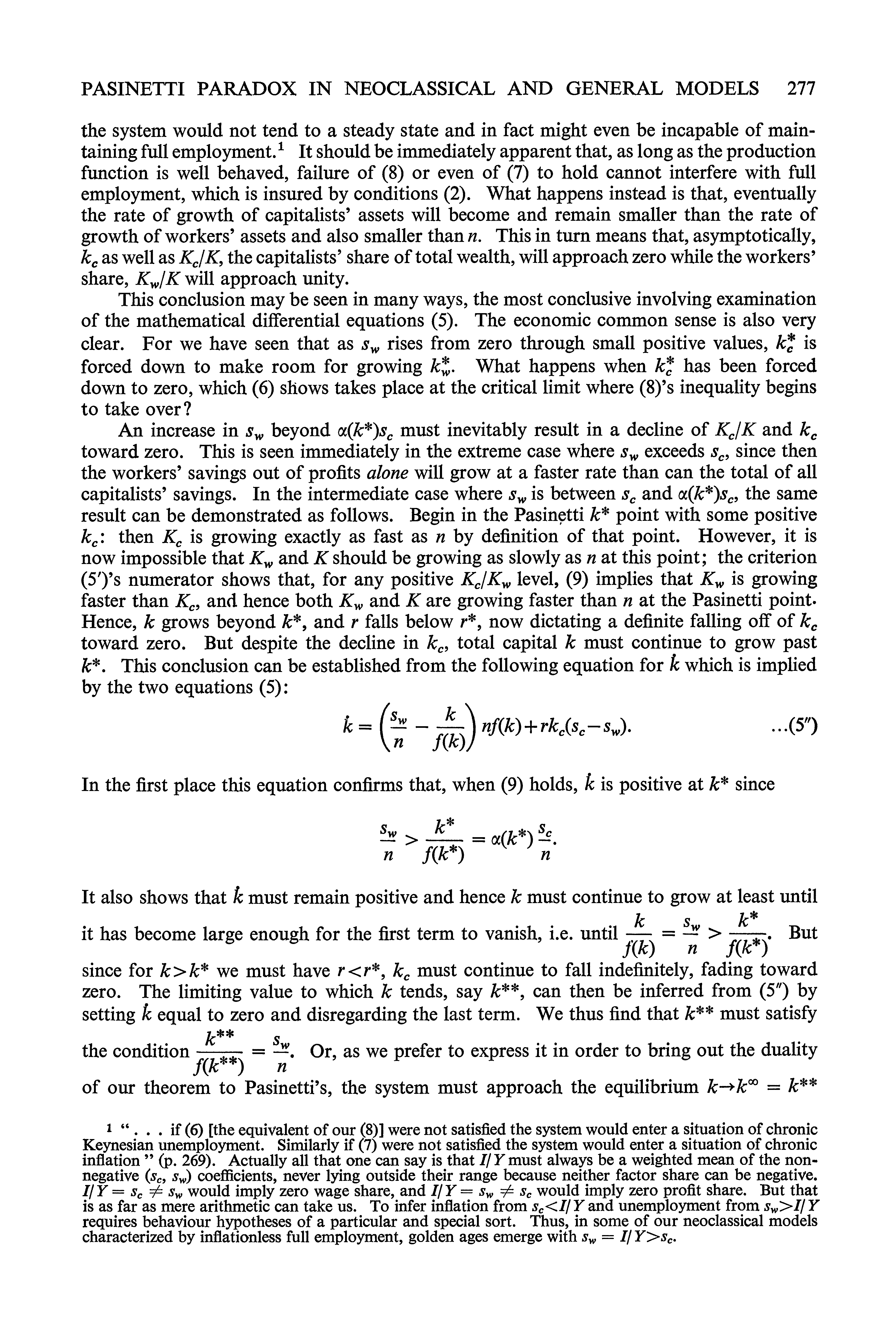
PASINETTI PARADOX IN NEOCLASSICAL AND GENERAL MODELS 277
where k** is the root of the dual relation
This result is readily understandable by noting that, with kc tending to vanish, the limiting
only) source of asymptotic saving.
This leads to another, perhaps more sophisticated way, of understanding the two
these are equivalent criteria.)
From equations (10) and the above discussion, we conclude that when sw exceeds a modest critical level, Pasinetti's theorem must be replaced by the following:which the system tends has the following characteristics:
The general formulae that cover both theorems can be stated as follows. For any General Theorem. Then: (i)
n/s,v, 7nsc
PASINETTI PARADOX IN NEOCLASSICAL AND GENERAL MODELS 281
VI. STABILITY ANALYSIS
where the * outside the matrix indicates that we evaluate its elements as the partial derivatives of (5) at the equilibrium levels (k*, k*). [In a moment, we shall perform similar stability analysis of our anti-Pasinetti equilibrium (0, k**), putting ** on the related matrix of partial derivatives.]
The calculated result isHow local is local? That is never easy to specify. However, if initially (or, equivalently, ever) KC = 0, obviously it is forever zero and the motion will approach the (0, k**) asymptote. However, the slightest positive perturbation of kc will send the system away from that point so long as sw < a(k*)sc. And our analysis confirms that there exists no locally unstable equilibrium point in the positive quadrant.
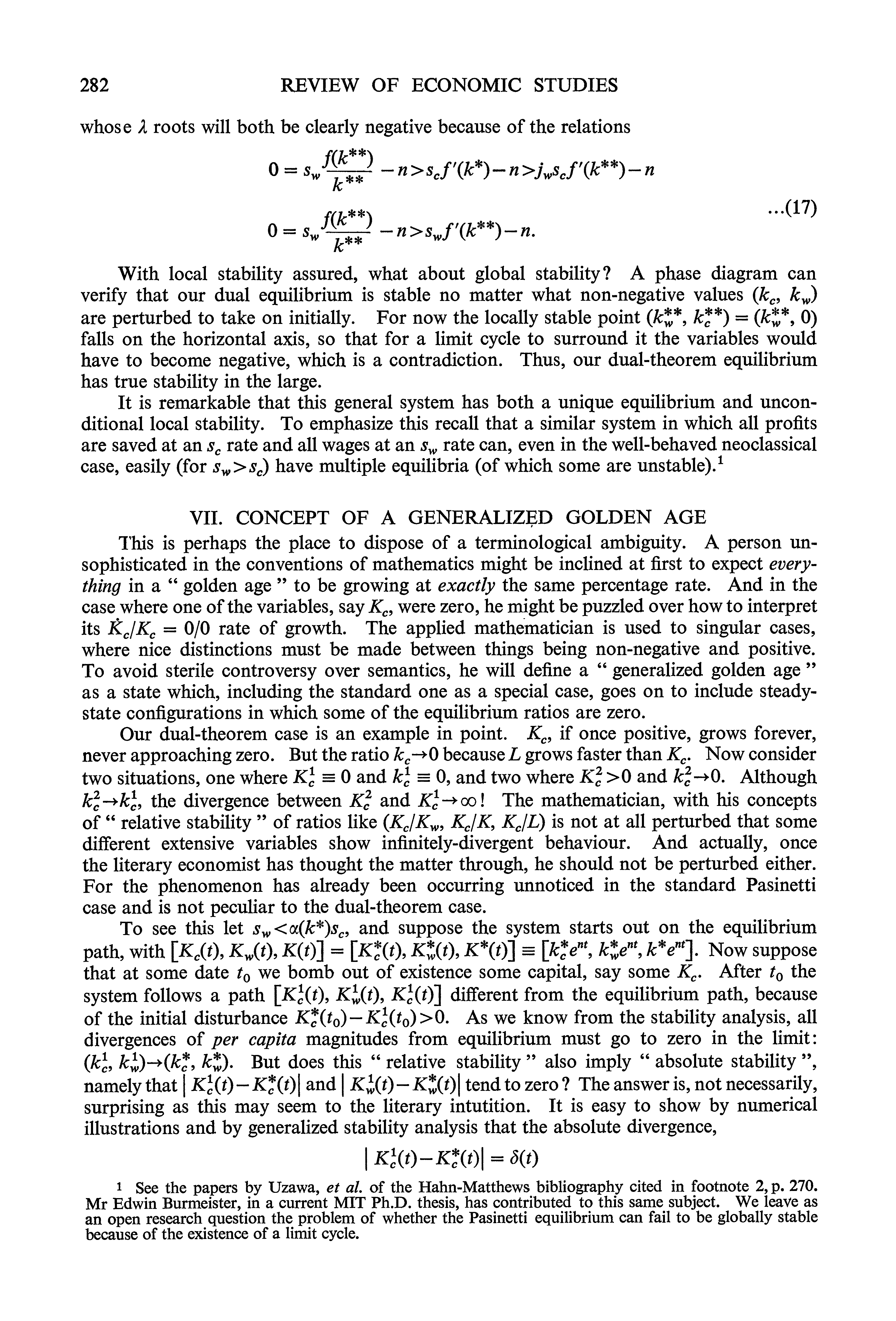
With local stability assured, what about global stability? A phase diagram can verify that our dual equilibrium is stable no matter what non-negative values (kc, kw) are perturbed to take on initially. For now the locally stable point (k**, kc**) = (k**, 0) falls on the horizontal axis, so that for a limit cycle to surround it the variables would have to become negative, which is a contradiction. Thus, our dual-theorem equilibrium has true stability in the large.
To see this let sw<ca(k*)sc, and suppose the system starts out on the equilibrium
path, with [KC(t), Kw(t), K(t)] = [KC*(t), K*(t), K*(t)] [kc*ent, k*ent, k*ent]. Now suppose
Thus, we have already had in the Pasinetti range the same infinite divergence of absolute magnitudes that is apparent in the Dual range. Why not? When on semi-log paper one curve approaches a positive-sloped straight line asymptotically, the eye sees a vanishing divergence; but when we translate into absolute numbers the magnitudes of the divergence, it can often be shown to become infinite. The sophisticated eye knows how one must allow for the properties of exponentials and ratios.
the fact that all their curves end up paralleling L's growth rate. The broken lines show that no lasting per capita improvement will result for society from a small increase in sw alone: the new K path approaches the old asymptote, as Kc comes to lose what Kw gains.
where p(t)-+p(oo) = 0. Provided n>-m =-Max [real part of Aj, we have infinite absolute divergence.
the above analysis by considering explicitly the problems that arise when KIL tends either to zero or infinity.
PASINETTI PARADOX IN NEOCLASSICAL AND GENERAL MODELS 285
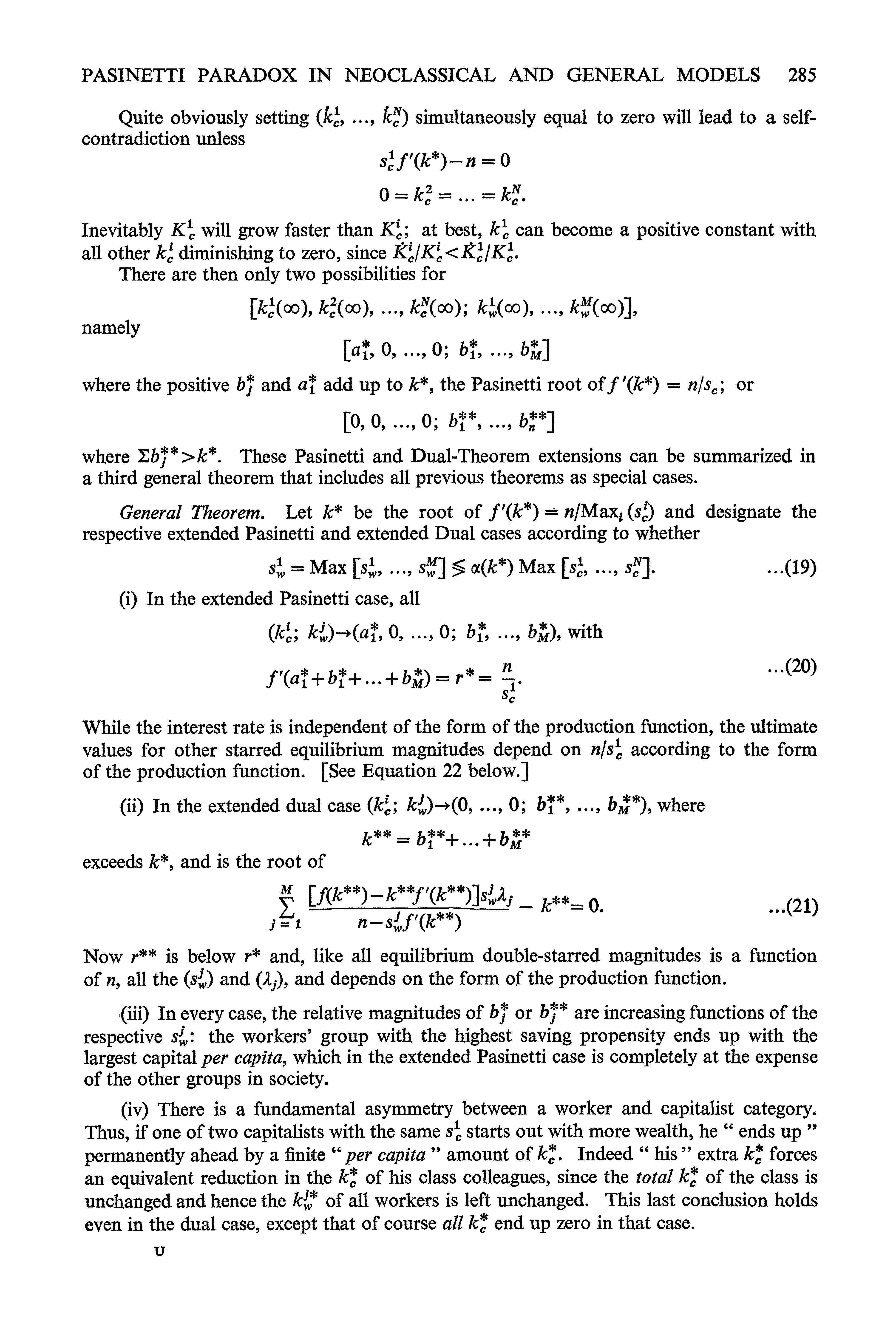
General Theorem. Let k* be the root of f'(k*) n/Maxi (s') and designate the
respective extended Pasinetti and extended Dual cases according to whether
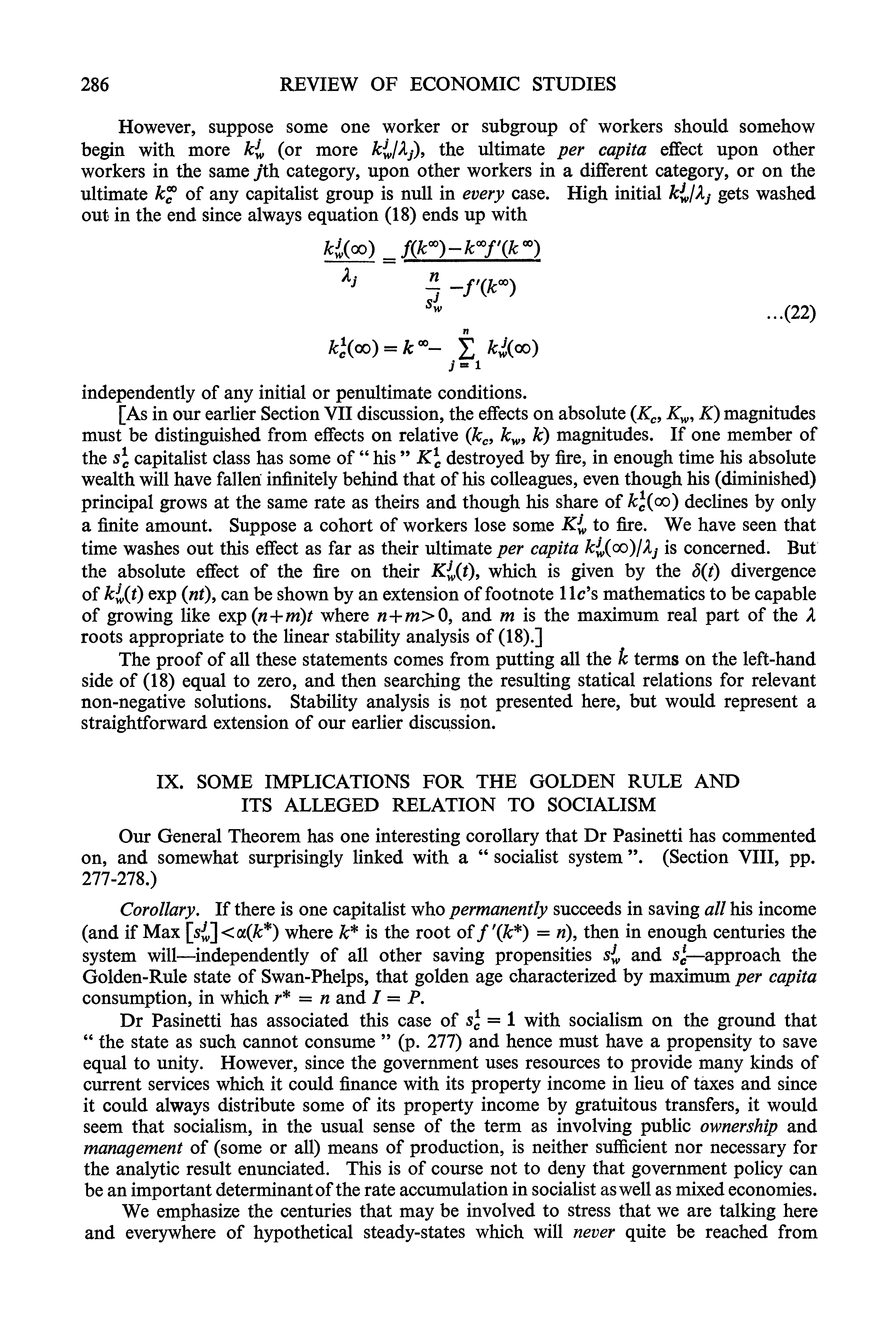
However, suppose some one worker or subgroup of workers should somehow
side of (18) equal to zero, and then searching the resulting statical relations for relevant
non-negative solutions. Stability analysis is not presented here, but would represent a
"the state as such cannot consume " (p. 277) and hence must have a propensity to save
We emphasize the centuries that may be involved to stress that we are talking here
Most of the above seem to rest on marginal productivity notions of the Clark-
the Pasinetti formalism and our various duals and generalizations of them remain valid.3 Now the positive wage rate becomes f(k) -ko(k) rather than f(k) -kf '(k) and oc(k) becomes kq(k)/f(k) rather than kf '(k)/f(k). The basic equations are now
are all neo-Keynesians. Along with rejecting the notion that some particular range of the s,,/s, parameters has a neo-Keynesian as against neoclassical significance, we question the imperialistic notion that the