Nist the national institute standards and technology
ACM Word Template for SIG Site
Author
General Terms
Entity Relational Diagram, Data Manipulation Language, Data Definition Language, Data Dictionary
INTRODUCTION
These standards form the foundation of a multi-billion dollar industry employing thousands of people in the United States. To some extent, the success of these standards and the industry that implements them is due to the contributions of the U.S. Federal Government. The US Federal Government participates in the development of the standard and it also supports the independent testing and verification of products claiming conformance to the SQL standard. This has contributed to the success of SQL.
NIST (National Institute of Standards and Technology) is the Government agency which is directly involved in supporting the SQL standard. It announced its intent to drastically reduce its level of participation in SQL standardization efforts. NIST's participation as a neutral, vendor-independent player has permitted the industry to grow and prosper. NIST's on-going participation protects taxpayer's interests and provides the independent verification of conformance that is needed worldwide.
History
Even earlier to the publishing of SQL-89, ANSI Technical Committee X3H2, Database, and the corresponding ISO group, ISO/IEC JTC1/SC21/WG3, had begun work on a major revision of the SQL standard. Published in late 1992 as ANSI X3.135-1992 and ISO/IEC 9075:1992, and commonly called SQL-92, this standard has asserted itself to be a major event in database standardization history. For the first time, it enabled to write significant applications entirely in a standard language, although it was and is true that no vendor implemented the entire language. The focus of SQL-92 was just to standardize enough language to allow significant applications to be built without depending on vendor extensions to SQL.
2.2 Development of SQL Standards
| Standards | Implements |
| SQUEL | data manipulation and schema definition controls |
| SQL-86 | Ratification and Acceptance of a formal SQL Standards by ANSI and ISO |
| SQL-92 | New data types, Scalar, Set operations |
| SQL:1999 | New User Defined Types (UDT), Triggers, procedure , Regular expression matching |
| SQL:2003 | XML related features, sequences (auto generated values) |
| SQL:2006 | Importing and storing XML data, integrate into their SQL code the use of XQuery |
| SQL: 2008 | INSTEAD OF triggers, TRUNCATE statements |
DBMS
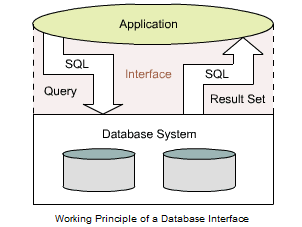
The application poses with the help of SQL, a query language, a query to the database system. In Interactive Interface, SQL can be used interactively from a terminal. In Embedded Interface, SQL can be embedded into another language (host language) which might be used to create a database application.
All the SQL queries are based on Mathematical operations. Relational algebra has more notations based on Selecting, updating and inserting tuples. It supports simple and powerful for formal foundation based on logic. It allows optimization
Basic operations:
Union ( ) Tuples in reln. 1 and in reln. 2.
Additional operations:
The most important DDL statements in SQL are:
CREATE TABLE - creates a new database table
DML
SQL (Structured Query Language) is syntax for executing queries. But the SQL language also includes syntax to update, insert, and delete records. It classifies two different languages; procedural language specifies what data is required and how to get those data. Non-Procedural language specifies what data is required without specifying how to get those data
Current Trends
REFERENCES
[1]. Jim Melton, Alan R. Simon, Understanding the new SQL: a complete guide
[2]. R. H. Katz Univ. of California, Berkeley, E. Wong Univ. of California, Berkeley, Decompiling CODASYL DML into retional queries, Volume 7 Issue 1, March 1982
[3] Ewing L. Lusk, Ross A. Overbeek , A DML for Entity-Relationship Models, ISBN:0-444-85487-8
[8] C J Date,A guide to the SQL standard, ISBN:0-201-05777-8