Naoh sodium hydroxide not acid but strong base
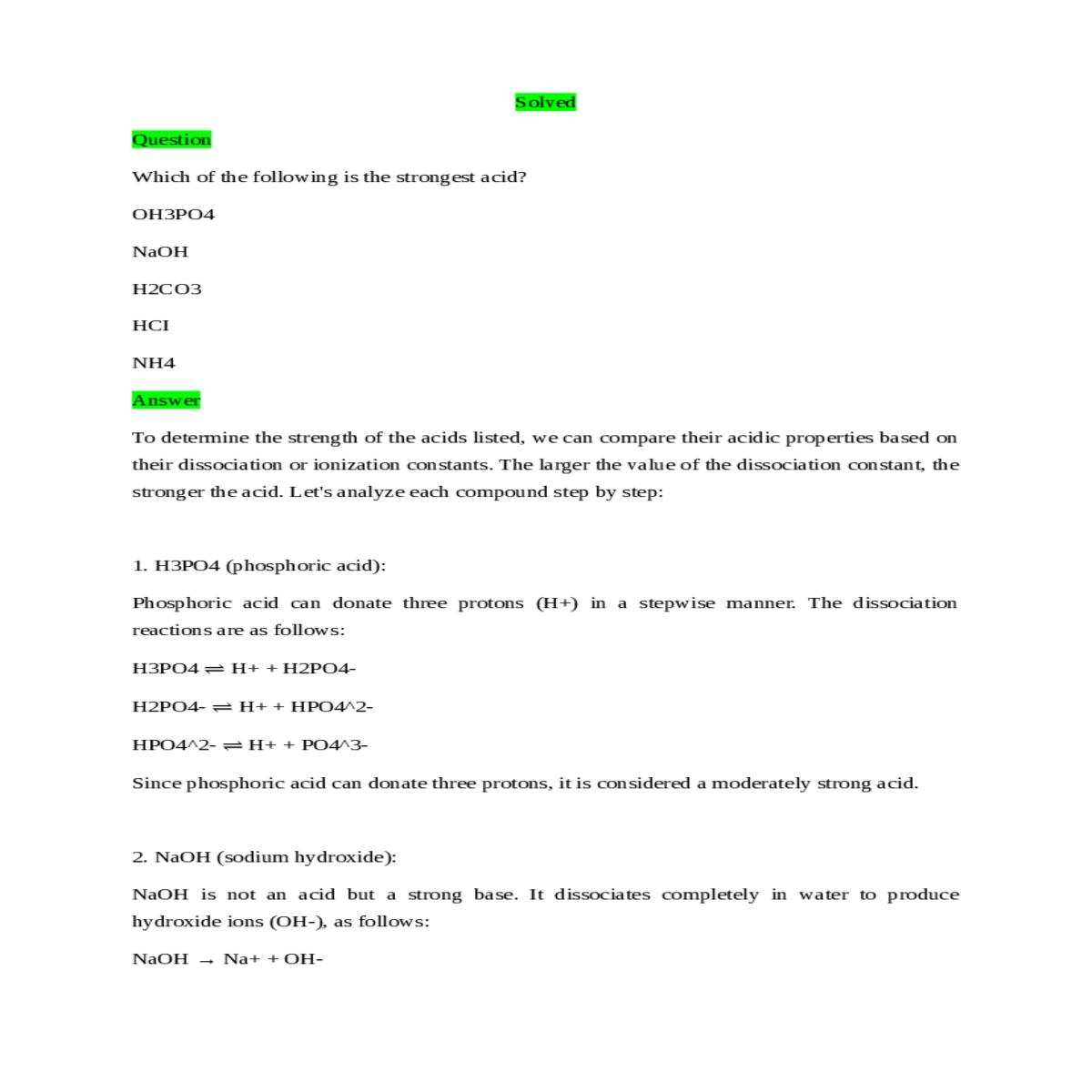
NaOH
H2CO3
1. H3PO4 (phosphoric acid):
Phosphoric acid can donate three protons (H+) in a stepwise manner. The dissociation reactions are as follows:
2. NaOH (sodium hydroxide):
NaOH is not an acid but a strong base. It dissociates completely in water to produce hydroxide ions (OH-), as follows:
H2CO3 ⇌ H+ + HCO3-
It can further dissociate into bicarbonate ions (HCO3-) and hydrogen carbonate ions (CO3^2-). However, carbonic acid is relatively weak compared to strong acids.
5. NH4 (ammonium ion):
NH4 is not an acid but a cation derived from the weak base ammonia (NH3). However, it can act as an acid in certain reactions by donating a proton (H+). Ammonium ion is a weak acid, and its dissociation can be represented as: