Mthe dna fragment consists the and segments
New Senior Secondary Mastering Biology (Second Edition) E4: Chapter 1 Question Bank Short questions
The restriction enzyme MstII recognizes the sequence CCTNAGG – where N can be any DNA nucleotide.
Sickle-cell anaemia is caused by a mutation in the β-globin gene.
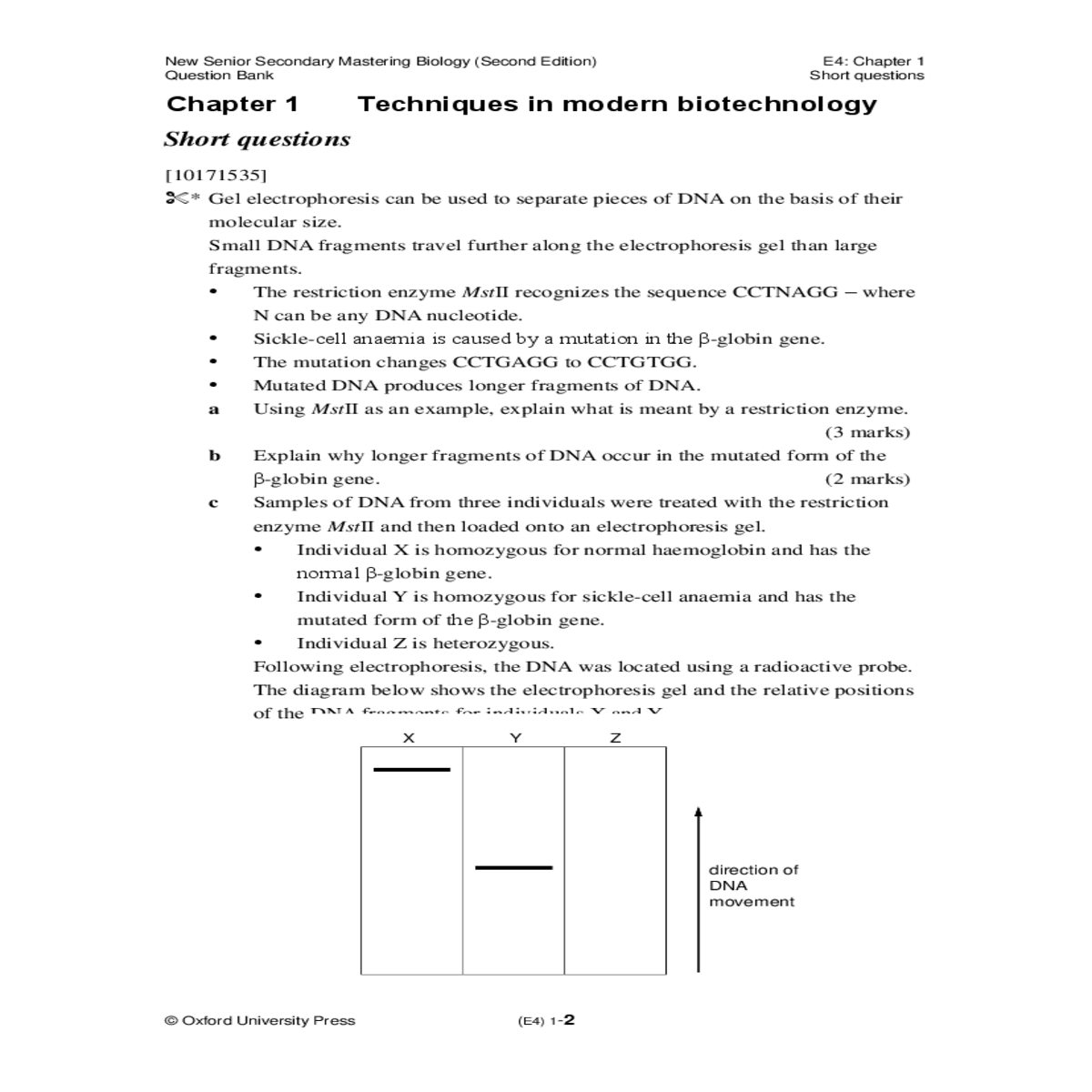
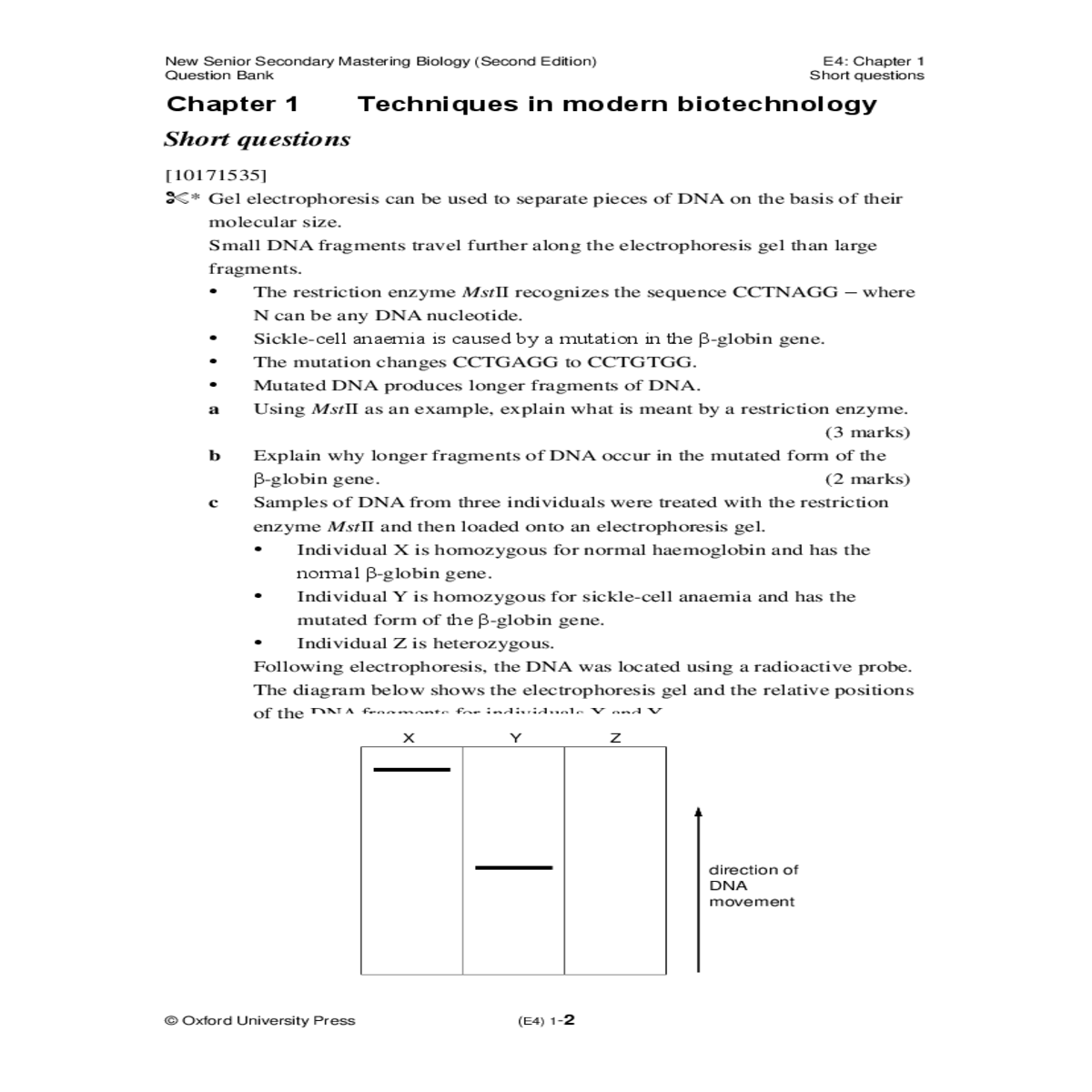
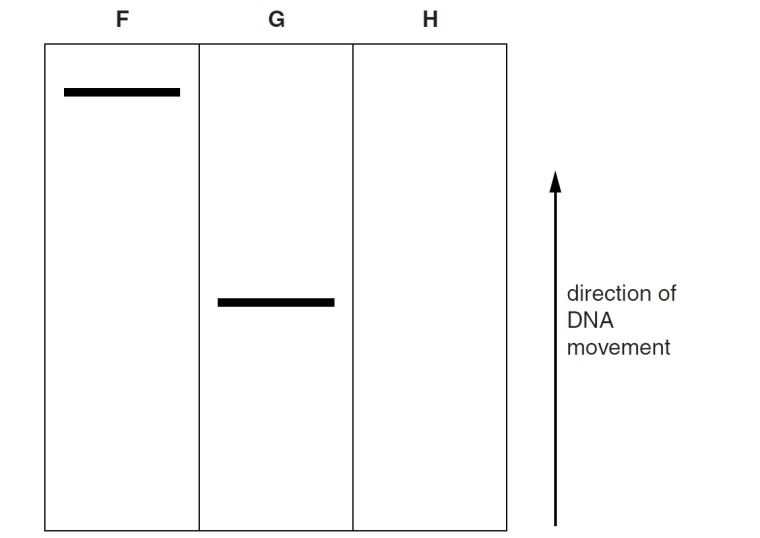
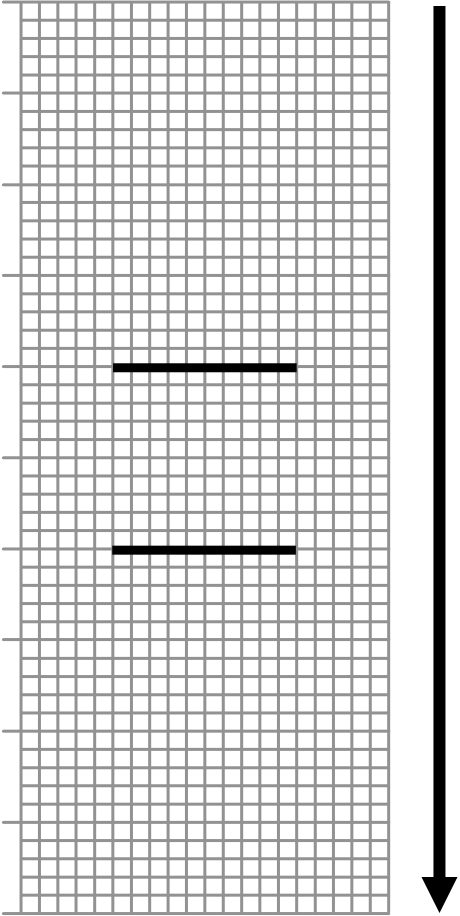
c Samples of DNA from three individuals were treated with the restriction enzyme MstII and then loaded onto an electrophoresis gel.
Individual X is homozygous for normal haemoglobin and has the normal β-globin gene.
| X | Y |
|---|
direction of
DNA
movement
Complete the diagram by drawing the position of the DNA from individual Z in the blank column on the diagram. (1 mark) OCR GCE (A) Human Biology Genetics, Control and Ageing Jun 2012 Q2a–c
-- answer --
1m
b There are fewer recognition sites in the mutated form of the β-globin gene. 1m
It shows the cloning technique used to produce Dolly the sheep.
| sheep X | sheep Y |
|---|
ovum
© Oxford University Press (E4) 1-3
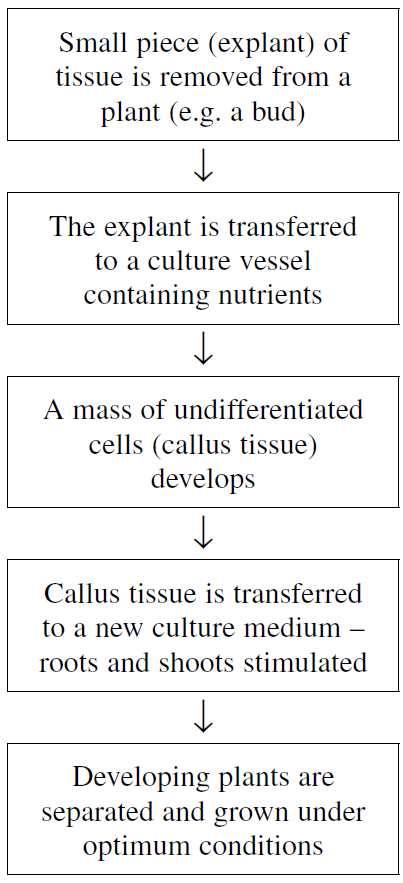
small piece (explant) of tissue
is removed from a plant
(e.g. a bud)the explant is transferred to a
culture vessel containing
nutrients
New Senior Secondary Mastering Biology (Second Edition) E4: Chapter 1 Question Bank Short questions
culture medium and damage the plant tissue. 1m
c Add hormones to the culture medium. 1m
| e |
|
1m x 2 |
|---|---|---|
|
||
[10171552]
**The enzyme, polygalacturonase (PG), is responsible for the softening of fruits such as tomatoes. To prolong the shelf life of tomatoes, scientists have
genetically engineered tomato plants to create the ‘Flavr Savr’ tomato that does not bruise during shipping and lasts longer on the shelf.To do this, the PG gene responsible for the production of the enzyme was first isolated. Scientists then used this isolated gene to create an ‘anti’ or ‘nonsense’ PG gene that was then introduced into tomato plants. This nonsense gene stops the translation of the original PG gene in the tomato plant and so stops enzyme production.
The diagram below summarizes the action of the introduced nonsense PG gene.
| portion of original PG gene | portion of ‘nonsense’ PG gene |
|---|
process X
no polygalacturonase enzyme produced
no softening of fruit
| (any 3) | (E4) 1-6 | 1m x 3 |
|---|---|---|
carrot plant pieces of phloem grown in culture carrot plants tissue removed medium developed
1m b Desirable characters of selected plants can be preserved. /
It can be used as a method to overcome reproductive difficulties of plants. 1m c It is because plants produced by tissue culture are genetically identical / lack genetic variations. 1m d Hormones 1m They are used to promote the growth of roots and shoots. 1m - - - - - - - - - - - - - - - - - - - - - - - - - - - - - - - - - - - - - - - - - - - - - - - - - - -© Oxford University Press (E4) 1-7
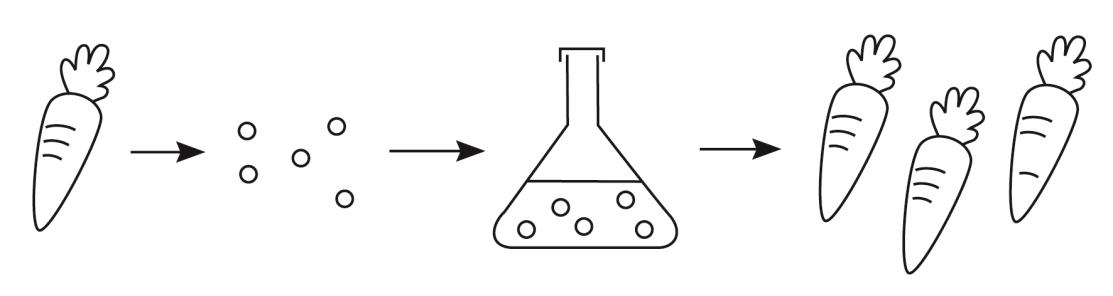
Cloning can also be used to create embryos, which can provide d for research and medical treatment.
-- answer --
| a | 1m | |
|---|---|---|
| b | 1m | |
| c | 1m | |
| d | 1m |
- - - - - - - - - - - - - - - - - - - - - - - - - - - - - - - - - - - - - - - - - - - - - - - - - - -
© Oxford University Press (E4) 1-8
[10171760]
* Tissue culture is a method of artificial propagation in plants. One technique for carrying out tissue culture is to remove meristems from shoot tips of plants and culture them as shown in the diagram below.magnified view
of shoot tipseparate callus
cells grow into
plantletsrooting and conditioning
of transplanted plantlets-- answer --
a Meristems are rapidly dividing. 1m b Meristematic cells divide by mitotic cell division to form a mass of cells. / The cells are separated. /
Each cell contains genes that are required to produce a new plant. / The cells differentiate. /
| c |
|
1m x 3 |
|---|---|---|
[10171772]
* The human protein, insulin, is involved in the homeostatic control of blood sugar. Most artificially produced human insulin is currently produced by
genetically modified bacteria, but several companies are now investigating the possibility of producing human insulin using the safflower plant, a plant which is normally grown for its oil. This method would allow large scale production and, in theory, one large North American farm would be capable of meeting the global demand for insulin.© Oxford University Press (E4) 1-10
b Suggest why eating safflower plants containing insulin would not result in an increase in the patient’s blood insulin levels. (2 marks) One possible risk of growing a genetically modified crop in this way is that it might interbreed with wild plants. Pharmaceutical companies try to minimize such risk by growing the crop ‘counter-seasonally’ to reduce the chances of the insulin gene being transferred to other plants.
| c |
|
(1 mark) |
|---|
The sticky ends allow the plasmid and the human insulin gene to bind together
with hydrogen bonds. 1m
The absorbed amino acids cannot be reassembled into insulin in the body due to
the lack of a functional gene. 1m
|
|---|
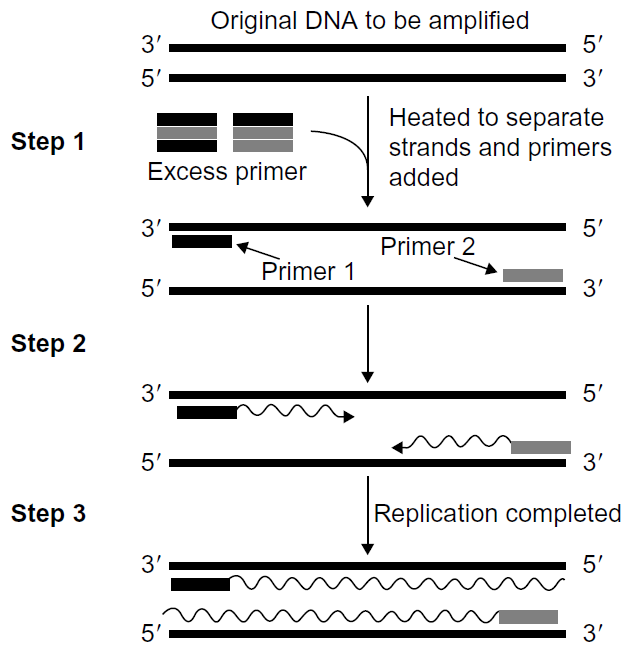
| step 3 | replication completed |
|---|
| b | i |
|---|
(1 mark) iv What else should be added to the process in step 2 to allow successful replication of the DNA sample? (1 mark) c In step 3, replication of the DNA is completed. Describe the sequence of events, following the separation of the DNA strands in step 1, which lead to
(1 mark) ii Suggest how scientists have solved this potential problem. (1 mark) e In some legal cases, the use of PCR has been discredited. Suggest one possible source of error in the PCR process. (1 mark) CCEA GCE (AS) Biology (New Specification) Module 1 Jun 2009 Q7
-- answer --
a A large number of DNA copies can be synthesized from a single DNA sample. / It can be used in DNA fingerprinting. 1m 1m b i Heating breaks the hydrogen bonds between DNA strands.(or other reasonable answers) 1m- - - - - - - - - - - - - - - - - - - - - - - - - - - - - - - - - - - - - - - - - - - - - - - - - - -
© Oxford University Press (E4) 1-13
(2 marks) b The polymerase chain reaction (PCR) enables many copies of DNA to be made from a small sample. The diagram below summarizes the procedure.
|
|---|
keep repeating the
process
| Number of bases | ||||
|---|---|---|---|---|
| A | G | T | C | |
| Strand 1 | 7 | 8 | ||
| Strand 2 | 4 | |||
(2 marks) CCEA GCE (AS) Biology (New Specification) Module 1 Jan 2009 Q7
© Oxford University Press (E4) 1-14
| DNA nucleotide | RNA nucleotide | |
|---|---|---|
| 1 |
|
|
| 2 |
|
1m ii 32 1m c Restriction enzymes cut DNA molecules at specific base sequences, 1m across the sugar-phosphate backbone. 1m d
| Number of bases | ||||
|---|---|---|---|---|
| A | G | T | C | |
| Strand 1 | 7 | 8 | 4 | 5 |
| Strand 2 | 4 | 5 | 7 | 8 |
2m- - - - - - - - - - - - - - - - - - - - - - - - - - - - - - - - - - - - - - - - - - - - - - - - - - -
| cut | (1 mark) | |||
|---|---|---|---|---|
b State the base sequence of the bases in the sticky end on strand Y.
(1 mark) c The diagram below shows the positions of four restriction sites, W, X, Y and Z, in a plasmid. The distances between these sites are measured in kb (1 kb = 1000 base pairs)
10 kb
|
|---|
(1 mark)
-- answer --
New Senior Secondary Mastering Biology (Second Edition) E4: Chapter 1
d The molecular spaces in the gel slab allowed shorter DNA fragments to move
faster than the longer ones. 1m
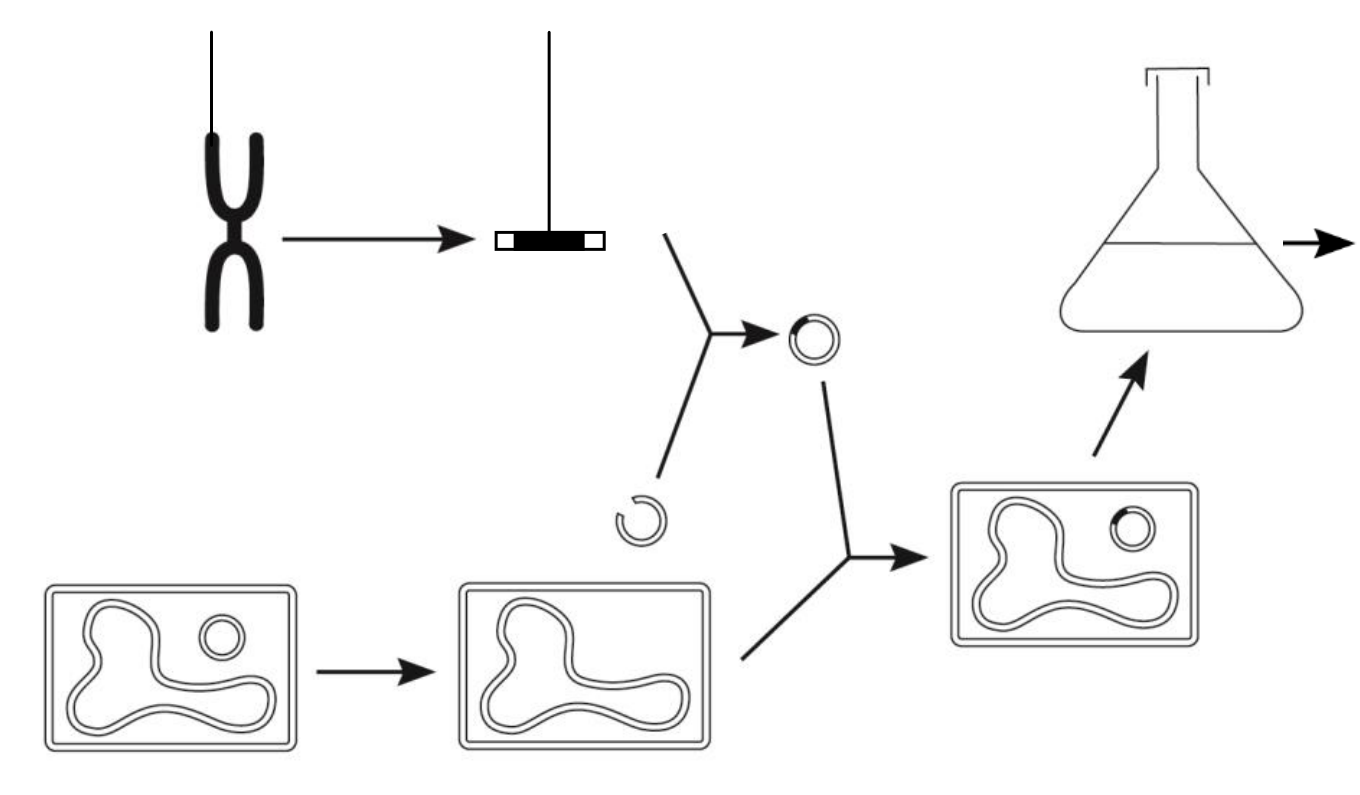
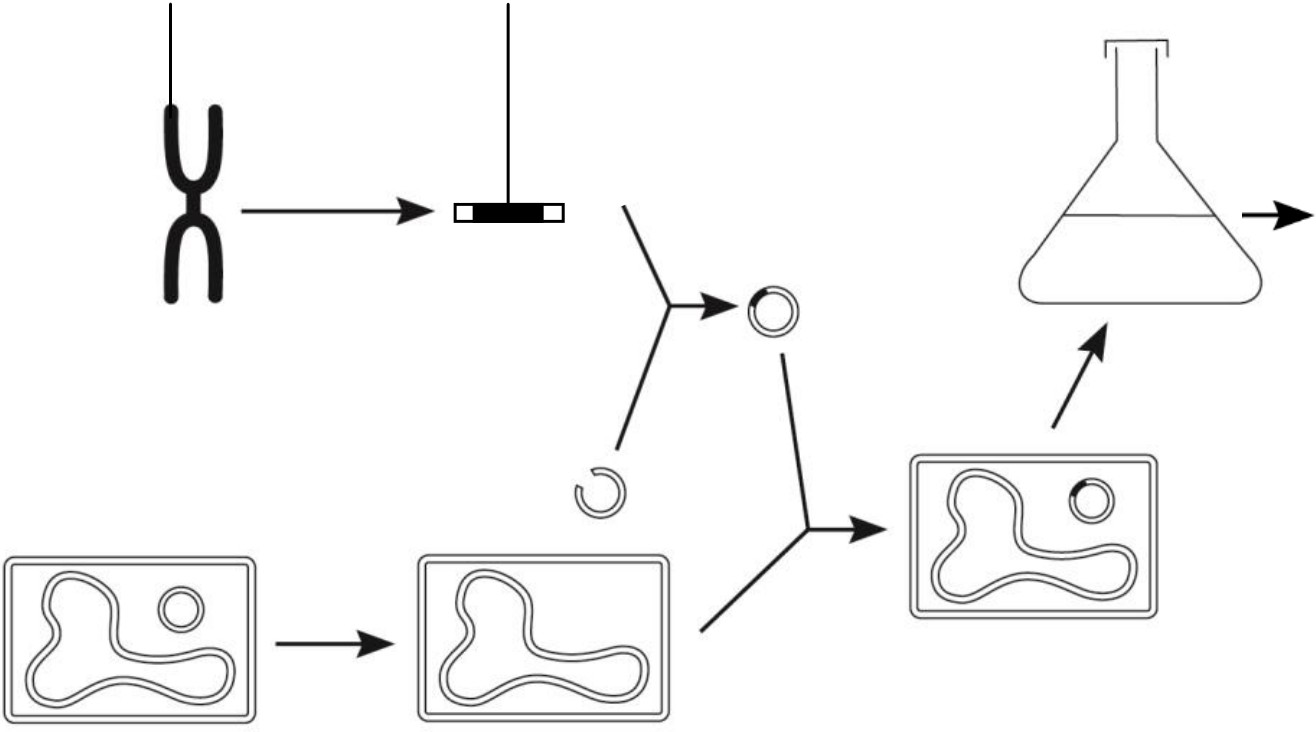
b Many copies of the DNA encoding human insulin are required. Name the
technique which can be used to amplify a specific DNA fragment from a
iii Describe three properties of this structure which make it ideal for use
in genetic engineering. (3 marks)
(2 marks) -- answer --
| a |
|
1m | |
|---|---|---|---|
| b | 1m | ||
| 1m | |||
| c | i | 1m | |
| ii | 1m | ||
to carry the DNA encoding human insulin into the bacterial cell. 1m
iii It can pick up foreign DNA easily. /
| e | 1m | |
|---|---|---|
The product yield is much higher. /
The extraction cost is lower. (any 2) 1m x 2 - - - - - - - - - - - - - - - - - - - - - - - - - - - - - - - - - - - - - - - - - - - - - - - - - - -
f After cycles of PCR, the DNA fragments containing the gene for the protein were cut using a restriction enzyme. Three restriction enzymes and their corresponding recognition sites are shown below.
ATCGGATCCACGGCGGAATTCGCGTCGGGATCCTAG T A G C C T A G G T G C C G C C T T A A G C G C A G C C C T A G G A T C
gene for the protein
| (3 marks) | ||||
|---|---|---|---|---|
| iii | Name an enzyme that can be used to join the resulting DNA fragments | |||
| (1 mark) | ||||
| g | ||||
|
|
|||
-- answer --
a To amplify the gene. /
To increase the quantity of the gene. 1m b To separate the double helix of the DNA fragment into two single DNA strands by 1m breaking the hydrogen bonds between the base pairs in the DNA.c To bracket the DNA region to be amplified. /
To serve as starting points for DNA synthesis. /
To stop the two DNA strands from rejoining. 1m d Heat-stable DNA polymerase would not be denatured when the reaction mixture was heated to high temperatures in PCR cycles.
1m e 25 = 32 copies 1m 1m f i X and Y leave sticky ends on the DNA fragments after cutting.
b Explain why BamHI is useful in recombinant DNA technology. (2 marks)
c Name the enzyme used to join DNA fragments. (1 mark)
The recombinant plasmid is mixed with bacteria. The bacteria are then cultured on an agar plate containing the antibiotic ampicillin.
d Explain why the bacteria have to be cultured on an agar plate containing ampicillin. (3 marks) The bacteria on the agar plate are then cultured in fermenters. They produce polypeptides, which can be processed into human insulin.
The unpaired bases in the sticky ends of the DNA fragments cut with the same restriction enzyme can bind together with hydrogen bonds. This facilitates the joining of the DNA fragments. 1m c DNA ligase 1m
d
Only some of the bacteria have picked up the recombinant plasmid / are transformed. 1m Only the transformed bacteria which carry an ampicillin resistance gene survive on the agar plate containing ampicillin. 1m Culturing the bacteria on the agar plate containing ampicillin allows the selection of
| e |
|
1m |
|---|---|---|