Ling schedule type lecture recommended prerequisite ling
| Linguistics (LING) | 1 |
|---|
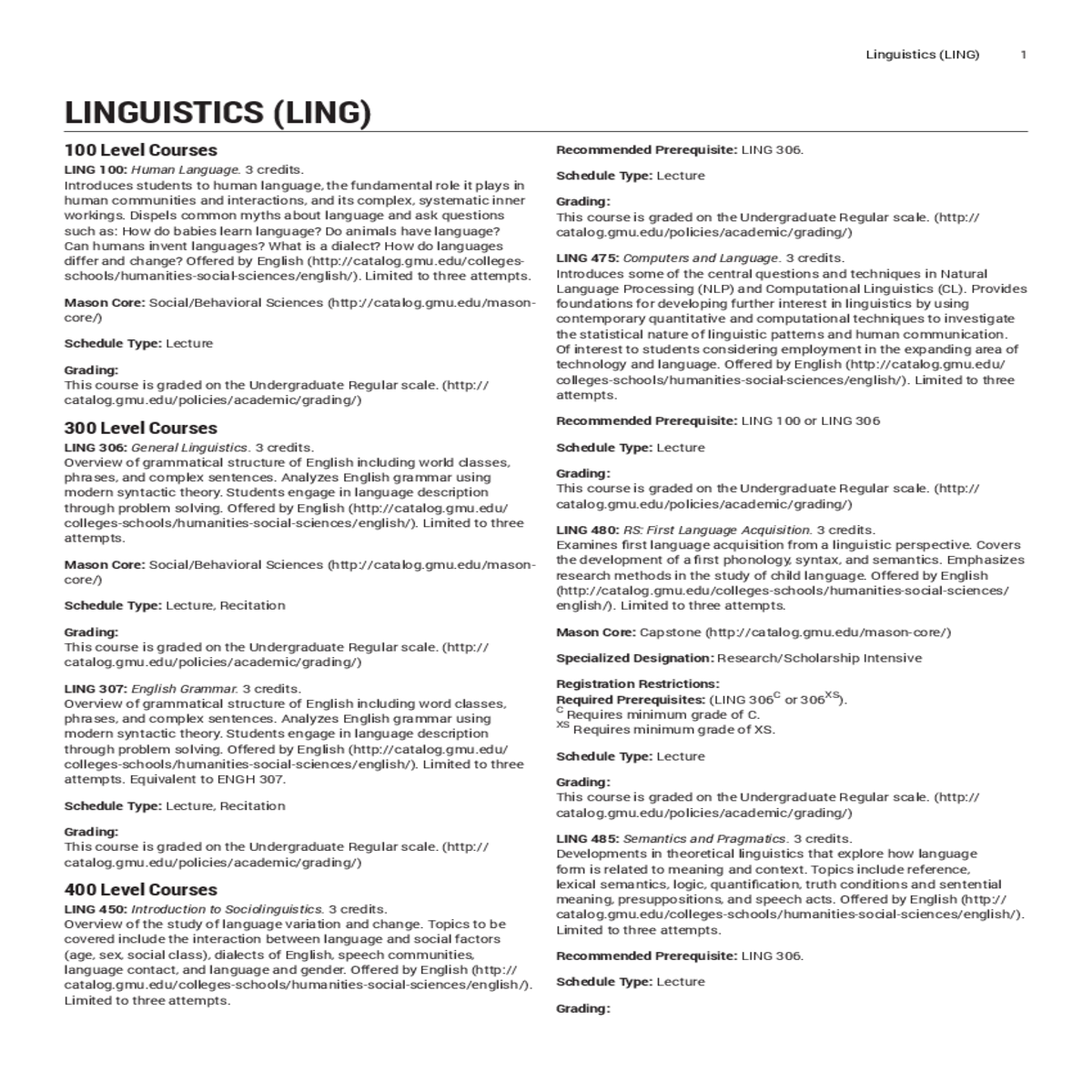
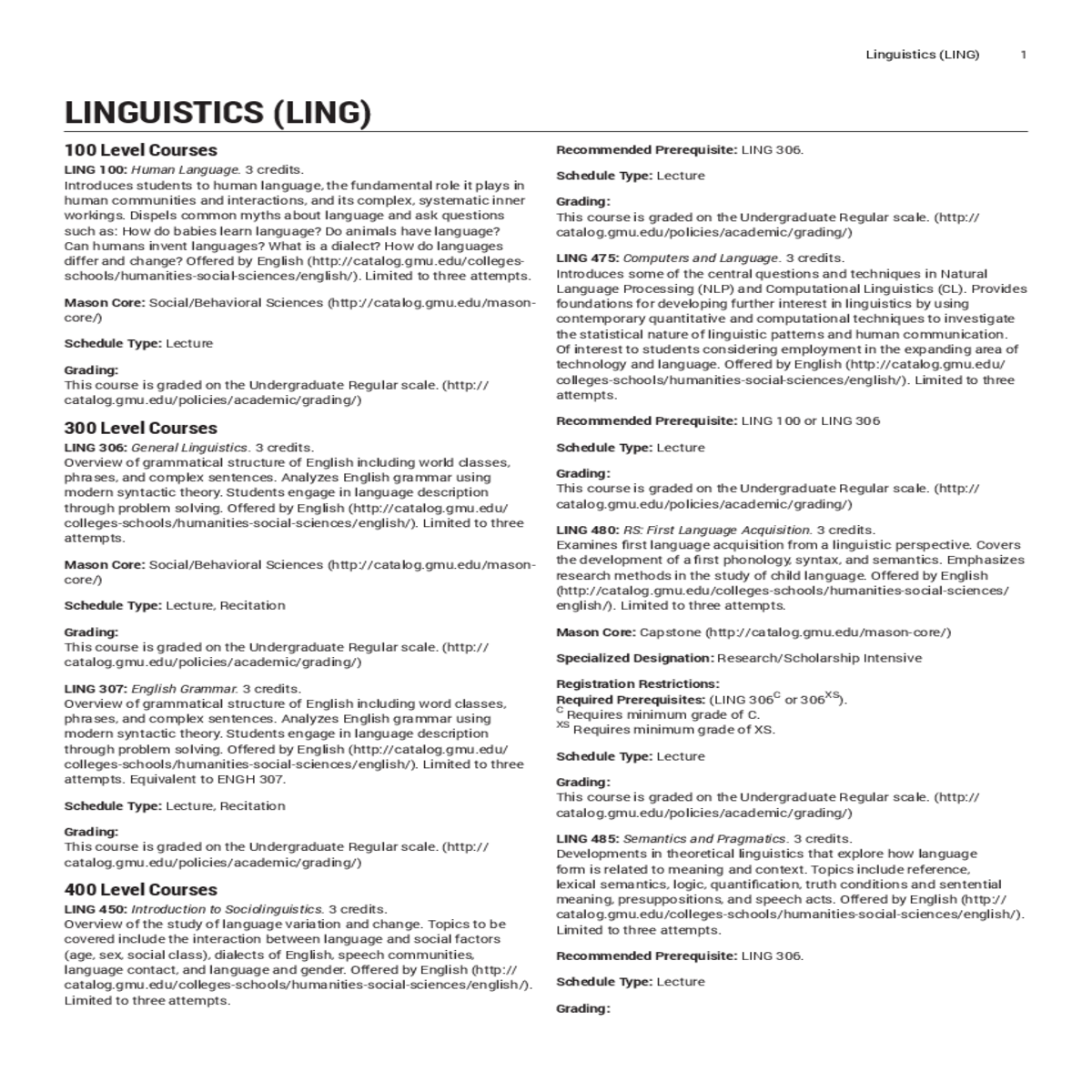
LINGUISTICS (LING)
Mason Core: ()
Grading:
This course is graded on the ()
Grading:
This course is graded on the ()300 Level Courses
Mason Core: ()
Schedule Type: Lecture, Recitation
This course is graded on the ()
LING 307:English Grammar. 3 credits.
This course is graded on the ()
LING 485:Semantics and Pragmatics. 3 credits.
| Grading: |
|---|
Intensive study of particular theoretical problem in linguistics conducted by student in close consultation with instructor. Student produces
substantial piece of written work on research findings. Notes: May be repeated with permission of instructor. Offered by (). May be repeated within the degree for a maximum 6 credits.Recommended Prerequisite: LING 306 and 3 other LING credits and permission of instructor.
Recommended Prerequisite: LING 306
Grading:
This course is graded on the ()
| Schedule Type: Lecture Grading: |
|---|
This course is graded on the ()
LING 490:Generative Phonology. 3 credits.
and phonological universals and constraints. Offered by (). Limited to three attempts.
Recommended Prerequisite: LING 306.
| Schedule Type: Lecture |
|---|
syntax. Offered by (). May not be repeated for credit.
) Registration Restrictions:
Enrollment is limited to Graduate, Non-Degree or Undergraduate level students.
Students in a Non-Degree Undergraduate degree may not enroll.
| LING 521:Applied Linguistics: Teaching English to Speakers of Other | Linguistics (LING) | 3 |
|---|---|---|
| Languages (TESOL). 3 credits. |
|
Theories and basic principles of teaching a second language, especially as they relate to English language. Introduces students to methods of
Students in a Non-Degree Undergraduate degree may not enroll.
This course is graded on the ()
This course is graded on the ()
LING 522:English Grammar and Pedagogy. 3 credits.
Recommended Prerequisite: One linguistics course or permission of
Students in a Non-Degree Undergraduate degree may not enroll.
Either a chronological survey of development of English from Old and Middle English to Modern English and American English, taking into account historical changes in phonology, morphology, syntax, and
semantics. Offered by (). May not be repeated for credit.
students. Registration Restrictions:
| Schedule Type: Lecture Grading: |
|---|
Students in a Non-Degree Undergraduate degree may not enroll.
LING 523:English Pronunciation and Pedagogy. 3 credits. Schedule Type: Lecture
Introduces programming and quantitative language data analysis. Builds fundamental skills in computational tools such as Python and R. Notes: This course assumes no background in coding. Offered by (). May not be repeated for credit.
Recommended Prerequisite: LING 520 or equivalent
Students in a Non-Degree Undergraduate degree may not enroll. instructor.
Schedule Type: Lecture Registration Restrictions:
Examines first language acquisition from a linguistic perspective. Covers the development of a first phonology, syntax, and semantics. Methodology in studying child language is discussed. Offered by |
|---|
Recommended Prerequisite: LING 520 or one of the following: LING 690,
Grading:
This course is graded on the ()
Students in a Non-Degree Undergraduate degree may not enroll. LING 525.
Schedule Type: Lecture Recommended Prerequisite: LING 522, LING 523
Registration Restrictions:
Required Prerequisites: LING 521B- or 521XS. B- Requires minimum grade of B-.XS Requires minimum grade of XS.
Students in a Non-Degree Undergraduate degree may not enroll.
instructor. Schedule Type: Internship
LING 650:Introduction to Sociolinguistics. 3 credits.
An overview of the study of language variation and change. Topics to be covered include the interaction between language and social factors (age, sex, social class), dialects of English, speech communities,
| Schedule Type: Lecture Grading: |
|---|
Compares first and second language acquisition. Explores factors contributing to L2 variation, including linguistic universals, transfer, age, input, and affective considerations. Offered by (
Recommended Prerequisite: LING 520, 523, or 690.
This course is graded on the ()
LING 686:Special Topics in Linguistics. 3 credits.
Enrollment limited to students with a class of Advanced to Candidacy, Graduate, Junior Plus, Non-Degree or Senior Plus.
Students in a Non-Degree Undergraduate degree may not enroll.
| Schedule Type: Lecture Grading: |
|---|
This course is graded on the ()
LING 675:Computational Linguistics I. 3 credits.
Registration Restrictions:
Required Prerequisites: (LING 570B- or 570XS). B-
Requires minimum grade of B-.
XS Requires minimum grade of XS.
Recommended Prerequisite: LING 520 or equivalent
LING 685:Typology. 3 credits.
Developments in theoretical linguistics that explore how language form relates to meaning and context. Topics include reference, lexical semantics, logic, quantification, truth conditions and sentential
meaning, presuppositions, and speech acts. Offered by (
| 6 |
|
|
|---|---|---|
| ). | ||
Students in a Non-Degree Undergraduate degree may not enroll.
Recent trends in phonological theory. Topics include stress assignment, tone spreading, and vowel harmony, from within nonlinear framework.
Grading:
This course is graded on the ()
Enrollment is limited to Graduate, Non-Degree or Undergraduate level students.
languages, and the dominant descriptive and theoretical models of this variation. Connections to typology, psycholinguistics, and computational approaches are discussed. Offered by (). May not be repeated for credit.
Recommended Prerequisite: LING 520 or equivalent
Introduction to phonetic theory and phonetic representation, including articulatory, acoustic and perceptual characteristics of human speech.
Students will learn and practice acoustic analysis, perceptual testing, production and transcription of speech sounds from the world’s
languages. Offered by (). May not be repeated for credit.
| Schedule Type: Lecture Grading: |
|---|
| constraints. Offered by (). May not be repeated for credit. |
|---|
Recommended Prerequisite: LING 520 or equivalent
Registration Restrictions:
Enrollment limited to students with a class of Advanced to Candidacy,
Graduate, Junior Plus, Non-Degree or Senior Plus.
| This course is graded on the ( | Linguistics (LING) | 7 | |
|---|---|---|---|
| ) |
LING 775:Computational Linguistics II. 3 credits.
Practical introduction to automated data collection and using linguistic resources for computational and quantitative data analysis. Topics include existing resources, licensing and data sharing issues, ethical considerations, and the speed, consistency and precision issues that arise when collecting linguistic data from a variety of corpora. Offered by (). May not be repeated for credit.
Students in a Non-Degree Undergraduate degree may not enroll.
This course is graded on the ()
Schedule Type: Lecture
Grading:
This course is graded on the ()
Advanced course in second-language acquisition theory. Detailed analysis of internal and external constraints. Variation addressed from linguistic, psychological, and environmental perspectives. Offered by (). May not be repeated for credit.
literature. Offered by (). May not be repeated for credit. Recommended Prerequisite: LING 786.
| Recommended Prerequisite: LING 582 or permission of instructor. |
|---|
Students in a Non-Degree Undergraduate degree may not enroll.
Grading:
This course is graded on the ()
LING 785:Semantics and Pragmatics. 3 credits.
Developments in theoretical linguistics that explore how
language
form relates to meaning and context. Topics include reference, lexical
semantics, logic, quantification, truth conditions and sentential
meaning, presuppositions, and speech acts. Offered by ().
Registration Restrictions:
Enrollment is limited to Graduate or Non-Degree level students.
Students in a Non-Degree Undergraduate degree may not enroll.
| 8 |
|
|
|---|---|---|
| by (). May not be repeated for credit. | ||
Recommended Corequisite: LING 690
Registration Restrictions:
Enrollment limited to students with a class of Advanced to Candidacy,
Graduate, Non-Degree or Senior Plus.
Recommended Prerequisite: LING 782 or permission of the instructor.
Registration Restrictions:
Enrollment is limited to Graduate level students.
Registration Restrictions:
Enrollment is limited to Graduate or Non-Degree level students.
Sem #5, Lec/Sem #6, Lec/Sem #7, Lec/Sem #8, Lec/Sem #9, Sem/Lec #10, Sem/Lec #11, Sem/Lec #12, Sem/Lec #13, Sem/Lec #14, Sem/Lec #15, Sem/Lec #16, Sem/Lec #17, Sem/Lec #18, Seminar
Recommended Prerequisite: LING 786, LING 787, or permission of instructor.
| Students in a Non-Degree Undergraduate degree may not enroll. Schedule Type: Thesis |
|
|---|
Registration Restrictions:
Enrollment is limited to Graduate or Non-Degree level students.
Schedule Type: Lec/Sem #1, Lec/Sem #2, Lec/Sem #3, Lec/Sem #4, Lec/ Sem #5, Lec/Sem #6, Lec/Sem #7, Lec/Sem #8, Lec/Sem #9, Sem/Lec #10, Sem/Lec #11, Sem/Lec #12, Sem/Lec #13, Sem/Lec #14, Sem/Lec #15, Sem/Lec #16, Sem/Lec #17, Sem/Lec #18, Seminar
Recommended Prerequisite: LING 786, LING 787
| This course is graded on the ( | Linguistics (LING) | 9 |
|---|---|---|
| ) |
|
|
| LING 890:Advanced Phonology Seminar. 3 credits. |
|
Schedule Type: Lec/Sem #1, Lec/Sem #2, Lec/Sem #3, Lec/Sem #4, Lec/ Sem #5, Lec/Sem #6, Lec/Sem #7, Lec/Sem #8, Lec/Sem #9, Sem/Lec #10, Sem/Lec #11, Sem/Lec #12, Sem/Lec #13, Sem/Lec #14, Sem/Lec #15, Sem/Lec #16, Sem/Lec #17, Sem/Lec #18, Seminar
Registration Restrictions: Grading:
Advanced topics seminar in current linguistic theory. Offered by (). May be repeated within the term for a maximum 27 credits.
This course is graded on the ()
Schedule Type: Dissertation
Specialized Designation: Topic Varies Grading:
Doctoral dissertation research and writing under direction of student's dissertation committee. Offered by (). May be repeated
Schedule Type: Seminar within the degree.
Recommended Prerequisite: PhD rank or permission of instructor.
Registration Restrictions:
Enrollment is limited to Graduate level students.
Registration Restrictions:
Enrollment limited to students with a class of Advanced to Candidacy.Enrollment is limited to Graduate level students.