Letters etc the internal environment
Business Communication: An Essential Element For Effectiveness
Discuss about the Case Study for Business Communication for An Essential Element For Effectiveness?
Answer:
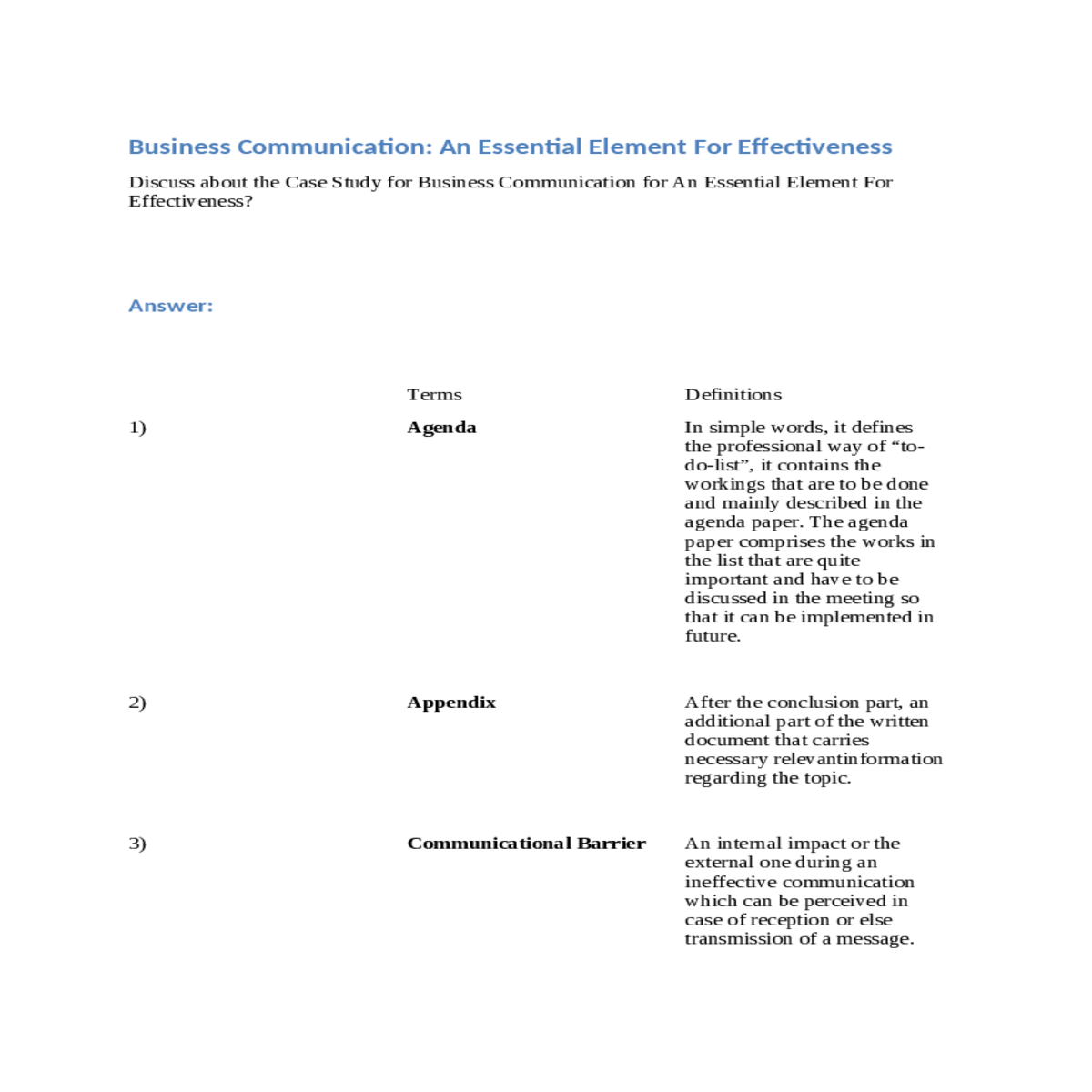
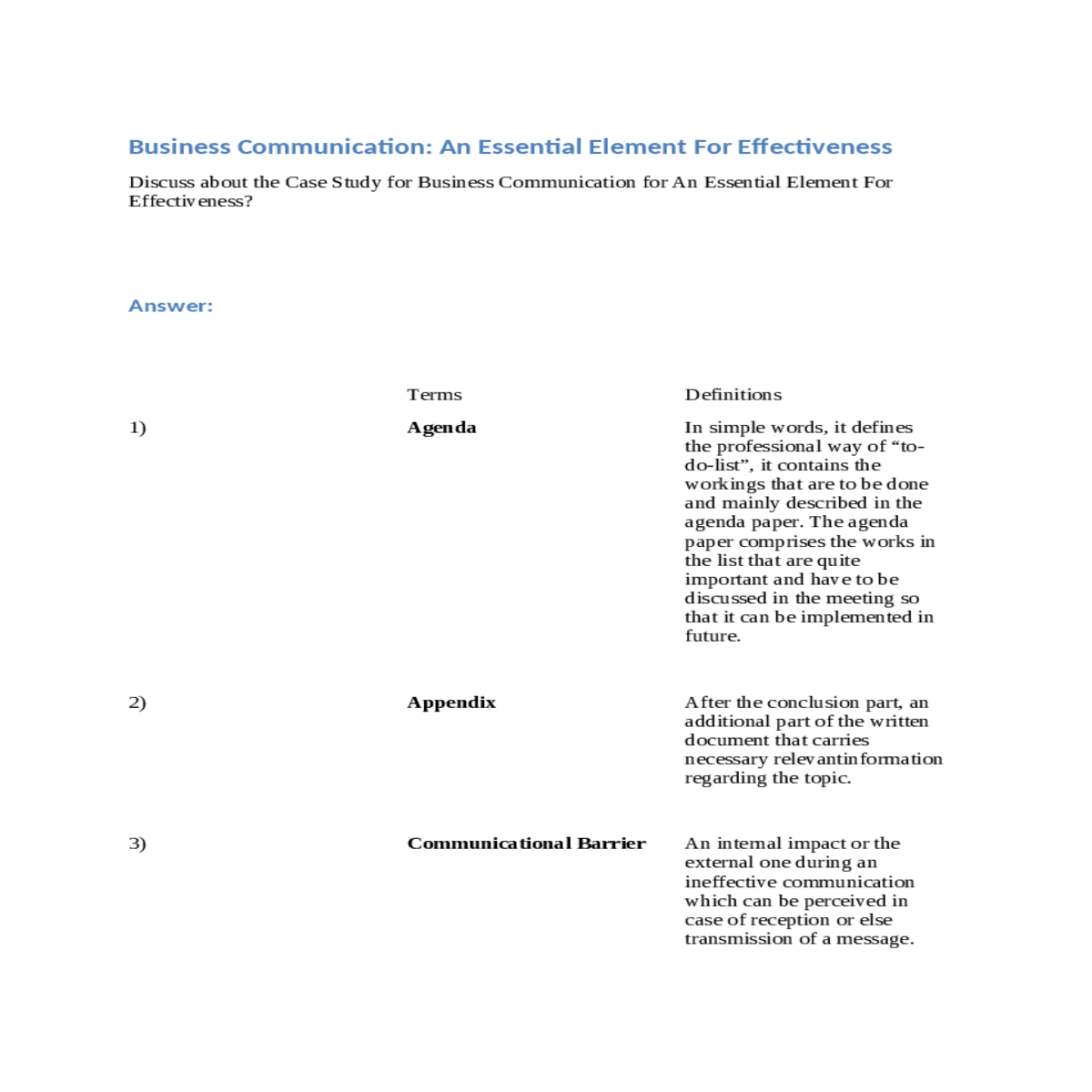
| Terms | Definitions | |
| 1) |
|
|
| 2) | Appendix |
|
| 3) |
|
An internal impact or the external one during an ineffective communication which can be perceived in case of reception or else transmission of a message. |
| 4) |
|
|
| 5) | Channel |
|
| 6) |
|
Information sharing with the help of mutual understanding with the integration of new ideas and information. |
| 7) | , work experience etc are briefly described.
|
|
| 8) | Decoding |
|
| 9) |
|
Interactive communication among different departments of the same company. |
| 10) | After the information comes from the source, the encoders shape the information or idea into a definite message. | |
| 11) |
|
The communication which is absolutely business-related and some specific standards, rules as well as laws are there to evaluate it. |
| 12) |
|
|
| 13) | Hierarchy |
|
| 14) |
|
Communication between two people present at the same hierarchical level in a company. |
| 15) |
|
|
| 16) | Medium |
|
| 17) |
|
In the internal environment, among the colleagues memorandum is utilized which is just a form of short notice |
| 18) |
|
|
| 19) | Mushroom communication |
|
| 20) |
|
A disruptive intrusion which has negative impact on the communication. |
| 21) |
|
|
| 22) | Oral communication |
|
| 23) |
|
For effective communication, the laws, rules and regulations along with the standards and activities, that the members have to follow. |
| 24) | Reports |
|
| 25) |
|
Information sharing from upper levels to lower levels or the lower levels to upper levels in the chain of command of an organizational structure. |
| 26) | Transmission of message or sharing of information with the help of text or written documents. |
Introduction
Considering different views, opinions, suggestion and ideas is a decisive part of communication which is quite a practical proficiency. For the communication, diverse media, channels and sources of other organizations are taken into consideration. It is because; communication is an aspect that is very necessary to work on behavioural aspects and relations. In the world of business, communication is the aspect which is the reason behind many issues of disagreement(Chatterjee & Subramanian, 2013). By improving the communication, effective management of the company can be possible and for this all the conflicts among the aspects should be resolved right away.
Objective
The communication related factors get more complicated once an organization gets more big or approaching towards business expansion. So, here the different factors, attributes, points and technological features associated with communication have to be analysed which is an objective of this study(Coombs, 2014). Then, the problems associated with the topic and its impact on effective communication has to be assessed properly. Afterwards, with the help of robust strategies regarding effective management techniques and comprehensive interpersonal skilfulness, the mitigation techniques will be found to solve the problems.
Procedure
Findings
| Mode of Communication | Advantages | Disadvantages | Applications |
|
Immediate Feedback: feedbacks are received immediately regardless of the receivers understanding. Appropriate and Suitable: there is an opportunity of immediate clarifications of the message conveyed. |
Lack of Privacy: Confidentiality of information gets disclosed in any oral communication. Lack of Records: Due to difficulty in preserving the messages for future references it is impossible to keep records of the communication. |
v Presentations v Face to Face Communication v Counselling v Speeches |
|
Used as Future Reference: The preserved documents of written messages can be used as a reference in future when required. Accuracy and Legality: Written messages can be kept and used as a legal document therefore must be carefully drafted. |
Time Consuming: Written communication consumes more time between two or more parties. Delay in Approval: Time is consumed in such process and hence there is delay in approval of orders |
v Websites v Telegrams v Contracts
|
|
Low Cost: Electronic communication saves money as well as time. Instantaneous feedback: Feedback obtained from such communication process is instantaneous in nature(Eksteen& Basson,2015). Easy Access: With accurate credentials one can access and communicate using Electronic communication system through numerous platforms. |
Undelivered Data: Due to technical errors data gets undelivered and retrieving is tedious. Volume of Data: When the volume of information increases, it is tough for the organisation to absorb the data in due time. |
v Emails v Internal Information System |
| Hard Copy | Ø Can be accessed at any time |
Ø Not Eco Friendly Ø Can be destroyed easily |
v Briefing Documents v Reports |
Communicational Barriers
Physical barriers
Lack of attention, interest or irrelevance to the receiver.
Use of over-complicated terms.
A skilled communicator should always be aware of such barriers by checking continually as well as understanding these barriers to reduce their impact and by providing appropriate feedback(Honda et al., 2014).
categories of communication barriers:
Systematic Barriers:
Systematic Barriers may reside in the structures and organisations where there inadequate and inefficient information systems and in various channels of communication. Systematic barriers mostly occur when there is absence of set of rules and roles of the team. In such circumstances, an individual may not be aware of their role in the process of communication.
Psychological barriers:
language barriers:
References
Chatterjee, R.B. and Subramanian, K. eds., 2013. Excellence in business communication. Pearson.
Coombs, W.T., 2014. Ongoing crisis communication: Planning, managing, and responding. Sage Publications.
Hua, T.K., Nor, N.F.M. and Jaradat, M.N., 2012. Communication strategies among EFL students: An examination of frequency of use and types of strategies used. GEMA Online Journal of Language Studies, 12(3), pp.831-848.
Hunt, D., Atkin, D. and Krishnan, A., 2012. The influence of computer-mediated communication apprehension on motives for Facebook use.Journal of Broadcasting & Electronic Media, 56(2), pp.187-202.