Knowledge management process model and sustainability issues
Reflection on knowledge management by Accenture company
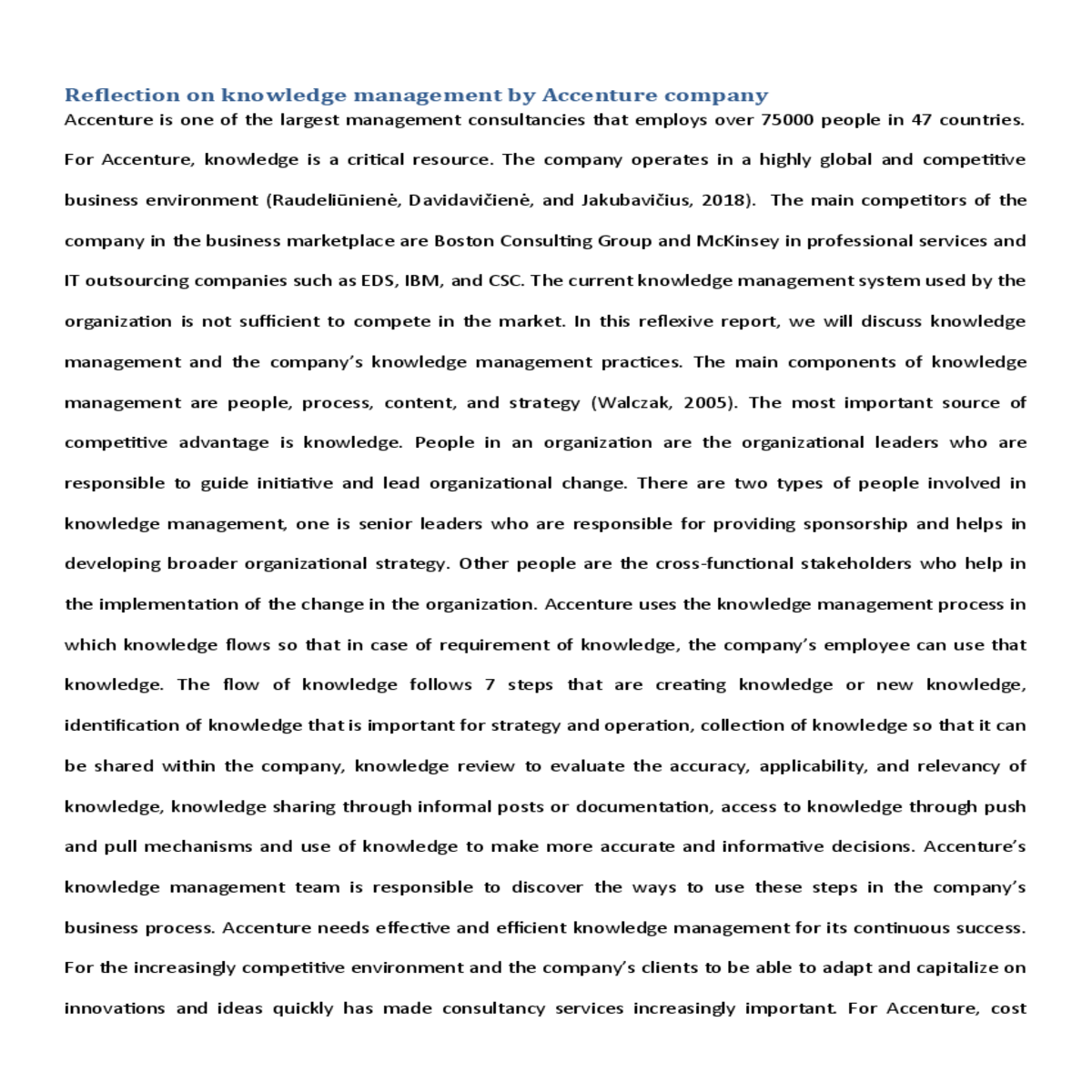
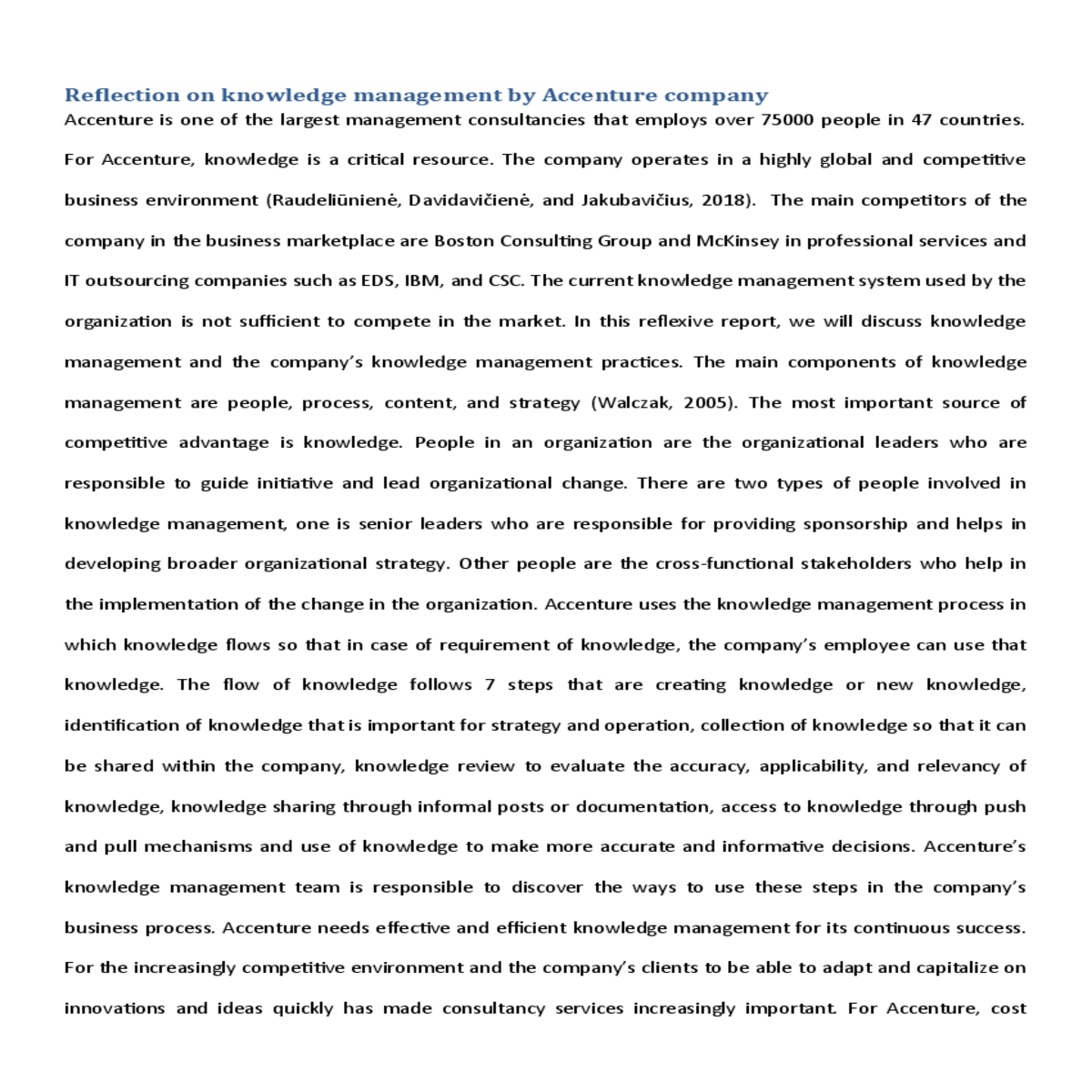
Accenture is one of the largest management consultancies that employs over 75000 people in 47 countries. For Accenture, knowledge is a critical resource. The company operates in a highly global and competitive business environment (Raudeliūnienė, Davidavičienė, and Jakubavičius, 2018). The main competitors of the company in the business marketplace are Boston Consulting Group and McKinsey in professional services and IT outsourcing companies such as EDS, IBM, and CSC. The current knowledge management system used by the organization is not sufficient to compete in the market. In this reflexive report, we will discuss knowledge management and the company’s knowledge management practices. The main components of knowledge management are people, process, content, and strategy (Walczak, 2005). The most important source of competitive advantage is knowledge. People in an organization are the organizational leaders who are responsible to guide initiative and lead organizational change. There are two types of people involved in knowledge management, one is senior leaders who are responsible for providing sponsorship and helps in developing broader organizational strategy. Other people are the cross-functional stakeholders who help in the implementation of the change in the organization. Accenture uses the knowledge management process in which knowledge flows so that in case of requirement of knowledge, the company’s employee can use that knowledge. The flow of knowledge follows 7 steps that are creating knowledge or new knowledge, identification of knowledge that is important for strategy and operation, collection of knowledge so that it can be shared within the company, knowledge review to evaluate the accuracy, applicability, and relevancy of knowledge, knowledge sharing through informal posts or documentation, access to knowledge through push and pull mechanisms and use of knowledge to make more accurate and informative decisions. Accenture’s knowledge management team is responsible to discover the ways to use these steps in the company’s business process. Accenture needs effective and efficient knowledge management for its continuous success. For the increasingly competitive environment and the company’s clients to be able to adapt and capitalize on innovations and ideas quickly has made consultancy services increasingly important. For Accenture, cost competitiveness is also important for the company’s capacity to operate in a competitive professional and increasingly crowded market. The most important part of the market for the company is the enterprise resource planning system implementation. The basis of Accenture’s learning model is standardization and innovation to create new standards and then transformed into new standards. The knowledge management practices are important as it allows the employees of the company to produce knowledge implementation, formulating enterprise knowledge, and transforming into the learning of the entire enterprise. Knowledge management is linked to Accenture's training for new and existing employees. Skill development and training to employees at Accenture are done through the company’s online e-learning system. Knowledge management provides intelligence on potential business areas that contributes to business competitiveness. The company’s clients want the company to be at the cutting edge of new trends in business and management. The company is currently developing products, services, and ideas in the emerging field of “supply relationship management”. Traditionally, Accenture’s knowledge management was managed and sponsored by service lines and industry groups that were a siloed approach. For this, the company’s project team has to be contacted by the knowledge management group from different business regions. Since the past few years, the business career of the company becomes difficult to comply with the standards but the company is trying best to present themselves best in the business processes, encouraging its employees for developing better ways to develop new standards.
According to Accenture, the most important part of the company are employees and the company’s assets. The company not only provides good products and services but it also makes people. For this, the company has developed its uniques education and employment mechanism. The company follows its uniques training rules and ensures that every staff of the company learns it (Bhatt, 2002). A good degree of knowledge is important to actively seek learning and improvement, and standardization to empower employees and providing a platform for improvement. The company has strengthened training programs for employees organized team learning, transfer, and sharing of knowledge and enhanced the knowledge transfer into a more comprehensive corporate-based knowledge. Some of the knowledge principles that the company follows to run its business effectively and efficiently and improve its business performance. According to the company, knowledge is a valued asset which means the company must have sufficient knowledge to deliver its products and services effectively and efficiently. The company accepts that knowledge should be captured where necessary and possible. By sharing knowledge within the company increases the performance of the company. The company’s focus is to deliver various consulting services including supply chain, customer relationship, change risk, talent, strategy consulting, marketing sciences services, and workforce performance management. The company focuses on the knowledge gained from customers so that it can provide the services as per their requirements (du Plessis, 2007). The company uses cloud bases system and customer relationship management for storing and delivering knowledge across the company. The company focuses on knowledge sharing within employees through group meetings, video conferencing where employees can put their views and are free to express. For a successful business, it is necessary to have a free flow of knowledge within the company’s employees and its clients. The company also incorporated knowledge management in its marketing and sales department where the company can improve its business performance by acquiring knowledge from different customers and markets. Another main component of knowledge management for the success of the business is the use of CRM (Mohamed, Stankosky, and Murray, 2004). The success of the business depends on the customer’s satisfaction that is how much customers are satisfied with your products and services. The implementation of CRM in the company helps the company to maintain a good relationship with its customers and keep the business up to date about the customer’s needs and requirements. CRM helps the company to store knowledge efficiently and utilizing the captured knowledge when required. The main factor behind the success of the Accenture is knowledge management as the company focuses extensively on knowledge management.
References
Mohamed, M., Stankosky, M., and Murray, A., 2004. Applying knowledge management principles to enhance cross‐functional team performance. Journal of Knowledge Management, 8(3), pp.127-142.