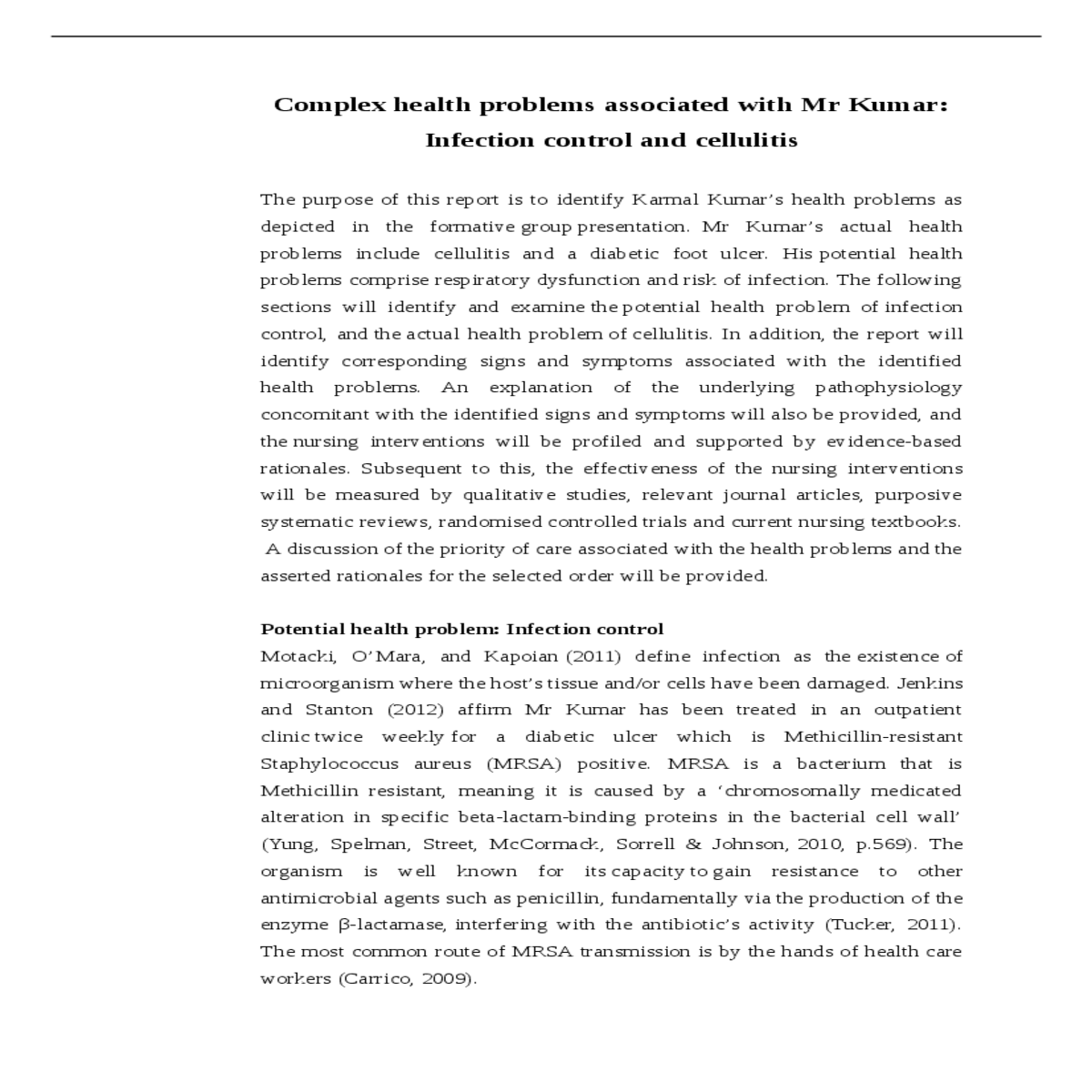
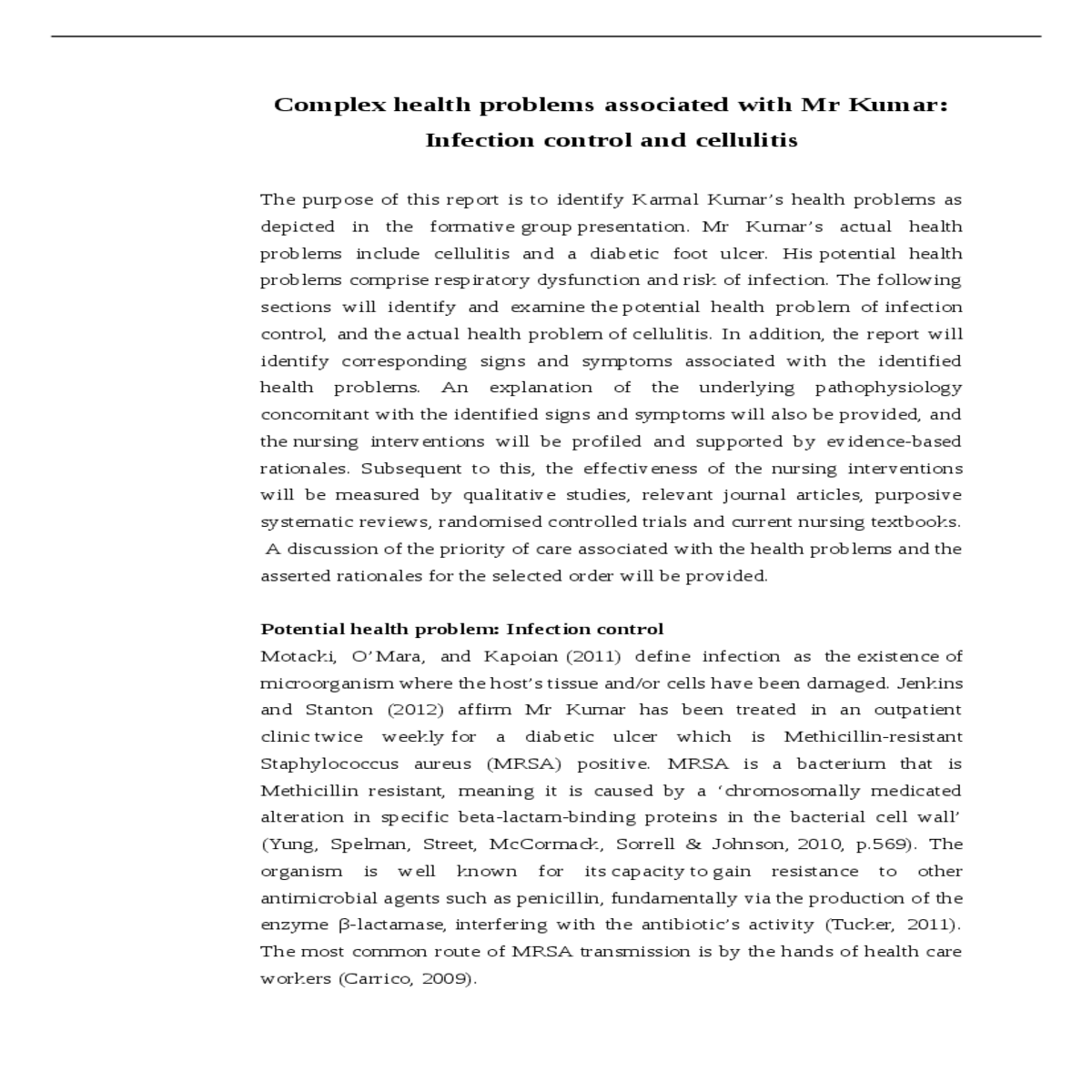
Intake chart and fluid balance chart
Complex health problems associated with Mr Kumar:
Infection control and cellulitis
Bhalla, Aron and Donskey (2007) conducted a six month prospective study of 71 patients with skin colonised by Staphylococcus aureus including MRSA. These patients were found to have a high prevalence of organisms transferred from health care workers who touched both the patients and their surroundings. The Department of Health (2008b) stated it is therefore beneficial for both parties to reduce infection by adhering to hand hygiene and other infection control practices. The nursing intervention of hand hygiene and its effectiveness will be measured by observing Mr Kumar carrying out hand hygiene and ensuring he has continuity with his technique (Barton & May, 2012).
It is important that Mr Kumar be isolated in a single room. If he is in a shared bay, the spread of infection is difficult to control and may be passed on to susceptible patients (Salem, 2011). Moreover, other protective measures such as additional precautions and the use of personal protective equipment (PPE) must be used to prevent and control the transmission of
when bacteria enters the body through a break in the skin that is not cleansed with soap and water.
The first symptoms of cellulitis are generally local pain and tenderness (Christensen & Kockrow, 2011a). Christensen and Kockrow (2011a, p.75) state that cellulitis usually occurs on the face or lower limbs, however may become more serious for the patient if the bacteria permeate lymph nodes, deep tissue or the bloodstream. Moreover, the authors assert that most patients who have acquired cellulitis may have ‘fever, chills, tachycardia, headache, hypotension, and confusion’ (Christensen & Kockrow, 2011a). Porth (2011, p.1177) asserts that cellulitis often presents as an ‘enlarged red, swollen, tender plaque with an indefinite border’ and can cover any sized portion of the dermis and subcutaneous tissue. Furthermore, inflammation is a common sign of cellulitis as the body attempts to recover homeostasis and minimise the effects of the infection (Mulryan, 2011).
Castledine and Close (2009) affirm the nurse should assess the patient’s wound dressings as more frequent dressing changes may be required if there is serous fluid leakage. Where possible, the affected body parts should remain immobile and elevated to assist reducing oedema, and warm moist dressings applied to the cellulitis may relieve discomfort and prevent venous pooling (Castledine & Close, 2009). The effectiveness of the wound dressing as a nursing intervention will be measured by having a detailed wound chart containing objective data such as the wound appearance, whether skin maceration is present, absorbency of dressing, and patient comfort.
Christensen and Kockrow (2011b) state that cellulitis itself is not contagious, although the bacteria can be spread to another part of the body via direct contact. The patient at risk of infection must understand the measures needed to reduce or prevent microorganism growth and spread. An important nursing intervention is therefore to openly discuss infection control with Mr Kumar and his wife, and to demonstrate appropriate procedures if required (McGuiness & La Trobe University; Melbourne, 2005).Finally, patient education remains an imperative aspect of nursing care (Castledine & Close, 2009). To educate effectively, the nurse must account for variations in a patient’s learning ability, have effective communication skills, understand the dynamic evidence based
Bailey, B. & Kroshinsky, D. 2011, ‘Cellulitis: diagnosis and management’, Dermatologic Therapy, vol. 24, no. 2, pp. 229–39.
Barton, D. & May, A.L. 2012, Adult nursing preparing for practice, Hodder Arnold, London.
Christensen, B.L. & Kockrow, E.O. 2011a, Adult health nursing, 6th edn, Elsevier Mosby, St Louis, Missouri.
Christensen, B.L. & Kockrow, E.O. 2011b, Foundations of nursing, 6th edn, Elsevier Mosby, St Louis, Missouri.
in acute trusts, Department of Health, London.
Department of Health, Victoria Australia 2007, Appendix 3: Standard & Additional
pp. 572-574.
Hinkin, J., Gammon, J. & Cutter, J. 2008, ‘Review of personal protection equipment used
& C. Taylor (ed.), Potter & Perry’s Fundamentals of Nursing, Elsevier Mosby,
Sydney, pp. 766-809.
Porth, C.M. 2011, Essentials of pathophysiology, 2nd edn, Wolters Kluwer Health/
Lippincott Williams & Wilkins, China.
aspects of infection prevention and control, MA Healthcare Limited, CLE,
Huntingdon, Cambridgeshire, London, pp. 181-92.