Instance Segmentation Model Implementation
Answer with Step by Step Explanation
Instance Segmentation Model Implementation
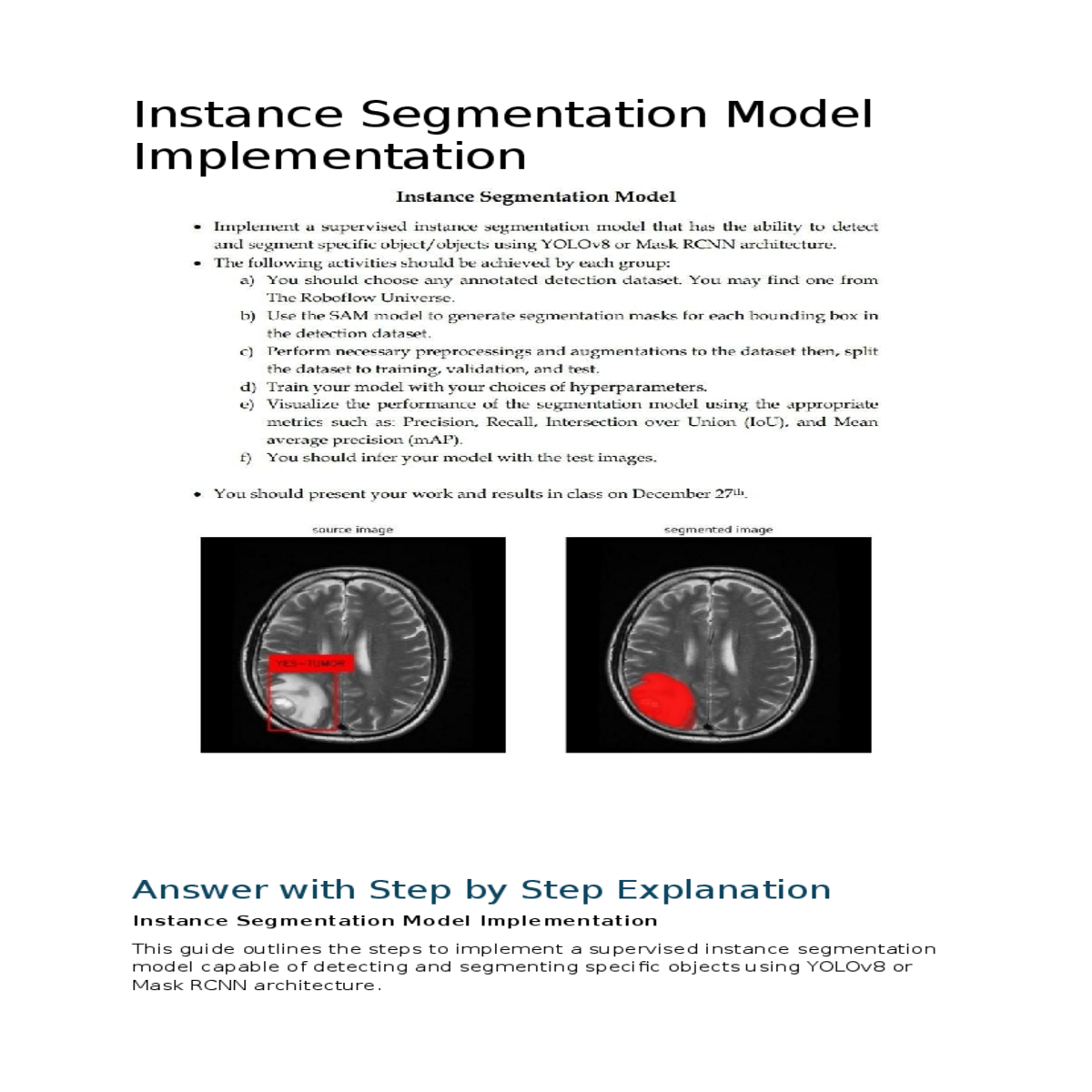
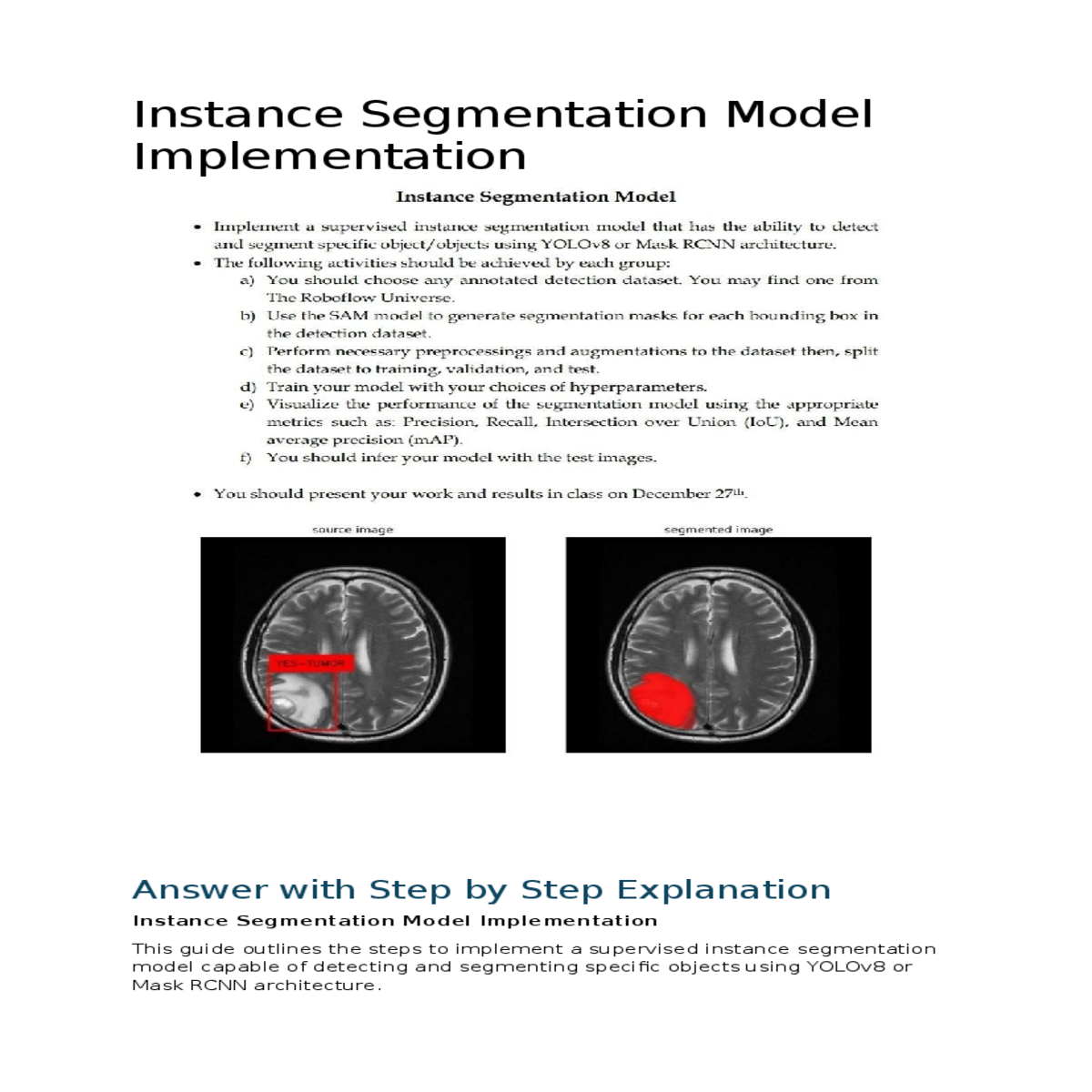
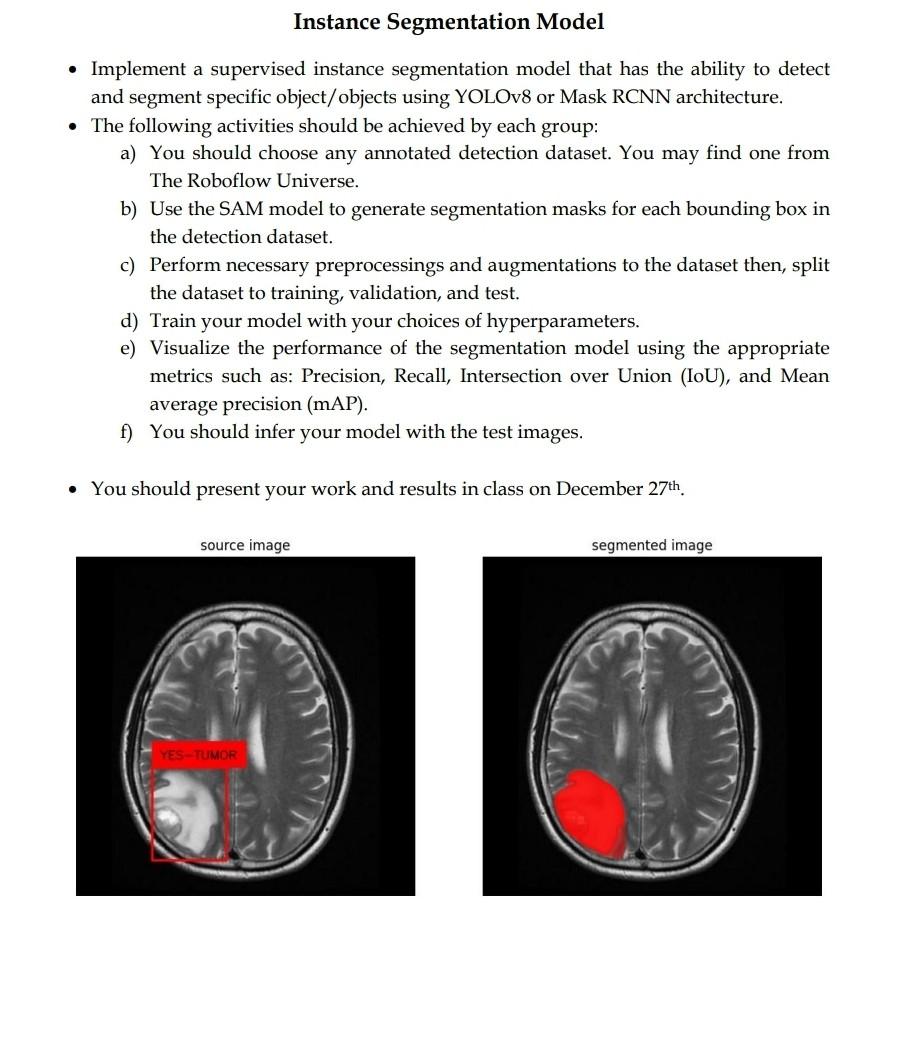
Use the SAM model (Segment Anything Model) to generate segmentation masks for each bounding box in the detection dataset.
Data Preprocessing and Augmentation:
Model Evaluation:
Visualize the performance using metrics such as Precision, Recall, Intersection over Union (IoU), and Mean Average Precision (mAP).
Explore the Roboflow Universe to find a suitable annotated detection dataset relevant to your object segmentation task.
Step 2: Segmentation Mask Generation
masks = model.generate_masks(detection_dataset)
Step 3: Data Preprocessing and Augmentation
def preprocess(image):
image = cv2.resize(image, (640, 640))
A.HorizontalFlip(p=0.5),
A.RandomRotate90(p=0.5),
from sklearn.model_selection import train_test_split
train_data, test_data = train_test_split(dataset, test_size=0.2, random_state=42)
model = YOLO('yolov8.yaml')
model.train(data='path/to/dataset', epochs=50)
recall = results['recall']
iou = results['iou']
for result in results:
result.show() # This will display the segmented results
import matplotlib.pyplot as plt
from PIL import Image
fig, axs = plt.subplots(1, 2, figsize=(10, 5))
axs[0].imshow(source_image)