Information gathering techniques
COIT11226 Systems Analysis
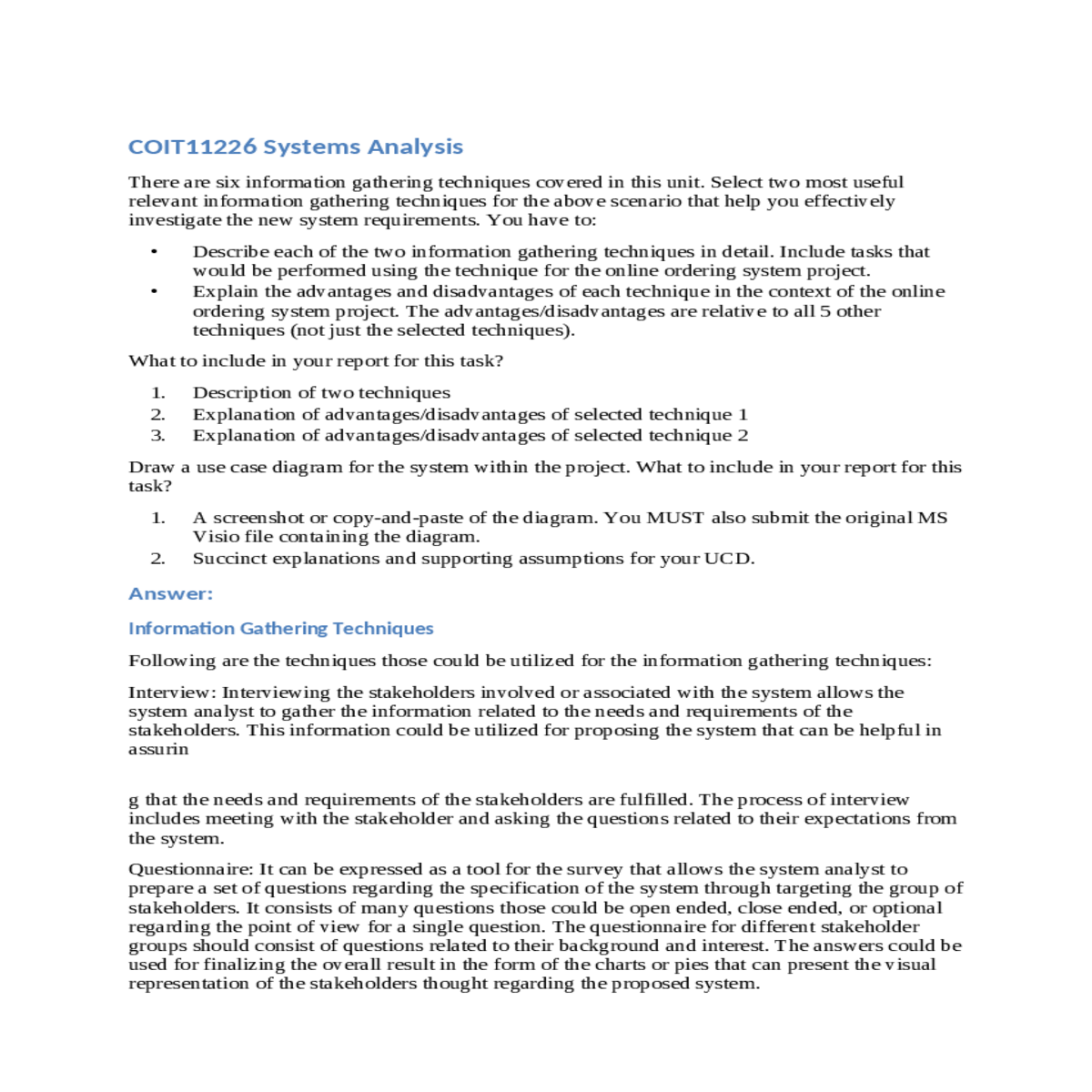
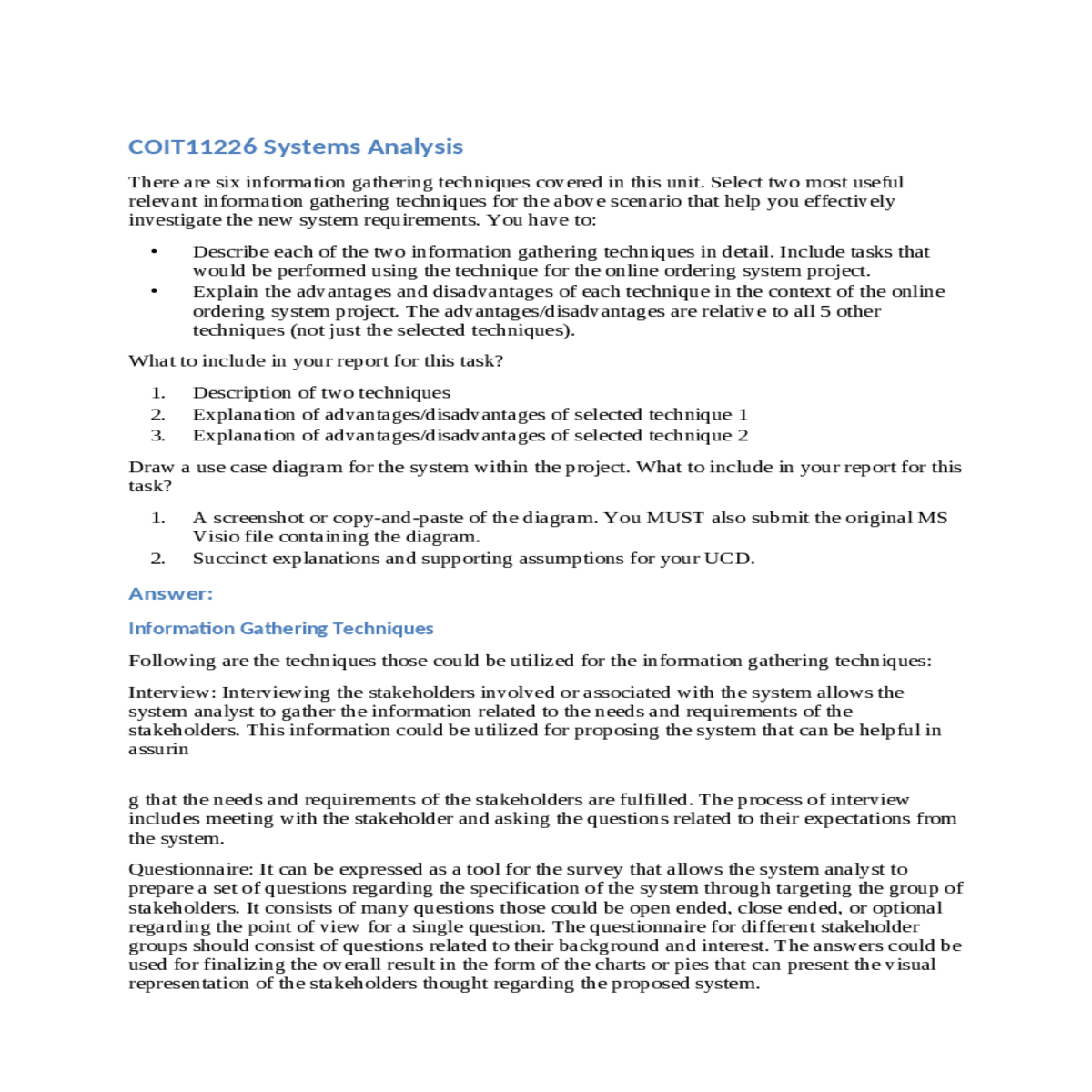
There are six information gathering techniques covered in this unit. Select two most useful relevant information gathering techniques for the above scenario that help you effectively investigate the new system requirements. You have to:
- Describe each of the two information gathering techniques in detail. Include tasks that would be performed using the technique for the online ordering system project.
- Explain the advantages and disadvantages of each technique in the context of the online ordering system project. The advantages/disadvantages are relative to all 5 other techniques (not just the selected techniques).
What to include in your report for this task?
- Description of two techniques
- Explanation of advantages/disadvantages of selected technique 1
- Explanation of advantages/disadvantages of selected technique 2
- A screenshot or copy-and-paste of the diagram. You MUST also submit the original MS Visio file containing the diagram.
- Succinct explanations and supporting assumptions for your UCD.
Answer:
Information Gathering Techniques
Questionnaire: It can be expressed as a tool for the survey that allows the system analyst to prepare a set of questions regarding the specification of the system through targeting the group of stakeholders. It consists of many questions those could be open ended, close ended, or optional regarding the point of view for a single question. The questionnaire for different stakeholder groups should consist of questions related to their background and interest. The answers could be used for finalizing the overall result in the form of the charts or pies that can present the visual representation of the stakeholders thought regarding the proposed system.
Advantages and Disadvantages
| Advantages | Disadvantages |
| Interview | |
| This is far better technique for identifying the needs and requirements of the end user | Time consuming |
| Deeper level of engagement with the end user | Bouncing ideas |
| Much easier to make the arrangement of the session to communicate with an individual rather than communicating with o group. | |
| It allows to gain better ‘buy in’ rom the stakeholders | |
| Offers better and effective support in the next stages of the project | |
| Questionnaires | |
| Faster | Consumes time in designing |
| Different stakeholders can be targeted | A good number of participant necessary |
| Saves time for further activities | One way conversation |
Use Case Diagram
Figure 1: Use Case Diagram
Explanations and Assumptions
Class Diagram
Explanations and Assumptions
The above class diagram is a composition of the inheritance, aggregation and association with the enlisted entities. The above class diagram presents the visual representation of the database management system for the LPC for selling and purchasing carpets.
Activity diagram
Figure 3: Activity Diagram
Explanation
System Sequence Diagram
References
Azar, A.T. and Vaidyanathan, S. eds., 2015. Chaos modeling and control systems design (Vol. 581). Germany: Springer.
Chitchyan, R., Rashid, A., Sawyer, P., Garcia, A., Alarcon, M.P., Bakker, J., Tekinerdogan, B., Clarke, S. and Jackson, A., 2015. Survey of aspect-oriented analysis and design approaches.
Munzner, T., 2014. Visualization analysis and design. CRC press.