Language:EN
Pages: 7
Rating : ⭐⭐⭐⭐⭐
Price: $10.99
Page 1 Preview
including the entorhinal cortex and the hippocampu

Including the entorhinal cortex and the hippocampus

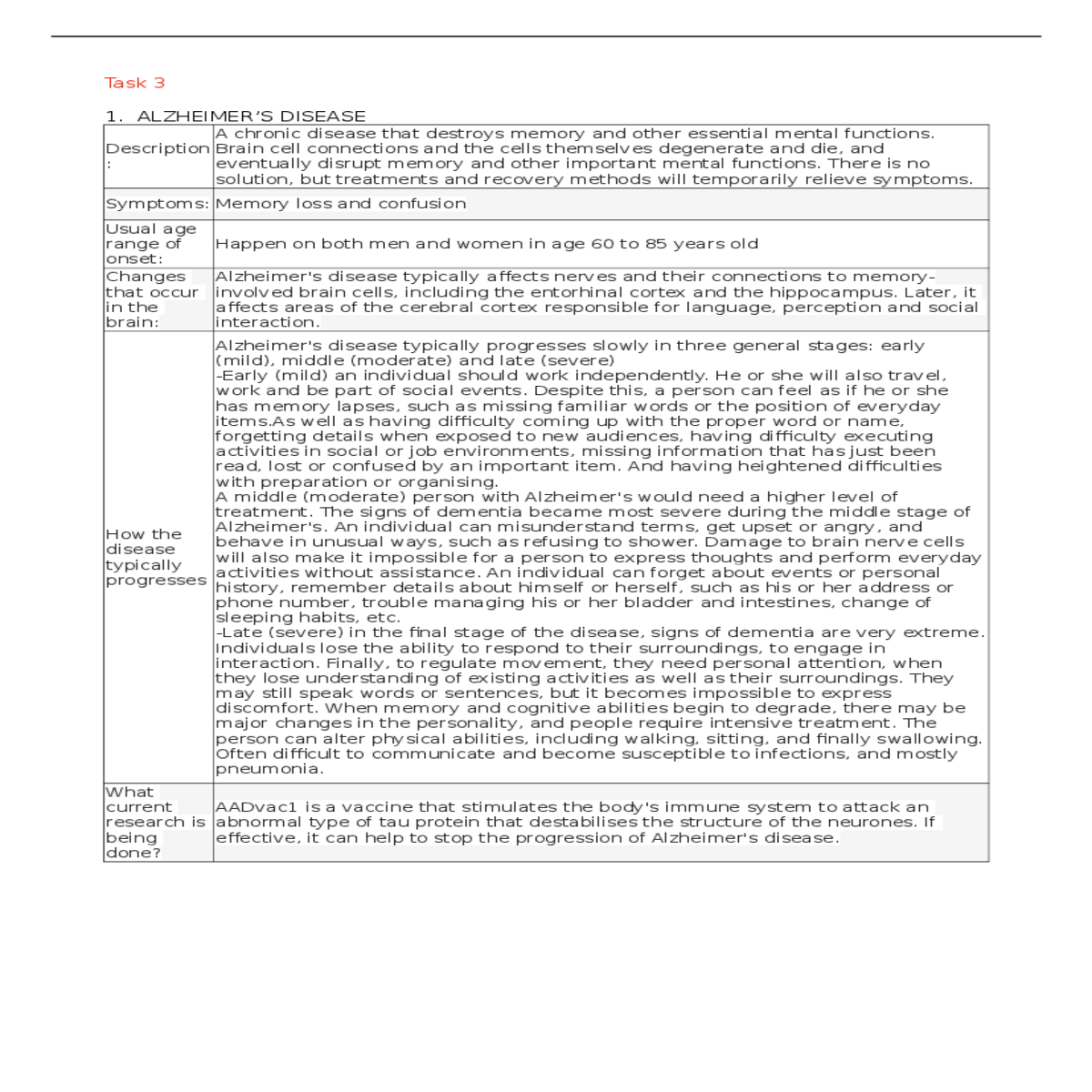
Task 3
1. ALZHEIMER’S DISEASE

Description :

Symptoms:

Happen on both men and women in age 60 to 85 years old

Changes
that occur in the
brain:

-Late (severe) in the final stage of the disease, signs of dementia are very extreme.

Individuals lose the ability to respond to their surroundings, to engage in
interaction. Finally, to regulate movement, they need personal attention, when they lose understanding of existing activities as well as their surroundings. They may still speak words or sentences, but it becomes impossible to express
discomfort. When memory and cognitive abilities begin to degrade, there may be major changes in the personality, and people require intensive treatment. The person can alter physical abilities, including walking, sitting, and finally swallowing.

Huntington's disease typically results in the progressive movement, thinking, sensory and psychiatric symptoms.

The usual age
range of onset:

It typically starts in a person's 30s or 40s.

Description:

Pick's disease is a rare form of age-related dementia that affects the brain's frontal lobes and induces speech disorders such as aphasia, behavioural disturbances and ultimately, death.

The usual age range of onset:

Pick's disease is a kind of dementia similar to Alzheimer's but far less common. It affects areas of the brain that influence feelings, behaviour, personality, and vocabulary. It is also a form of the disease known as frontotemporal dementia (FTD) or
frontotemporal lobar degeneration (FTLD). When you have Pick's disease, it sometimes builds up into spherical clumps known as Pick Bodies or Picks Cells. As they accumulate in the nerve cells of the frontal and temporal lobe of the brain, they cause the cells to die. This causes the brain tissue to shrink, leading to signs of dementia.

5. DEMENTIA WITH LEWY BODIES

• Depression
• Apathy

Changes that occur in the
brain:

What is current research being

There is still no cure for the disease. Study strengthens our knowledge of this difficult disease, and improvements in research

Symptoms:

• Problems in discovering new knowledge
• Inability to remember recent events and long-term memory gaps
• Memory problems can be strikingly severe.

Changes that occur in the
brain:

Korsakoff Syndrome affects the nerve cells and supportive cells in the brain and spinal cord and the part of the brain involved in memory.

The National Institute of Neurological Disorders and Stroke is funding studies on neurological disorders such as Wernicke's encephalopathy, Korsakoff's amnesic syndrome, and Wernicke-syndrome Korsakoff's to broaden our understanding of the physiological modifications of the diseases and how to treat them. One research area is to investigate how exercise can enhance cognitive functioning based on the regulation of certain nerve cells in a rodent amnesia model caused by thiamine deficiency. The National Center for Substance Dependence and Depression also fund studies into these conditions.

7. PARKINSON’S DISEASE

You are viewing 1/3rd of the document.Purchase the document to get full access instantly

Immediately available after payment
Both online and downloadable
No strings attached
How It Works
Login account
Login Your Account
Place in cart
Add to Cart
send in the money
Make payment
Document download
Download File
img

Uploaded by : Ishita Mangat

PageId: DOC983D00F