Including dynamic voltage and frequency scaling
Solved Step by Step With Explanation- FPGA-Based AES Encryption Review
Questions
Literature Review on AES Decryption/Encryption on FPGA
Introduction:
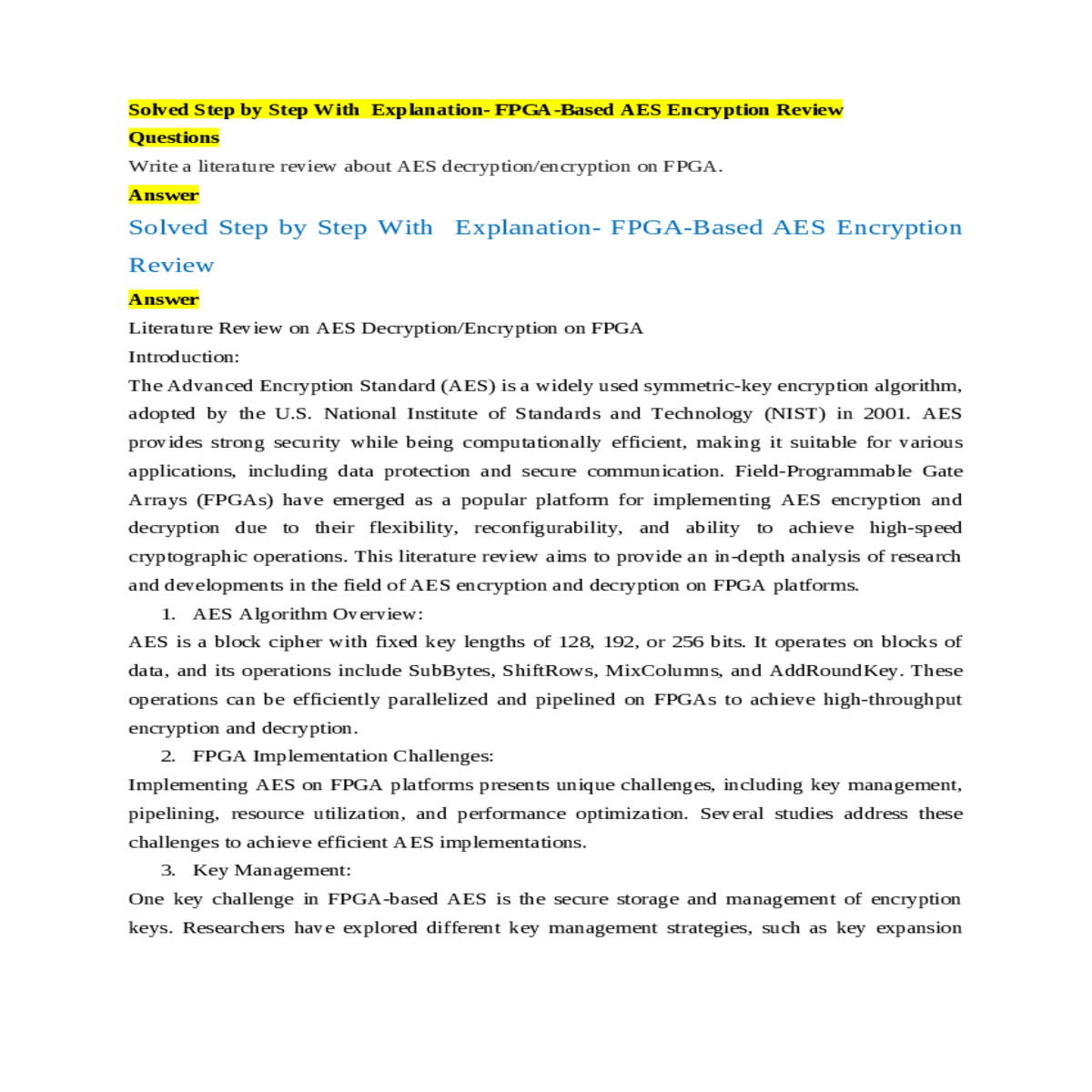
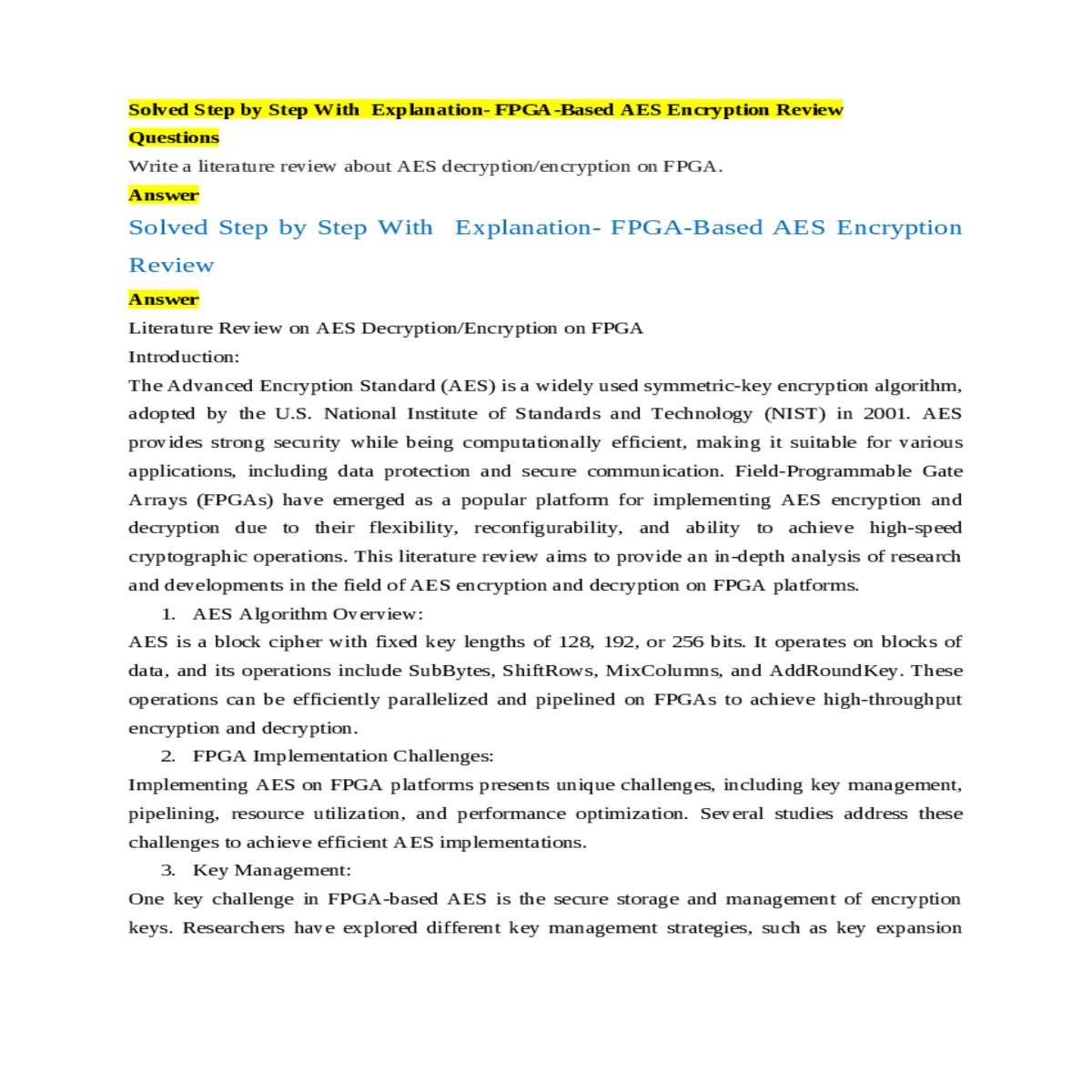
Implementing AES on FPGA platforms presents unique challenges, including key management, pipelining, resource utilization, and performance optimization. Several studies address these challenges to achieve efficient AES implementations.
Key Management:
FPGAs have limited resources in terms of Look-Up Tables (LUTs), registers, and memory. Researchers have investigated efficient resource utilization techniques, including compact and resource-efficient S-box implementations, to minimize the resource footprint of AES implementations.
Performance Optimization:
Security is a paramount concern in AES implementations. Researchers have examined the resistance of FPGA-based AES to various attacks, including side-channel attacks, fault attacks, and power analysis attacks. Countermeasures, such as data randomization and masking techniques, have been proposed to enhance security.
Power Efficiency:
FPGA-based AES encryption and decryption have gained significant attention due to their flexibility and ability to achieve high throughput. Research in this field has addressed various challenges, including key management, parallelism, resource utilization, performance optimization, security, and power efficiency. FPGA-based AES implementations continue to evolve, catering to a wide range of applications, from network security to embedded systems. Future research will likely focus on even more efficient and secure implementations, especially as new cryptographic standards and threats emerge.
Top of Form