Improve business skills and knowledge
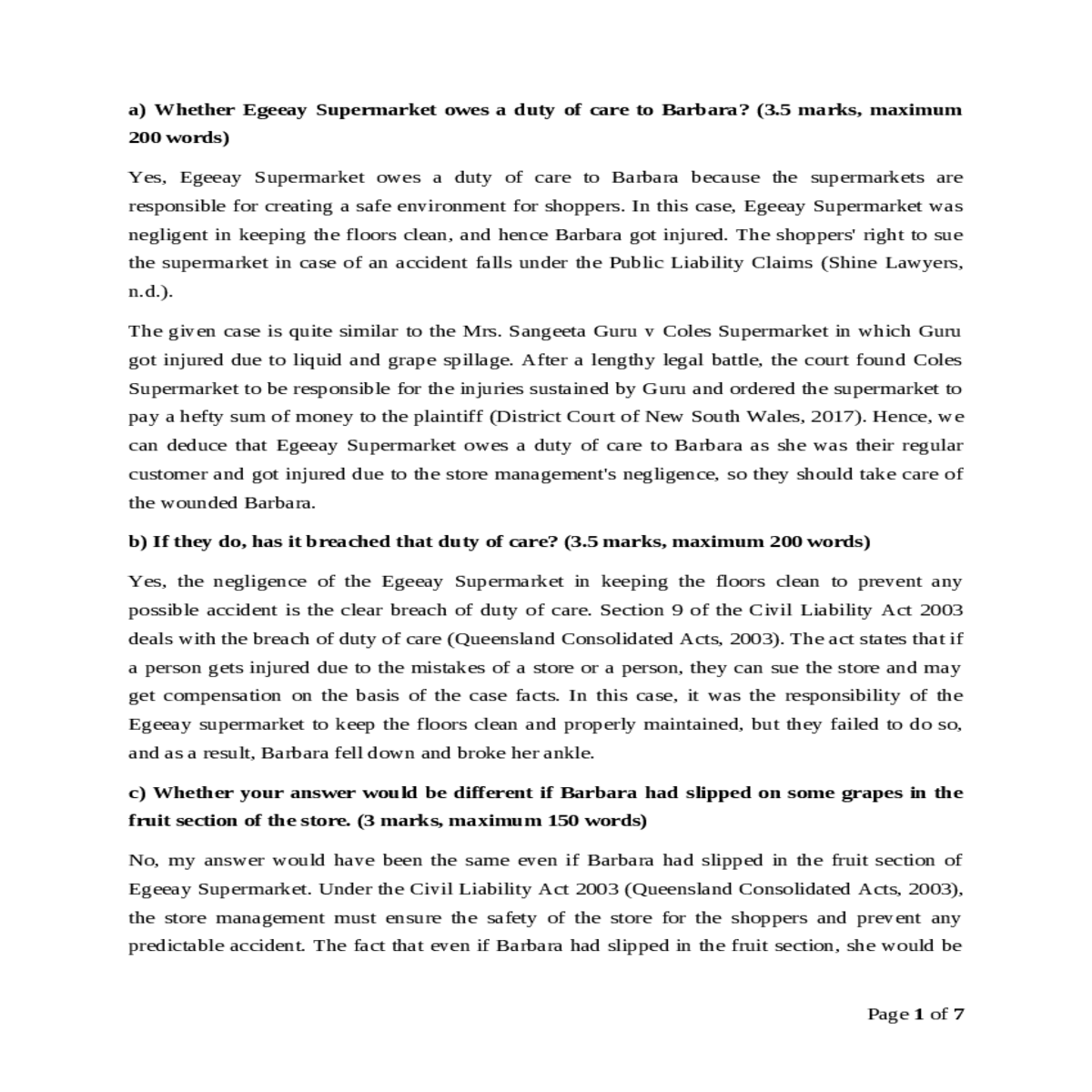
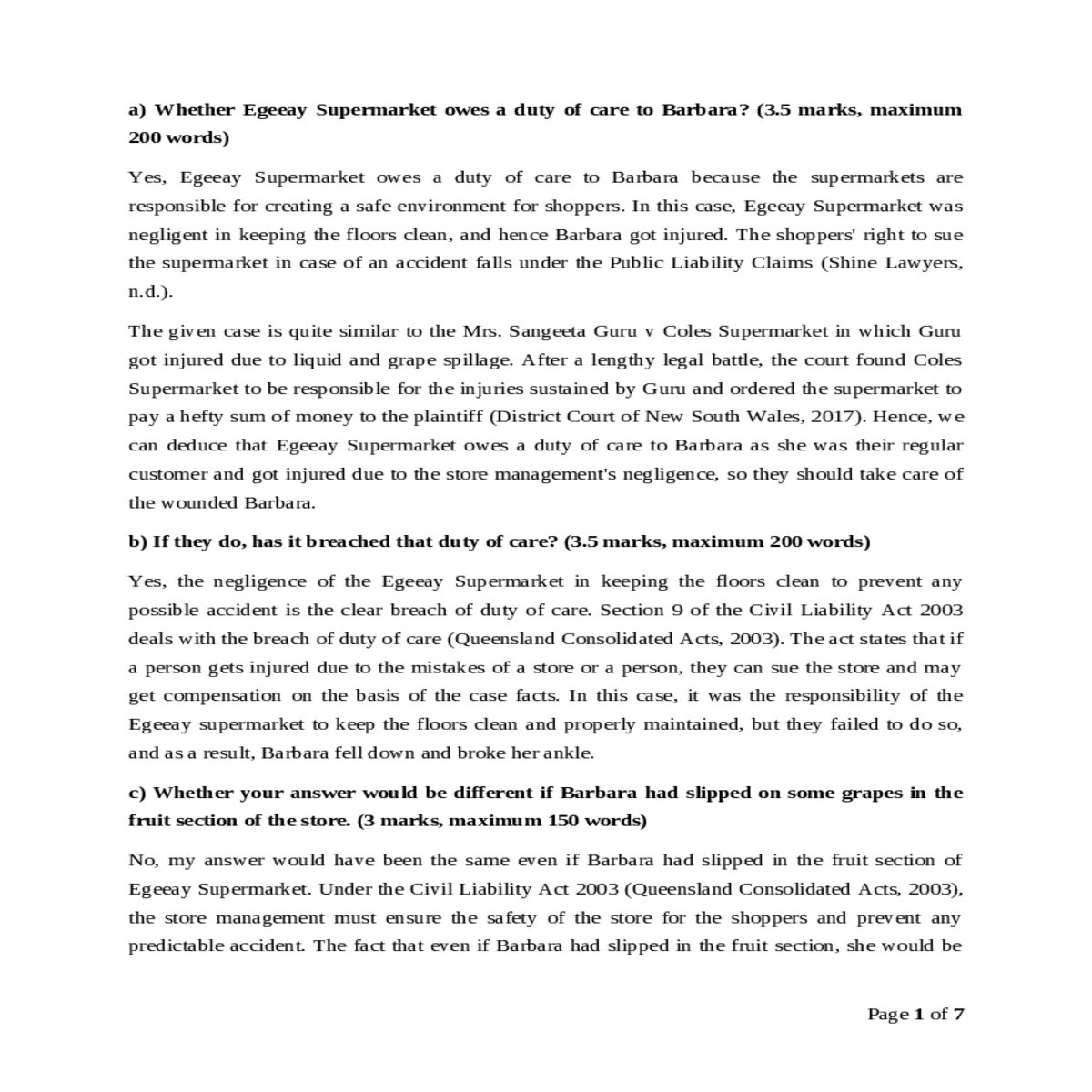
a) Whether Egeeay Supermarket owes a duty of care to Barbara? (3.5 marks, maximum 200 words)
Yes, Egeeay Supermarket owes a duty of care to Barbara because the supermarkets are responsible for creating a safe environment for shoppers. In this case, Egeeay Supermarket was negligent in keeping the floors clean, and hence Barbara got injured. The shoppers' right to sue the supermarket in case of an accident falls under the Public Liability Claims (Shine Lawyers, n.d.).
No, my answer would have been the same even if Barbara had slipped in the fruit section of Egeeay Supermarket. Under the Civil Liability Act 2003 (Queensland Consolidated Acts, 2003), the store management must ensure the safety of the store for the shoppers and prevent any predictable accident. The fact that even if Barbara had slipped in the fruit section, she would be on the premises of the store, and hence the store would have been responsible for Barbara's injury.
Week 7
Unfair terms of the agreement
All types of legal consumer-buyer agreements
There is an economic loss suffered by the consumer due to defective products or services.
In order to succeed in his lawsuit against the Underwear Galore, Mr. Brown has to establish the following facts:
Week 8
What are the advantages and disadvantages of becoming a franchisee? Should a person consider going into business the first time consider a franchise? Discuss. (10 marks, maximum 300 words)
Advantages of Becoming a Franchisee
Well-established Business Practices
Easy Financing
Improve Business Skills and Knowledge
Disadvantages of Becoming a Franchisee
Limited Autonomy
Expenses
Franchisees have to pay the ongoing expenses for getting associated with an established company. It can be a flat charge or a certain percentage of the profits.
Bankruptcy
It is also possible that the franchisor might get bankrupt due to any financial crisis. In such a case, the franchise model proves to be highly ineffective for the franchisees, especially the young entrepreneurs who will have to deal with a number of legal and financial issues.
Conclusion
Significance of Salomon v A Salomon & Co Ltd [1897] AC 22
The decision of the House of Lords in Salomon v A Salomon & Co Ltd [1897] AC 22 established the importance of a separate entity. It provided the much-needed boundaries in the law that a company that has compiled with all of the registration regulations is a separate entity from its members, even if the members control all of the shares. It simply means that a registered company exists as an independent entity, irrespective of the members, and controllers. The ruling created a 'corporate veil.'
Corporate Veil
The concept of 'Corporate Veil' originated from the companies' act and the ruling of the House of Lords in Salomon v A Salomon & Co Ltd [1897] AC 22. It means that since the company is considered to be a separate legal identity, it is provided a cover or a veil, compared with the shareholders.
Lifting Corporate Veil
‘Member’ VS ‘Shareholder’
Becoming a Member
According to Section 231 of the Corporations Act 2001 (Commonwealth Consolidated Acts, n.d.), a person can become a member of a company by:
Registering as a member at the time of company registration
Eligibility of Membership
There is no specific eligibility for becoming a member of a company. Anyone who can enter a legal contract can become a member.
Number of Members of a Company
There must be at least one member of all companies registered under the Corporations Act 2001. The maximum number of members in a proprietary company is 50.
Cessation of Membership
When a member takes an early-exist from the agreement.
In the case of the company's insolvency, the memberships can finish.
References
Commonwealth Consolidated Acts. (n.d.). CORPORATIONS ACT 2001 - SECT 231. Retrieved from Australasian Legal Information Institute: http://www5.austlii.edu.au/au/legis/cth/consol_act/ca2001172/s231.html
District Court of New South Wales. (2017, May 2). Guru v Coles Supermarkets Australia Pty Ltd (No. 2) [2017] NSWDC 90 (2 May 2017). Retrieved from Australasian Legal Information Institute: http://classic.austlii.edu.au/cgi-bin/sinodisp/au/cases/nsw/NSWDC/2017/90.html?stem=0&synonyms=0&query=title(Guru%20v%20Coles%20)