Identify service standards and best practice models
BSBCUS501 Customer Service Manage Quality
Question:
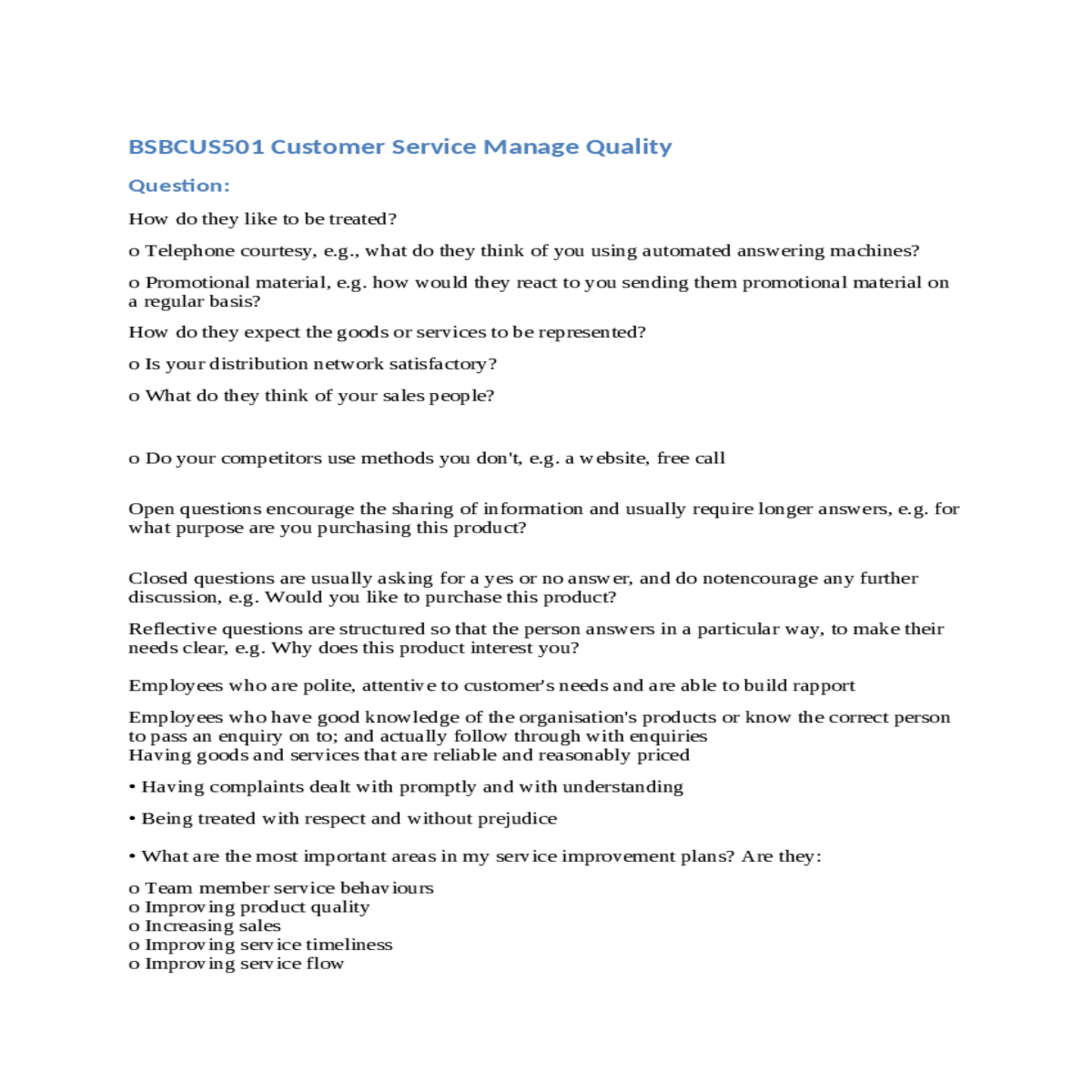
How do they like to be treated?
o Telephone courtesy, e.g., what do they think of you using automated answering machines?
o Do your competitors use methods you don't, e.g. a website, free call
• Having complaints dealt with promptly and with understanding
• Being treated with respect and without prejudice
• What are the most important areas in my service improvement plans? Are
they:
Question
Introduction
The customers can be described as the most crucial aspect of the organization and it is very important that the different custom complaints are effectively dealt with and the customers are given no future scope for complaints (Kursunluoglu 2014). The given report will be identifying the different complaints received by Bang on Bikes.
Type of complaints received
- Inspiring and mobilizing team members
- Formulating culture
The culture of the organizational team members needs to be effectively maintained.
- Clear communication
The communication in the organization needs to be very clear in nature.
- Understanding client needs
- Establishing rapport
- Showing interest in the customers
- Treating the customers well
- Ensuring good products
Monitoring team performance
- Identifying the poor performers.This shall assist in the understanding of the main targets.
- Addressing of the poor performers needs to be done effectively (Hill and Brierley 2017).
- Providing regular feedback is the primary step after identifying the poor performers.
- Supporting of the team members by ensuring reinforcing of performance excellence
The colleagues may be helped in the following manner:
- Training: The colleagues can be trained informally.
- Mentorship: The colleague who has been performing well can act as a mentor for another weak colleague.
- Encouragement: Encouraging good performance.
Obtaining customer feedback
- Formal research
- Surveys
- Feedbacks as given to the staff
- Proper documentation is very crucial as it helps to assist the company in understanding the series of events and which event triggered the actual complaint which was received.
- The findings as stated need to be presented adequately (Izogo and Ogba 2015).
- Communicating effectively with the consumer is crucial is important as it helps to form better relationships with the customers
- Analyze evidence in order to ensure better customer service strategies. This will help in ensuring that the mistakes are not repeated again and that the customers are successfully able to attain the services.
It is crucial for the organization to be successfully able to manage the customer complaint records so that they are able to ensure that the following records are present:
- Feedback from customers
- Training for staff members
- Performance management (Conway and Briner 2015).
- Customer complaints
Conclusion
- Public service act 1999
- Disability discrimination act 1992 (Austrade.gov.au. 2018).
- work health & safety act 2011
- racial discrimination act 1975
- age discrimination act 2004
- fair work act 2009
- sex discrimination act 1984
- Australian human rights commission act 1986
Organizational policies and procedures for customer service
The organizational procedures and policies in order to handle customer complaints have been given as follows:
- Ensuring Quality is maintained throughout: This helps in ensuring that no customer complaint is received by the organization.
- Ensuring customers are attended: So that the customers are able to express their emptions easily and are able to address their grievances.
Identify service standards and best practice models
- Ensuring that the phones are answered within 15 seconds
- Ensuring delivery within 48 hours (Woolworthsgroup.com.au. 2018).
- Ensuring best quality goods are delivered to the customers.
The Woolworths organization engages in extensive product promotions. The organization promotes its products with the help of social marketing, digital marketing, traditional marketing and other techniques (Bansal and Taylor 2015). The company is very popular among the Australian audience and hence it ensures that the operations are successful in nature.
Techniques to deal with customers of specific needs
- Patience and personal assistance: Patience is required when the company is required to deal with consumers o specific needs. In such a scenario, the company needs to see to it that personal assistance is provided to the customers.
- Training employees: Moreover, the training of the employees to deal with these people plays a crucial role in ensuring that the specific needs can be met effectively.
Techniques for solving complaints
| Customer behavior | Engage in observations and practices which shall help in understanding what the customer requires and resonates their behavior. |
| Customer needs research | Engage in research techniques, surveys, consumer feedbacks and other platforms to understand the needs of the consumers (Khan and Fasih 2014). |
| Customer relations | Maintaining relationships with customers by loyalty programs and well trained staff and employees. |
| Ongoing product and service quality | Taking continuous assessments to ensure that the product as well as the service quality offered is maintained throughout the organization. |
| Problem identification | Analyze the problem of the organization regularly in order to look out for any problems which may exist in the system or may arise in the future. |
| Quality service of customer delivery | A proper quality department needs to be employed which will then assist the company in ensuring that the last step of value chain is completed successfully. |
| Record keeping | The organization needs to maintain digital records for organizational success. |
| Strategies for monitoring, managing and introducing ways to improve ways for customer relationships. | Having a separate monitoring team will be beneficial (Jüttner et al. 2013) |
| Obtaining customer feedback | Conduct surveys and other researches regularly. |
Managing quality service at work Procedure
- Research
- Feedback
- Survey
In order to ensure that the company achieves long term success, the quality time and cost specifications need to be met with the following need to be done:
- Team needs to be encouraged: This enables them to perform well.
- Communication has to be clear: This needs to be present to ensure that there is clarity.
- The monitoring needs to take place effectively: This will help to ensure the maintenance of standards (Fullerton 2014).
- Monitoring team performance
The given procedure needs to be maintained in order to monitor the team performance:
- Identifying the poor performers.
- Addressing of the poor performers
- Providing regular feedback (Cheshin, Amit and van Kleef 2018).
- Supporting of the team members
Strategies to monitor progress
- Identifying the industry standards
- Setting performance metrics
- Measuring actual performance
- Comparing against the metrics
- Taking corrective measures.
- Ensure healthy participation so that the customers can share information willingly
- Gain in confidence for future success
- Use methods like focus groups, surveys, research and sales feedback.
The procurement of resources needs to be made in a timely manner for which the given procedures can assist:
- Check for quality products as it helps in ensuring a successful relationships with customers
- Engaging in quality monitoring
- Ensure that service delivery takes place appropriately.
Utilizing resources effectively
- Maintain team spirit and clarity
- Ensuring that all the processes are well understood by members
- Effective communication: This helps to see to it that any resources are not wasted.
- Maintaining quality procedures (Radnor and Johnston 2013).
- Identifying source of problem
- Analyzing the problem
- Brainstorming for solutions
- Choosing alternatives
- Ensuring proper redressal of grievances
Records management
The records must be maintained effectively. The following strategies to be used:
- Feedback from customers’ needs to be recorded properly
- Training for staff members needs to take place (Chen, Zhu and Zhou 2015).
- Performance management of employees to be managed.
- Customer complaints to be handled well
Answer to Question 1:
The different ways of identifying customer needs are as follows:
- Direct Observation – This is done by directly observing the behavior of the customers while they make the purchases.
- Survey questionnaires- The survey needs to be conducted adequately to understand the needs of the company.
- Interviews – Conducting one to one interviews with the customers
- Focus Groups- Brainstorming along with focus groups to understand the needs of the customers and their demands as well.
Answer to Question 2
- Understanding the needs of the customers so that requirements are clear
- Ensuring that the requirement is well understood by the producing team (Tan, Benbasat and Cenfetelli 2013).
- Monitor the specifications and products regularly to identify and rectify any gap.
Answer to Question 3
- Delivery standards- to ensure standard delivery takes place
- Quality check standards- so that quality of products is assured.
- Customer complaint standards- To ensure that the complaints are met with adequately
- Customer convenience- To ensure convenience of operations
- Customer communication- To see to it that customers are well attended to
- Overall service standards- to ensure that the quality of work is maintained.
Answer to Question 4
- Ensuring polite employees who are attentive in nature
- Employees with high knowledge and the ability to solve queries
- Having good complaint redressal system
- Having products which are well priced and reliable in nature
- Treating customer with respect and dignity
Answer to Question 5
The poor work performance of staff are due to the following reasons:
- Low pay: When the employees are paid low they exhibit poor performance.
- Personal grievances: When they are faced by personal grievances they portray poor performance (Shire, Holtgrewe and Kerst 2017).
- Low motivational factors: When the employees are not well motivated they often perform poorly.
- Pressure from managers: Very often they face pressure from their seniors.
- Lack of training: When employees lack training they perform poorly.
Answer to Question 6:
The staff members can be assisted in the following manner:
- Training: Proper training can be given to the employees so that they perform well.
- Bonus: They can be provided with bonus in order to ensure that they have certain motivational factors
Answer to Question 7
- Establishing the requirement for monitoring: Here, the key areas to be monitored are analyzed (Setia, Venkatesh and Joglekar 2013).
- Establishing the measures: The measures are stablished for standards
- Comparing: They are compared with actual performance
- Taking action: Rectifying actions to be taken
Answer to Question 8:
- Sales history
- Information on Product
- numbers of Service encounter
- Compilation survey
- customer data trend
- transaction data
References
Bansal, H.S. and Taylor, S.F., 2015. Beyond service quality and customer satisfaction: investigating additional antecedents of service provider switching intentions. In Proceedings of the 1999 Academy of Marketing Science (AMS) Annual Conference (pp. 75-82). Springer, Cham.
Chen, Z., Zhu, J. and Zhou, M., 2015. How does a servant leader fuel the service fire? A multilevel model of servant leadership, individual self identity, group competition climate, and customer service performance. Journal of Applied Psychology, 100(2), p.511.
Hill, N. and Brierley, J., 2017. How to measure customer satisfaction. Routledge.
Izogo, E.E. and Ogba, I.E., 2015. Service quality, customer satisfaction and loyalty in automobile repair services sector. International Journal of Quality & Reliability Management, 32(3), pp.250-269.
Setia, P., Venkatesh, V. and Joglekar, S., 2013. Leveraging digital technologies: How information quality leads to localized capabilities and customer service performance. Mis Quarterly, 37(2).
Shire, K., Holtgrewe, U. and Kerst, C., 2017. Re-organising customer service work: an introduction. Re-organising Service Work: Call Centres in Germany and Britain: Call Centres in Germany and Britain, p.1.