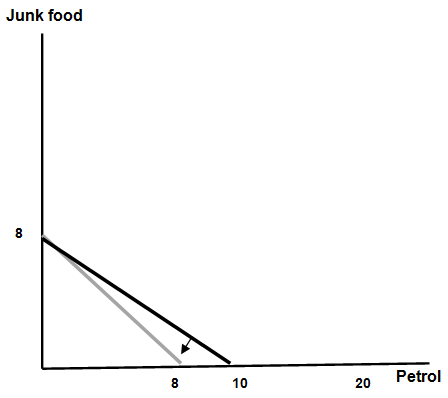
How does the trade-off between junk food and petrol change

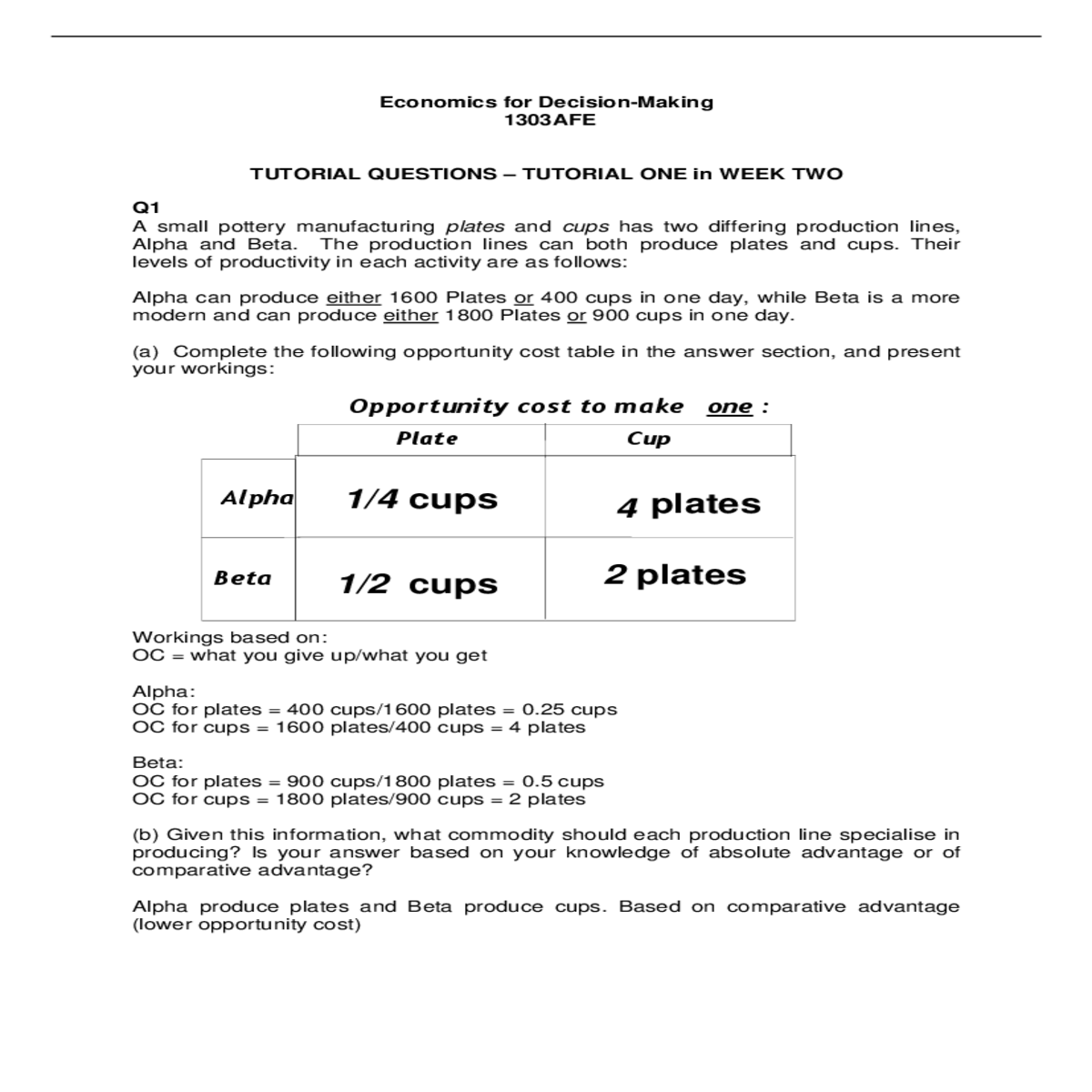
Economics for Decision-Making
1303AFE
Opportunity cost to make one:
| Alpha | Plate |
|
|
|---|---|---|---|
| 1/4 | |||
| Beta | 1/2 | ||
Workings based on:
OC = what you give up/what you getAlpha:
OC for plates = 400 cups/1600 plates = 0.25 cups
OC for cups = 1600 plates/400 cups = 4 platescakes or 12 cookies in 4 hours.
(a) Who has an absolute advantage at producing cakes and who has an absolute
this:
Opportunity Cost of Producing One:
| Cake | Cookie | |
|---|---|---|
|
||
|
Sam:
OC for cake = 12 cookie/6 cakes = 2 cookies OC for cookies = 6 cakes/12 cookies = 0.5 cakes(c) If both Debra and Sam concentrate on producing only the product in which
Q3
Kathy, a university study, has $20 a week to spend. She spends it either on junk food at $2.50 a snack, or on petrol at $2 per litre. Draw Kathy’s opportunity set. What is the trade-off between junk food and petrol? Now draw each new budget constraint she would face if:
If, for example PA=$3 and PB=$4 then our budget constraint is: Y = 3A+4B
Back to the question. What do we know?
Y/PF = 20/2.5 = 8 units of food
If Kathy spends all here income (Y=$20) on just petrol, how many litres of petrol will she buy?
Y = 2.5F+2Z
20 = 2.5(4) + 2Z
20 = 10 + 2Z
20-10 = 2Z
10=2Z
Z= 10/2 = 5
Thus we know that a combination of 4 units of food and 5 litres of fuel is also on the budget line BC1 as that combination adds up to $20.
c) If the price of petrol rises to $2.50 a litre and the price of a snack is $2.50, she can buy 1 litre of petrol for every snack. This is reflected by a pivot of the budget constraint.