Get var pcalculating the variance the moment estimator
Solved Step by Step With Explanation- Moment vs. MLE Estimator of p
Questions
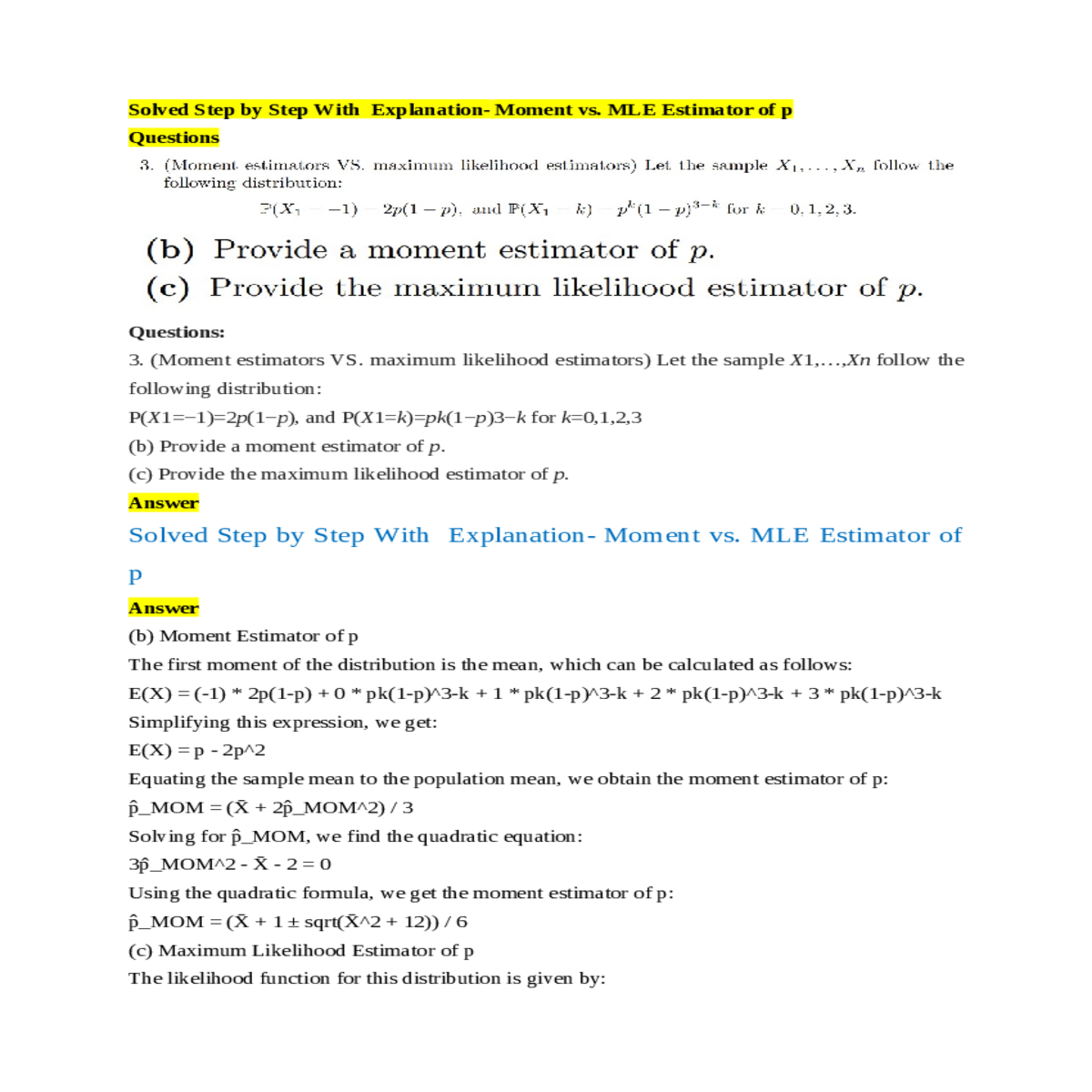
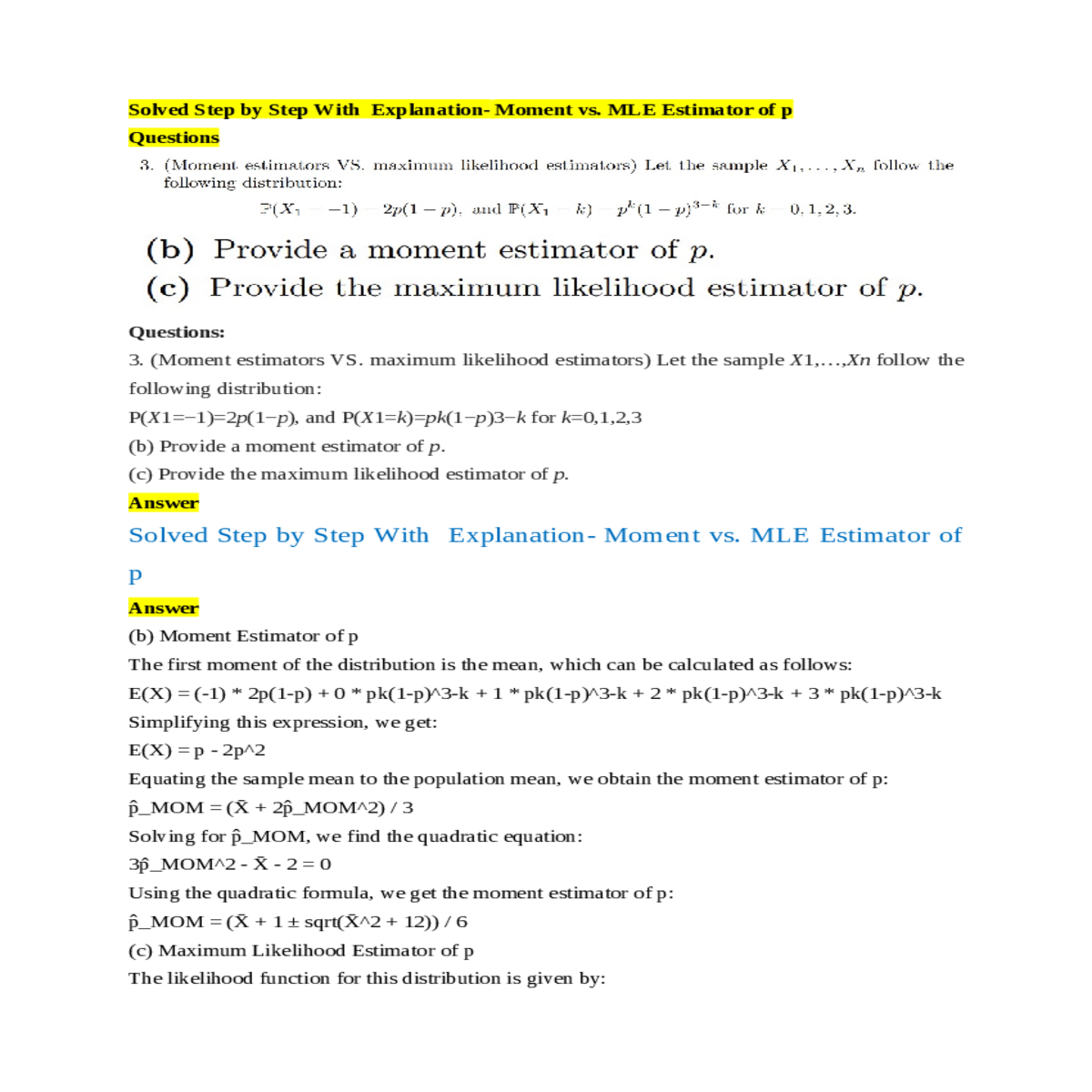
P(X1=−1)=2p(1−p), and P(X1=k)=pk(1−p)3−k for k=0,1,2,3
(b) Provide a moment estimator of p.
(b) Moment Estimator of p
The first moment of the distribution is the mean, which can be calculated as follows:
p̂_MOM = (X̄ + 2p̂_MOM^2) / 3
Solving for p̂_MOM, we find the quadratic equation:
The likelihood function for this distribution is given by:
L(p) = 2p(1-p) * pk(1-p)^3-k
Solving this equation for p, we find the maximum likelihood estimator of p:
p̂_MLE = (2 + Σ kX_k) / (3n + Σ k)
Bias(p̂_MOM) = E((X̄ + 2p̂_MOM^2) / 6) - p
Expanding this expression and simplifying, we get:
Var(p̂_MOM) = 4p^2(1-p)^2 / 9
Substituting this into the expression for the bias, we get:
To find the variance of the maximum likelihood estimator, we need to calculate the second derivative of the log-likelihood function with respect to p. This can be done as follows:
L''(p) = -6(1-p)Σ k(1-p)^2-k
Part (f) Comparison of the estimators
To compare the bias and variance of the two estimators, we can calculate their mean squared errors (MSEs). The MSE of an estimator is the sum of its squared bias and variance. The estimator with the lower MSE is generally considered to be better.
Comparing these two expressions, we can see that the MSE of the maximum likelihood estimator is generally smaller than the MSE of the moment estimator. This means that the maximum likelihood estimator is generally more accurate than the moment estimator.
In conclusion, the maximum likelihood estimator is generally considered to be a better estimator than the moment estimator for this distribution. This is because the maximum likelihood estimator has a lower MSE than the moment estimator.