Plasmid DNA Extraction Protocol Answers needed
Your question:
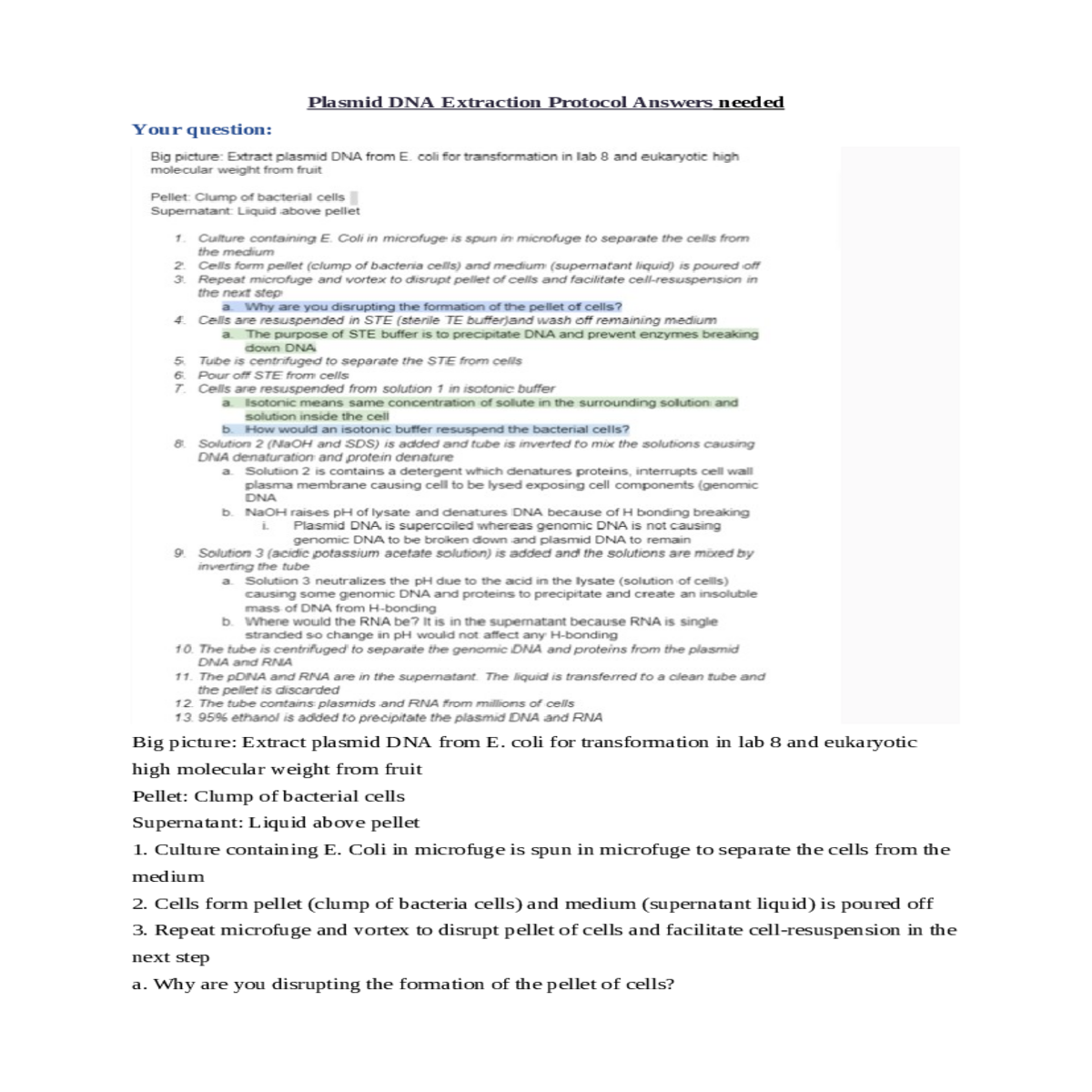
Big picture: Extract plasmid DNA from E. coli for transformation in lab 8 and eukaryotic high molecular weight from fruit
3. Repeat microfuge and vortex to disrupt pellet of cells and facilitate cell-resuspension in the next step
a. Why are you disrupting the formation of the pellet of cells?
7. Cells are resuspended from solution 1 in isotonic buffer
a Isotonic means same concentration of solute in the surrounding solution and solution inside the cell
b. NaOH raises pH of lysate and denatures DNA because of H bonding breaking L Plasmid DNA is supercoiled whereas genomic DNA is not causing genomic DNA to be broken down and plasmid DNA to remain
9. Solution 3 (acidic potassium acetate solution) is added and the solutions are mixed by inverting the tube
11. The pDNA and RNA are in the supernatant. The liquid is transferred to a clean tube and the pellet is discarded
12. The tube contains plasmids and RNA from millions of cells
Plasmid DNA Extraction Protocol Answers and Explanation:
Extracting Plasmid DNA from E. coli for Transformation: A Step-by-Step Guide
Supernatant: Liquid remaining after centrifugation.
pDNA: Plasmid DNA.
Lysate: Cell contents released after lysis.
Step 1: Separating Cells from Medium (50 words)
Resuspend the pellet in STE buffer to wash away remaining medium and stabilize DNA.
Centrifuge again and discard the STE buffer.
Step 4: Neutralization and Precipitation (80 words)
Add solution 3 (acidic potassium acetate) and mix. This neutralizes the pH and precipitates genomic DNA and proteins.
Centrifuge and discard the supernatant.
Wash the pellet with 70% ethanol to remove salts and impurities.
The extracted pDNA can be used for various downstream applications in Lab 8, including restriction enzyme digestion, ligation, and transformation into eukaryotic cells.
The high molecular weight DNA extracted from fruit will likely require additional purification steps depending on the intended use.