Extend your understanding with additional trc problems
Procedure
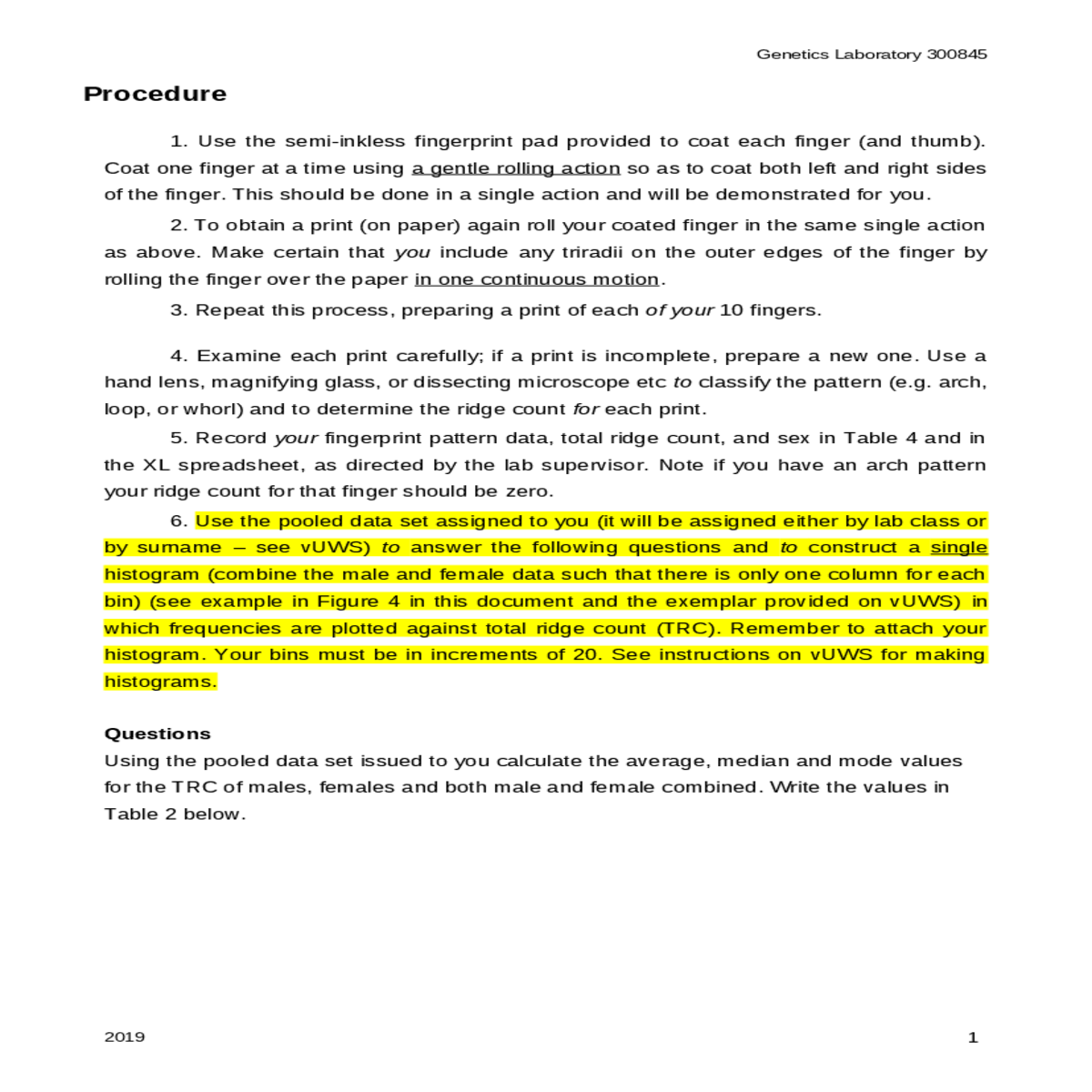
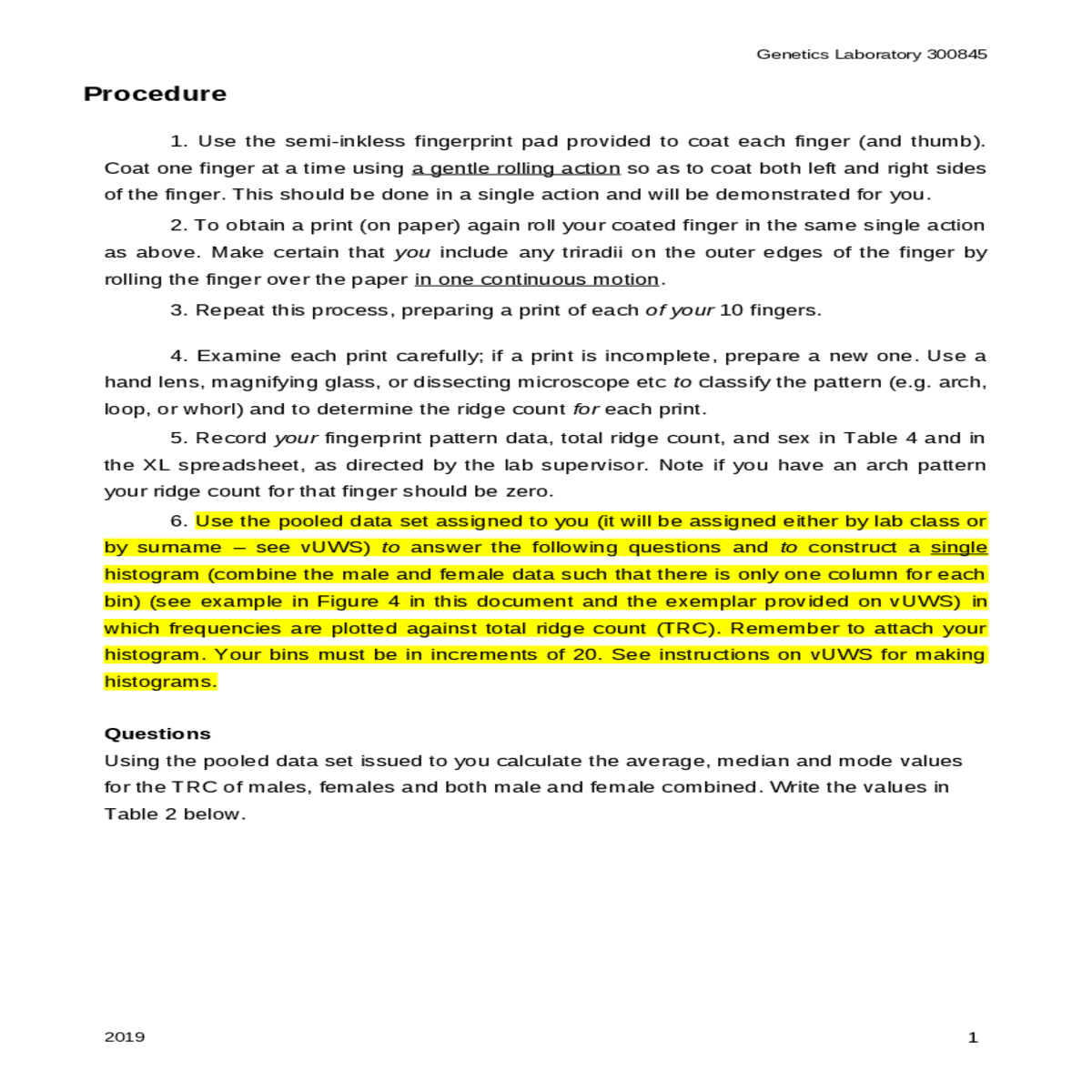
Use the semi-inkless fingerprint pad provided to coat each finger (and thumb). Coat one finger at a time using a gentle rolling action so as to coat both left and right sides of the finger. This should be done in a single action and will be demonstrated for you.
To obtain a print (on paper) again roll your coated finger in the same single action as above. Make certain that you include any triradii on the outer edges of the finger by rolling the finger over the paper in one continuous motion.
Questions
Using the pooled data set issued to you calculate the average, median and mode values for the TRC of males, females and both male and female combined. Write the values in Table 2 below.
Table 2. Average, median and mode values for the TRCs for male, females and male and female combined. Answers must be correct to 2 decimal places. (Mendenhall and Mertens, 2019)
| 141.0571 | 129.9429 | 135.5 | |
|
147 | 126 | 138.5 |
|
152 | 120 | 152 |
Below is the data for my finger print (Source: select collected)
The average for your sex?
I am male and average TRC of male is 141.0571
In what bin (see your histogram) did the average value occur in (e.g. bin 20 or 40 etc )?
Male:140, Female: 120, combined: 140
Using the data set issued to you (XL sheet from vUWS) calculate the percentage frequency of occurrence for the three fingerprint patterns (arch, loop and whorl) for males, females and male and females combined. Enter the percentages in Table 3 below.
Table 3. Percentage frequency for the fingerprint patterns arches, loops and whorls. Values must be correct to 2 decimal places.
Figure 4. Histogram showing total ridge counts (TRC) for 80 (male and female combined) people.
A SAMPLE OF DATA
The following fingerprint data were collected from individuals participating in a workshop (Figure 4, above). The average TRC for the males in the sample population was 149.2 and that for the females was 129.6. These results compare favorably with those reported by Holt (1968): 145 for males and 126 for females. The frequencies for the different fingerprint patterns for the participants in the workshop also compared favorably with Holt's (1968) data from the general population:
|
|||
|
|||
|
|||
|
Below is my data

EXTEND YOUR UNDERSTANDING WITH ADDITIONAL TRC PROBLEMS
|
|
|
|---|---|---|
| 70 + 72 = 142 | ||
| 70 + 27 = 97 | ||
|
|
70 + 45 = 115 |
| 70+36 = 106 |
Write the genotype of a child (from the cross above in Question 9a) who has the minimum number of active alleles possible.
aabbccdd
1/4 * ¼ * ¼ * ¼ = 1/256
10a. If an AaBbCcdd male mates with an AaBbCCDD female
If this child is a male, will he have a higher or lower TRC than the parent with the lower ridge count?
The TRC of the male will be less than the parent with a lower ridge count.
If an AaBBCcdd male mates with an AABbCcDd female,
What is the minimum number of active alleles possible in a child this couple could produce?
What would be the TRC for this child if it were female? 70+ (2*9)= 88
In solving some problems above, you made some predictions of TRCs based on the genotypes of the individuals involved. Suppose we could measure the TRCs for some people with those genotypes and found the actual values to be different from those predicted by your calculations. How would you explain these discrepancies (think about multifactorial inheritance -you could consult your textbook and look in the chapter that covers quantitative genetics)?
defect like genes received from parents
(Statistics How To, 2019)